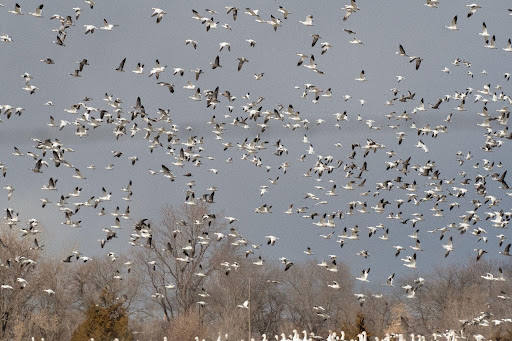
Every year, about 40 percent of the total species of birds migrate to and from their breeding and wintering grounds. Most species follow the same route they followed the season before, the year before, and their forefathers and mothers followed thousands of years earlier. But how do birds know where to go? This puzzled philosophers and scientists for a long time; to some extent, it still does.
Two years ago, I helped a friend with his project, where he monitored nesting grassland birds. The method for finding bird nests across acres and acres of grassland is called ‘nest dragging’. As the name suggests, you drag a long rope, with one person walking behind it to see where the birds flush from and eventually locate the nest.
But it’s not as easy as it sounds. That was my first time doing it, and every time I would see the bird flush, I assumed I knew where it flew from, but it would take me 10-15 minutes to locate the nest. The bird, however, would fly back to its nest in an instant as soon as we were out of the way. The interesting part was that it was a grassland, about 40 acres, with nothing but grasses of similar length, no landmarks, no rocks or posts or anything.
It got me thinking: how do they know where their nests are? Granted, birds can see in the UV spectrum; they might have a better view of something that we cannot see. Still, that was one of the most impressive things I have ever seen.
In the same field, my friend had banded a couple of birds the year before, and the birds that were nesting in the same area returned the next year as well, almost to the same spot. These birds that fly thousands of miles south during winter somehow come back to the same spot year after year. So, how do they know where to go?
One thing birds are known to use is landmarks. Raptor species, in particular, often follow rivers and mountain ranges. Most others, the songbirds, usually migrate during the night. These nighttime migrants are known to use the stars to orient their journey. A long-standing belief was that birds have magnetite in their beaks and can use it to sense Earth’s magnetic field. However, it is not as simple as that.
To understand whether birds use the magnetic field or the sun or the stars, William Cochran and his colleague came up with an interesting idea. They trapped two different species of thrush, Swainson’s thrush and the Grey-cheeked thrush, and kept them in a chamber that switched their magnetic fields. Their true north was switched to west. They released the birds in the evening. As the birds took flight, they started flying west when they were supposed to fly north. Both species flew west until the next morning, when they saw the sun rise from the opposite direction. They realised they were flying in the wrong direction and corrected their flight that evening and started flying north again. So, as it seems, birds don’t rely on just one method to fly; they rely on multiple methods.
Does this mean all birds of a single species use the same route? The same technique? Well, not really. Northern Wheateaters are small passerines in the Muscicapidae (flycatchers), a species that overwinters in sub-Saharan Africa. To breed, they travel to northwestern Canada and Alaska. But the way they do it is very interesting. The eastern Canadian population of wheateaters takes the eastern route and reaches western Africa, whereas the Alaska population travels west, flying through northern Asia and Europe to reach eastern Africa. And the mind-blowing thing is, nestlings that hatch in Alaska take the same route as their parents, without their parents leaving the way. They are genetically hardwired to know that they should migrate to Africa and take the same route that their parents took and not the other route. So how do these nestlings know where to go?
Back to the magnetic field hypothesis: if the beak magnetite isn’t good enough to feel the Earth’s magnetic field, how do birds use it to orient themselves? The answer is very spooky!
Based on a ‘spooky science’, as Albert Einstein called it. New research on bird migration suggests that birds rely on quantum effects to find their way. In 1978, Klaus Schulten proposed that birds rely on magnetically sensitive chemical transformations to use a magnetic compass. His ideas relied on short-lived chemical intermediates known to science as radical pairs.
Electrons have spin angular momentum, and particles with spin have magnetic moments. In most molecules, an even number of electrons are arranged in pairs with opposite spins, thereby cancelling each other out. Radicals are molecules that have lost or gained an electron and therefore have an unpaired electron and a spin. If a chemical reaction creates two radicals, each radical contains an unpaired electron. These two electrons can have either opposite or parallel spins, often represented as ( ↑↓ ) and ( ↑↑ ), respectively. When a radical pair is created in a singlet state (opposite spins), the two electrons can undergo rapid transitions between singlet and triplet states. Magnetic fields can influence this singlet–triplet interconversion, potentially affecting the outcome of the chemical reaction.
In simple terms, scientists believe that the spins generated by the chemical reaction allow birds to visualise Earth’s magnetic field. In the eye of a bird, it migrates in the dead of night with nothing but the light from the stars, as the photons of the light hit the bird’s retina, especially a protein called cryptochrome that includes the flavin adenine dinucleotide (FAD) molecule and the tryptophan amino acid (TRP); an electron from the TRP hops onto the FAD, creating an odd number of molecules or radical pairs with opposite spins. The newly formed state oscillates between singlet and triplet forms influenced by the Earth’s magnetic field. These chemical reactions within the molecule send a signal to the birds, telling them which direction to fly. Sounds spooky, right?
Ghimire is a post-doctoral candidate of Evolutionary Ecology at the North Dakota State University.