Some of the most vocal advocates for the simple life probably came from people who never had to live it. Multimillionaire Count Leo Tolstoy, master of a sprawling family estate, spent his later years stitching his own boots and preaching the moral beauty of peasant labour. I suspect the peasants would have gladly swapped boots with him. The belief that comfort corrupts and hardship purifies is much older than Tolstoy. Sages, monks, and Stoics have sold versions of it for centuries, East and West alike. Mass media and pop culture have supercharged it into a mantra.
Like the only trillionaire in the world who shows up on fancy podcasts and says that in a few years, money will have no value at all.
In Cervantes' Don Quixote, Sancho Panza's wife, Teresa, says that hunger is the best sauce in the world and that, since the poor never run short of it, they always eat with relish. The line is funny until you sit with it. Teresa isn't celebrating hunger; she is making peace with it because nothing else is on her menu.
Growing up, every second Bollywood film, and the Nepali films that borrowed from them, sold us the same bargain. In Deewaar, Amitabh Bachchan's Vijay rattles off his buildings, property, bank balance, bungalow, and car, then asks his honest policeman brother what he has. Shashi Kapoor's reply, 'Mere paas maa hai' (I have mother), brought the house down. We whistled and cheered, and nobody asked why the honest brother couldn't have his mother and a decent flat too. Our songs still celebrate leaders who stayed dirt-poor after decades in power, as if a frayed daura and the look of a homeless man were proof of sainthood rather than a costume.
Then came the development sector and its favorite word. In nearly seven years with a foreign mission, the word I heard most in discussions about Nepal was 'resilience'. Earthquake? Resilient. Floods? Resilient. A new prime minister every other Dashain? Marvelously resilient. I'm still not sure Nepali even has an accurate translation. The British scholar Mark Neocleous has argued that resilience teaches people to absorb shocks rather than ask who keeps causing them. The survivor gets the applause, and the system gets a pass.
Why should every good story go through a painful life? Can we make it the new normal for people who ask for a better quality of life to be heroes?
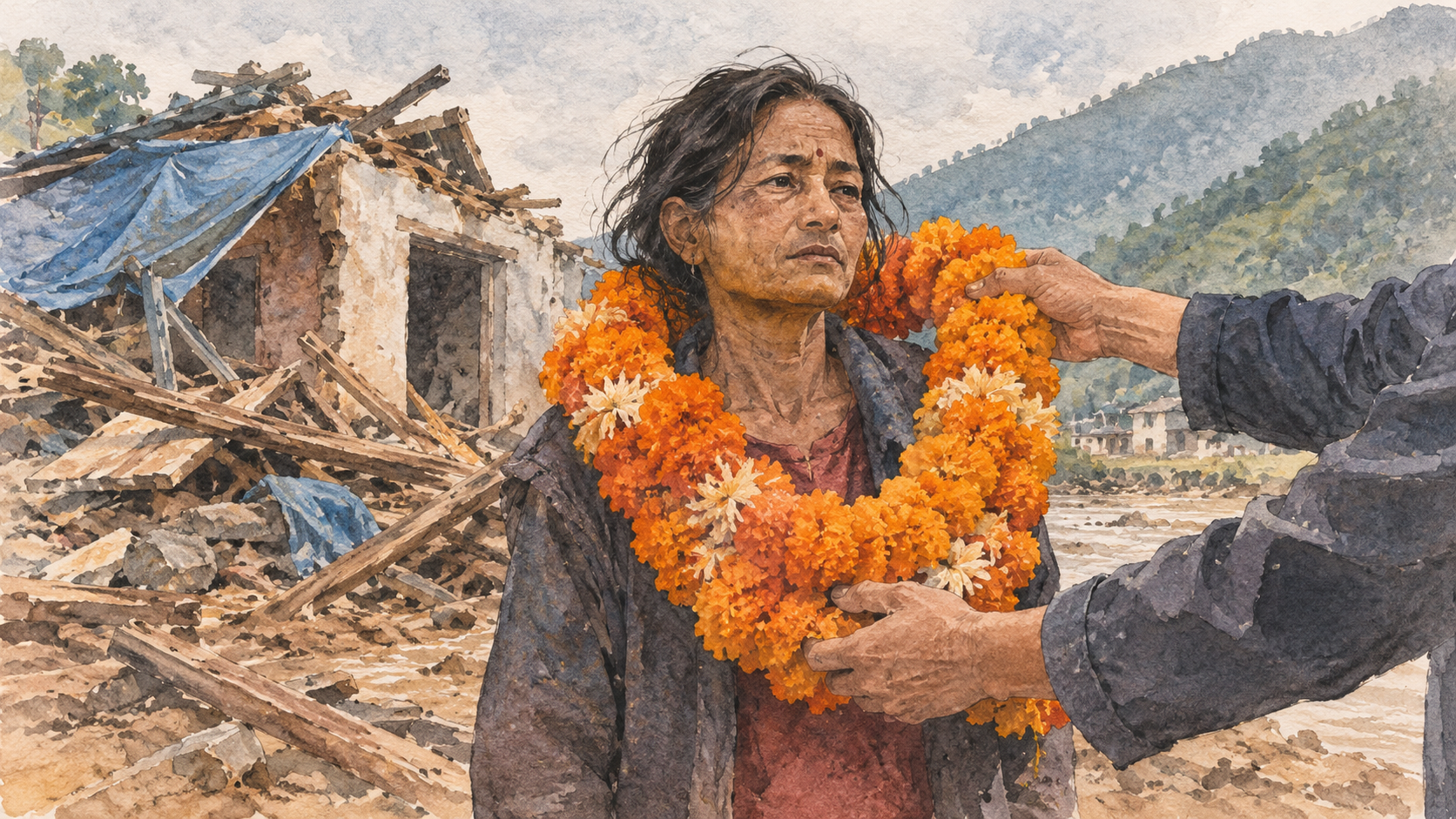
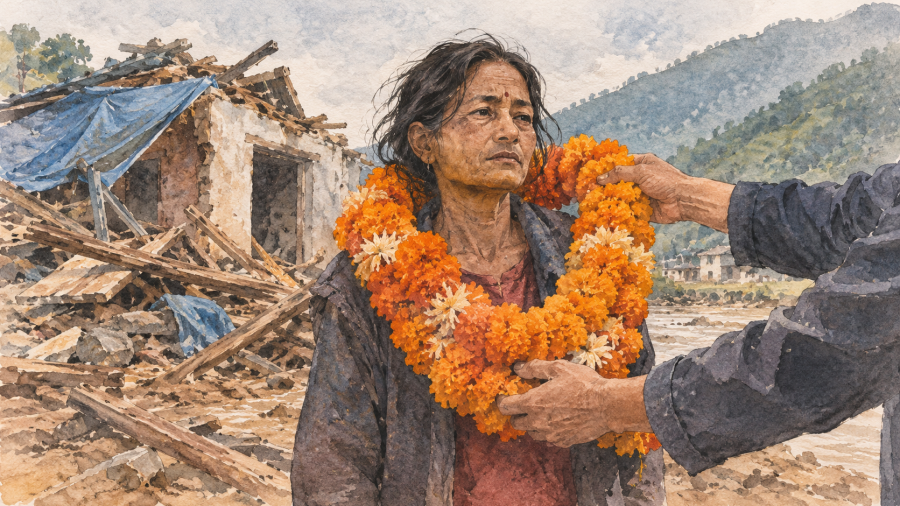
More than ten weeks have passed since the Bhotekoshi flood tore through Rasuwa and Nuwakot. For a few days, the cameras focused on climate justice, communities, and indigenous people. Now we're back to the smiling survivor, the narrative of not giving up. Click, click, smile, please. Look how brave they are. Meanwhile, self-appointed national saviors keep flaunting the Rs15,000 monthly support the government announced. That money still hasn't reached survivors properly, many of whom sleep in holding centers and monasteries. In Jajarkot and Rukum West, families remain in temporary shelters three years after the earthquake. Call it bravery if you like. To me, it looks like waiting, with no idea what comes next, dressed up for a photograph.
The habit runs deep in our DNA. Keshavraj Gnawali's historical fiction ‘Agyat’ revisits the Gorkha expansion through the eyes of people history never bothered to name. In Gnawali's telling, rulers pursued glory and their own appetites, including random animal organs and herbs to enhance sexual power. At the same time, commoners shouldered the burdens, fought the wars, and were paid in myths of courage and bravery. Women and the marginalized barely made the footnotes. That script never left us; it only changed formats, from patriotic songs to school textbooks to the evergreen claim that Nepal is a heaven the whole world envies.
Sent to countless wars at home and abroad. Quality of life or better access to learning? Nah, you are all brave. Come on, fight! Fight with others, fight with each other. That continued until recently: Maoist war, various protests, movements, revolutions; all cashed in on innocent people’s chase for glory. But the people themselves rarely could ask for a better life, with the ever-looming fear of being less brave.
Until when should a former Maoist cadre who still has bullets lodged in his body carry the mantle of ‘never-giving-up’ Nepalis? That’s not heroic; it’s our historical reality.
George Orwell saw this coming in ‘Animal Farm.’ Boxer, the strongest and most loyal horse, meets every crisis with two mottos: 'I will work harder' and 'Napoleon is always right.' He works until his lungs give out, and the pigs sell him to the knacker. Every regime loves a Boxer. We have produced millions of them, many now working harder in Doha and Kuala Lumpur.
So why do we swallow it? Partly because the alternative hurts. Psychologists John Jost and Mahzarin Banaji call it system justification: people defend the order they live under, because believing the system is fair feels safer than admitting you're stuck in an unfair one. Amartya Sen wrote about adaptive preferences, where the deprived learn to want less until their misery no longer registers as a complaint. Culture does its share of the lifting. We grow up on 'santosham paramam sukham' , contentment is the highest happiness, and on ‘bhagyako lekha, ’ the fate written on our foreheads at birth. The anthropologist Dor Bahadur Bista blamed that fatalism for holding back Nepal's development. It also makes a very soft pillow for those in power.
The political logic is even simpler. Scholars call it performance legitimacy when a government earns trust by delivering. Ours prefers the narrative kind; it’s easy to blame a deity or an unknown foreigner. A song about our brave, contented people costs nothing and still wins applause. When a state can't deliver services, it tells a story; it sells a dream.
Premchand never bought that story. In Kafan, Ghisu and his son Madhav collect money for the shroud of Madhav's wife, who died in labour while they sat outside roasting potatoes. They spend it on puris and liquor. Premchand isn't saying people with low incomes are wicked. Grinding want hollows people out. Bertolt Brecht put it in a single line of The Threepenny Opera: first comes grub, then comes morality.
If you're loading your gun to shoot me for being anti-national, relax. I'm as proud a Nepali as anyone. My headache generally begins when bravery becomes a cover for incompetence. Per capita income still hovers around $1,456. Roughly 2,000 Nepalis leave for jobs abroad every day. One in five young people can't find work. Hospitals and schools inch forward while speeches sprint. Somewhere along the way, the social contract became a one-way favour.
And yet, quality of life rarely becomes a central political agenda.
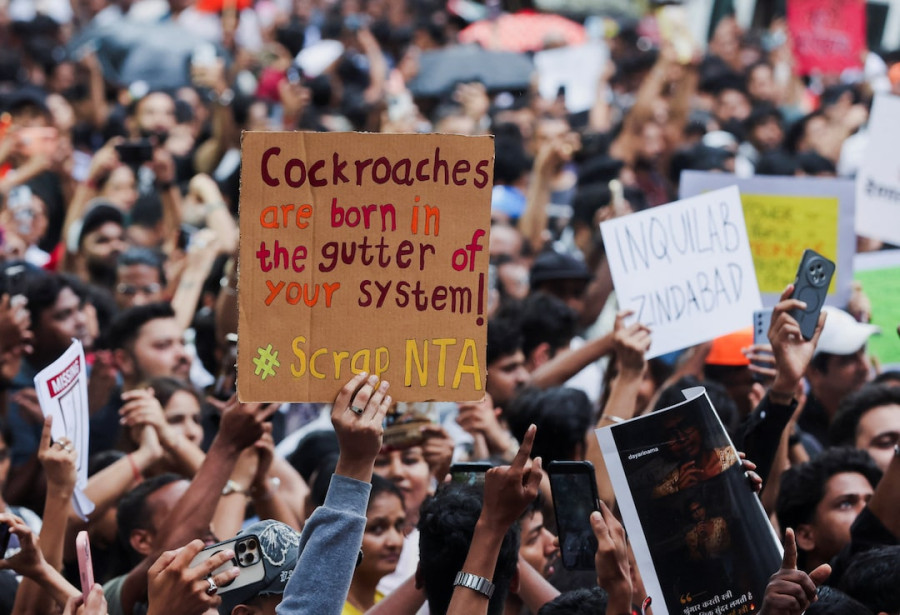
But then, I hold some hope for Gen Z, with my fair share of reservations, unapologetically. From Europeans cities to Dhaka to Kathmandu, their question has been refreshingly direct: democracy is lovely, but what about our lives? Last year, Gen Z activists like Rakshya Bam put it bluntly: 'We pay taxes, but we get nothing in return.'
The harder test comes now. The problem was never one party or one generation. It's a habit of mind. It’s about how we define our aspirations.
Look at last week's US midterms. Poll after poll put the cost of living on top: groceries, gas, and power bills pushed up by energy-hungry data centres. Nobody in Ohio is asked to feel proud of a huge electricity bill. Why should a flood survivor in Nuwakot feel tougher inside a tarpaulin tent?
Just doesn’t make sense, does it? But looks like common sense is becoming scarcely uncommon.
It's time we retired our romance with poverty. Quality of life isn't a luxury demand; it's the whole point of politics or revolution, if you may, whether those in power are the same or the system calls itself. Praising people for surviving what the state should have prevented isn't resilience. It's negligence with good PR, and frankly, savagery.
Most ironic is that agencies that should have held authorities accountable more often sugarcoat such shortcomings as resilience.
This year, 22-year-old Sujal, a barista trainee from Kathmandu, signed a two-year contract to work on a pig farm in Romania. He said he wants to 'come back after two years and see that my country has made progress.’ It reminded me of Sam in The Lord of the Rings, deep in Mordor, who looks up through the smoke, spots a single white star, and realises the Shadow is 'only a small and passing thing'. Sujal's star is modest: a country worth coming home to. Surely that isn't too much to ask.
People’s lives matter more than any myth or false sense of glory, Nuwakot and Rasuwa say. Can we turn ‘simple living, high thinking’ into ‘better living, rational thinking’?
Bhatta is a social behaviour change communication professional and a culture/literature student.