We are living in times of capricious optimism. Across Nepal’s natural landscape—from the snow-clad mountains to the frequently inundated valleys and plains—changes that lead to adverse impacts are happening with greater severity and speed than at any point before. The technical capacity of Nepali experts has grown substantially over the years, enabling a deeper understanding of these shifts and, to some extent, the science that drives them; every year, numerous research publications offer recommendations on measures to mitigate the adverse impacts.
At times, government plans, stretching from the centre to the local level, align with these recommendations, raising hopes of a secure future. Yet, as so often happens, implementation remains woefully weak. We fall short in learning why our plans and projects fail, leaving communities increasingly exposed to the worsening effects of these changes—frustrated and wary of hope itself. Nowhere is this more evident than in Madhesh Province, the breadbasket of the country, which has been reeling under deepening water stress for years.
Madhesh Province forms the mainstay of national food security and the agricultural economy because, despite being the smallest of Nepal’s provinces by area, it produces 25 percent of the country’s paddy, 31 percent of its wheat, 38 percent of its oilseeds, 64 percent of its sugarcane, 77 percent of its mangoes and 56 percent of its fish. Any setback in the province’s agricultural sector would therefore have nationwide consequences. The unfolding changes, particularly in the water sector, are already gravely hampering the province’s agriculture.
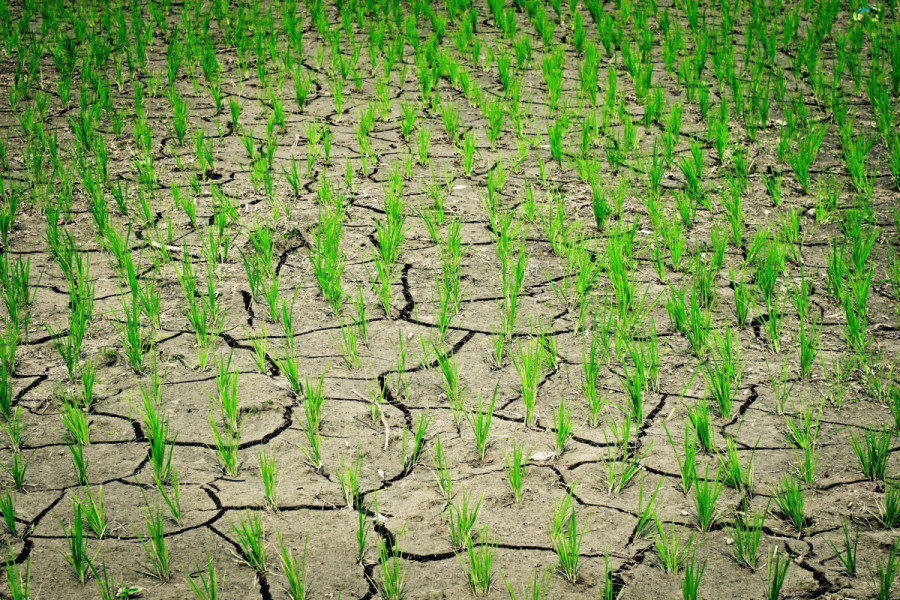
The provincial Ministry of Land Management, Agriculture and Cooperatives has identified erratic rainfall, delayed monsoons, and declining groundwater levels as formidable challenges for the agriculture sector. In 2025, delayed monsoon rains allowed only 51 percent of paddy fields to be planted, prompting the government to declare the province a drought-affected area. Rainfall remained below normal in 2026 as well, influenced by El Niño. Most weather stations across the province recorded deficits, resulting in an expected drop of 4.2 percent in paddy output. A ground report reveals that the groundwater table is falling continuously across the province, rendering cultivation increasingly unviable for farmers as irrigation costs rise.
The province is another critical hotspot where climate impacts—particularly growing water stress—are increasingly eroding the economy, with no clear or effective redressal in sight. About 30 percent households report that their local water sources have dried up permanently in the last 25 years. Over 70 percent households observed reduced flow in rivulets providing irrigation water. Yet this growing crisis in M a dhesh has not been a priority in climate action. The dilemma is clear: climate change is triggering multiple disasters simultaneously across the country, yet some remain far less visible than others.
While debates on climate impacts and shifting rainfall patterns often treat the nature of these changes as broadly uniform, the distinct characteristics of regions like Madhesh are frequently overlooked. Madhesh Province has no large snow-fed rivers; most of its smaller rivers, which originate in the middle hills and the Mahabharat range, are ephemeral. In contrast, rivers that originate in the high Himalayas, along with their tributaries rising from the middle hills, continue to flow even during the dry season, when many local streams run dry in the foothills. Madhesh is deprived of this natural advantage and remains largely dependent on rainfed ephemeral streams and groundwater, making its water crisis unique. Hence, the timing and distribution of rainfall and groundwater stability are critical for the province’s agriculture.
Without a clearer understanding of how much water stress in Madhesh stems from climate impacts versus other factors, such as over-pumping within and beyond national borders, lumping all possible factors together obscures the insights needed to design effective groundwater management measures. Water management, in particular, must always be area-specific. This is seen vividly in well-intended projects which failed to capture local specificity in their design.
Even after 15 years of the President Chure-Terai Madhesh Conservation Area programme, launched in 2010 to prevent Tarai Madhesh from becoming arid, the region continues to face water stress when rainfall is late or deficient. Likewise, the Green Climate Fund-funded seven-year ‘ Building a Resilient Churia Region in Nepal ’ project, launched in 2020, aims to strengthen the resilience of local communities and ecosystems to adapt to climate impacts within six river systems in the province. However, the water crisis continues unabated, leaving farmers at the mercy of the monsoon.
Rising temperatures and disrupted weather patterns remain our most unrelenting climate threats. The Bhotekoshi disaster was largely driven by rising temperatures, altering the nature and behaviour of the cryosphere and the rock landmass supporting the snowpack. In contrast, disruptions to weather patterns typically affect larger areas and often produce consequences that are harder to anticipate. While rising temperatures are relatively straightforward to measure and monitor, shifts in weather patterns—both between and within seasons—are far more difficult to assess and predict, with their impacts already growing across Nepal, including in Madhesh. Each year, Madhesh sinks a little deeper into a water crisis. It is, therefore, time to ask whether business-as-usual approaches can still address water stress. When a crisis such as water stress deepens faster than existing responses can manage, what Plan B, if any, do we turn to? Meanwhile, we continue to watch our food system slide ever deeper into the abyss of uncertainty.
Globally, the terrestrial water storage (TWS)—including soil moisture—has declined over the past decade , steadily eroding the natural buffer against drought. Between 2022 and 2025, persistent groundwater deficits were recorded across parts of the Indian subcontinent, accompanied by widespread below-normal to much-below-normal groundwater levels, particularly in North-Western India. These patterns closely mirror observations in Madhesh, where nearly a third of local water sources, including rivulets, have already disappeared over the past quarter century. Reduced flow in rivulets, reported by over 70 percent of households, is especially concerning because more than two-thirds of Madhesh’s population is now affected by this decline. The combined decline in TWS and reduced river discharge pose a huge threat to the productivity of the breadbasket of the country.
Meanwhile, the government plans to promote deep boring for irrigation to boost agriculture and employment. Given groundwater depletion across the country, this well-intentioned initiative risks becoming counterproductive without a robust groundwater recharge plan. A better response to rising water stress would be to design and implement sustained watershed restoration programmes at scale, guided by bioregional planning principles —an established approach refined for today’s context.
Upadhya is a senior watershed expert.