After a three-year break, Nepal and India have resumed talks to resolve longstanding disputes over cross-border air routes, an issue that has remained entangled in bilateral politics and geopolitical tensions since 2009.
The two countries have repeatedly attempted to settle the issue, but frequent changes of government, security concerns, and strained diplomatic relations have prevented a breakthrough.
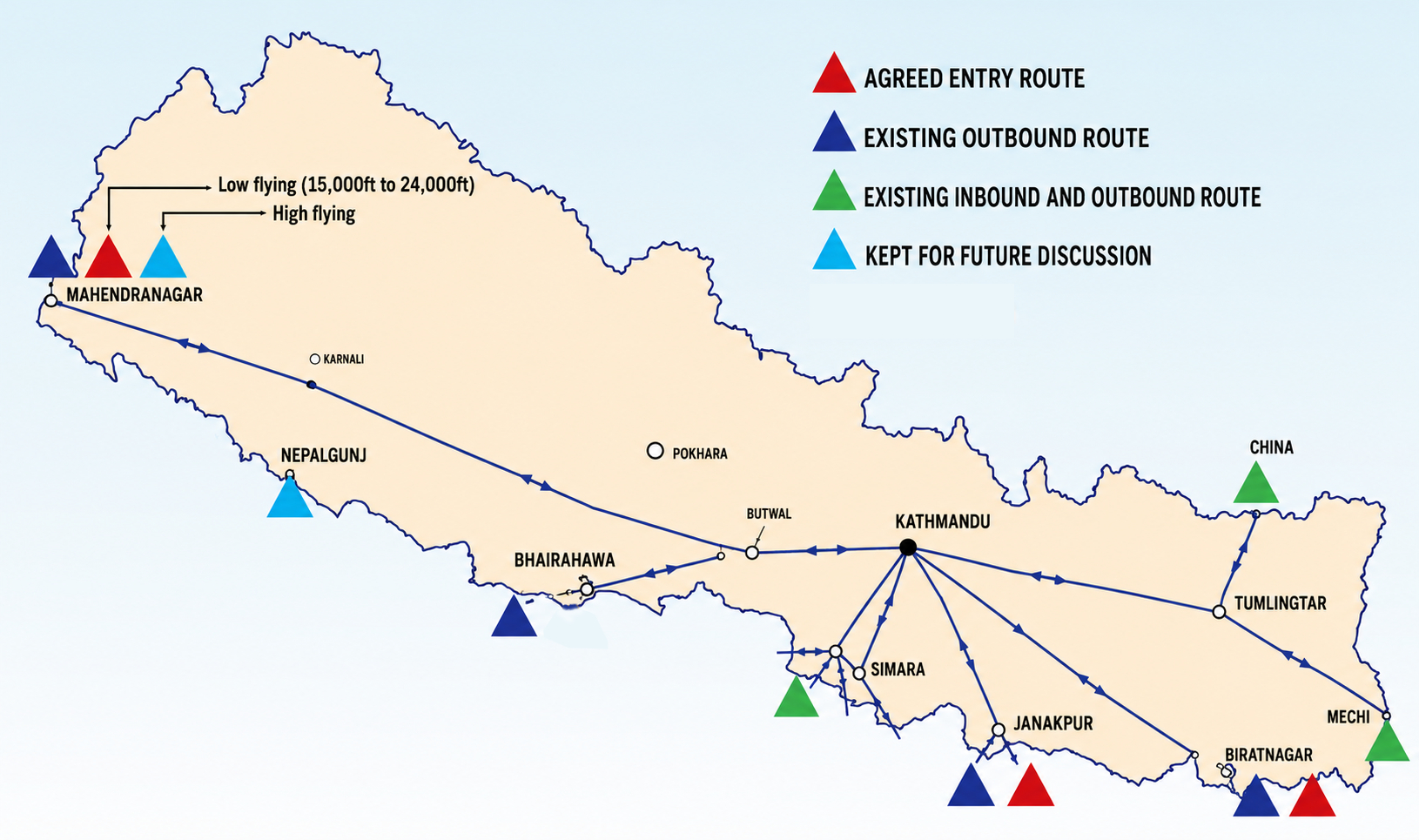
Nepal is now pushing to make the L626 (Kathmandu-Mahendranagar) route in western Nepal a two-way air corridor, allowing international aircraft to enter and leave through the western border, according to tourism ministry officials.
The route began operating on November 19, 2009, one-way to exit.
Jay Narayan Acharya, spokesperson for the Tourism Ministry, who is currently in New Delhi, said Nepal had prioritised securing two-way operation of the route. Nepal hopes for an agreement during Prime Minister Balendra Shaha’s Delhi visit next week.
The L626 route connects Kathmandu to Delhi via Mahendranagar in Nepal and Pantnagar in India. It is 20 miles shorter than the existing B345 (Bhairahawa-Lucknow-Delhi) route, which is also a one-way departure route. The L626 allows airlines to use 291 nautical miles (539 kilometres) of Nepali airspace, compared with just 100 nautical miles (185 kilometres) along the B345 route.
Greater use of Nepali airspace would generate additional revenue for the country while reducing flight distances and operating costs. According to officials at the Civil Aviation Authority of Nepal, depending on aircraft size, Nepal can generate $250-$500 per aircraft for using Nepali airspace.
Here is what you need to know about the air route dispute.
Nepal has been pressing India for additional international air entry routes since 2009, after deciding to build international airports in Pokhara and Bhairahawa.
The issue received political backing during Indian Prime Minister Narendra Modi's visit to Nepal in August 2014.
Nepal proposed three new entry points through Janakpur, Bhairahawa and Nepalgunj.
A joint communiqué issued after the visit stated that opening direct cross-border entry routes at Janakpur, Bhairahawa and Nepalgunj would facilitate flights between Pokhara, Bhairahawa, and Lucknow, reduce travel time and costs, and improve air connectivity between the two countries.
The two prime ministers, Sushil Koirala and Narendra Modi, subsequently directed their respective authorities to resolve the issue within six months. However, the commitment was never fulfilled.
In 2016, Nepal and India agreed to make the L626 (Kathmandu-Mahendranagar) route two-way, following an assessment that it would benefit both countries and facilitate the future development of the Trans-Himalaya 2 route (Kathmandu-Bagdogra-Guwahati-Silchar-Imphal-Kunming).
India, however, said it needed further internal consultations before making a final decision.
New Delhi had long expressed reservations about opening entry points through Bhairahawa and Nepalgunj, citing security concerns linked to the strategic Gorakhpur air base, where fighter jet exercises are regularly conducted.
In February 2017, the two countries agreed to form a joint technical team to examine the feasibility of opening the three proposed routes.
Until April 2018, India had remained positive about opening western entry routes after a technical team was formed to address safety concerns.
However, bilateral relations deteriorated after Kathmandu withdrew from a joint military exercise with BIMSTEC countries in Pune in September 2018, despite initially agreeing to participate.
India expressed dissatisfaction over Nepal's withdrawal, particularly within its defence establishment.
That same year, Nepal participated in the second Nepal-China joint military exercise, Sagarmatha Friendship-2, in China's Sichuan province, further complicating bilateral defence sensitivities.
Discussions on the safety assessment of the proposed air routes subsequently stalled.
Officials say India's position later hardened. Meetings were held in 2019 and again in 2023, but neither produced a breakthrough.
Nepal has consistently argued that expanding cross-border air routes is essential because almost all inbound international air traffic depends on the Simara entry point.
In contrast, aircraft departing Nepal have access to seven exit points—Bhairahawa and Mahendranagar in the west; and Simara, Biratnagar, Tumlingtar, Mechi and Janakpur in the east.
Two additional entry points over Mechi and Tumlingtar (NONIM), used by aircraft arriving from Bhutan and Lhasa respectively, also exist but handle limited traffic.
As a result, Simara remains heavily congested.
How have the restrictions affected the new international airports?
The lack of western entry routes has undermined the commercial viability of Gautam Buddha International Airport in Bhairahawa and Pokhara International Airport, projects on which Nepal has spent more than Rs60 billion combined.
Gautam Buddha International Airport was upgraded as Nepal's second international airport on May 16, 2022, while Pokhara International Airport was inaugurated on January 1, 2023 as the third international gateway.
For a long time, both airports failed to attract scheduled international passenger services, handling only occasional charter flights.
On September 25 this year, flydubai launched daily scheduled non-stop flights between Dubai International Airport and Pokhara International Airport, establishing the first direct air link between Dubai and western Nepal.
Air entry routes are considered critical for both airports.
For example, an aircraft flying to Bhairahawa from the west cannot enter Nepal directly over Bhairahawa, Nepalgunj or Mahendranagar. Instead, it must make a roughly 300-kilometre detour to enter Nepal through Simara in the east before flying back west.
Experts say the longer route increases fuel consumption and operating costs, making flights more expensive, particularly flights from New Delhi.
Tourism Ministry documents show that international flights to Pokhara from the west must fly an additional 185 kilometres if new cross-border air entry routes are not opened.
Were air routes the only reason the airports failed to attract flights?
No. Officials familiar with the matter say the lack of marketing by Nepal's civil aviation body was also a major reason the new airports failed to attract international airlines.
Two former officials from the Civil Aviation Authority of Nepal said the air route issue had been used to explain away shortcomings in promoting the airports.
"To hide the shortcomings, a narrative was built that due to the air route problems, Bhairahawa and Pokhara failed to attract flights," they said. "If the problem was for flights coming from the west, for example, New Delhi, both airports had no problems on the route for flights coming from the east, for example, Japan, South Korea, Dhaka and even Kolkata."
Of the 28 international airlines connecting Nepal, half enter the country through the east.
"So, it's not logical to say that the air route was the sole problem that kept international airlines off route to Bhairahawa and Pokhara," the former officials said.
"There was zero marketing to promote the new airports," said a Tourism Ministry official who wished not to be named. "We cannot just blame the route as there was a wider option to draw flights from East Asian countries. Airports basically have to create demand. Once there is competition, airlines come and operate. That's a global trend. Nepal, however, failed to market its new facility.”
What happened during the 2023 talks?
India agreed to allow inbound flights to use the L626 route, entering Nepal from the west over Mahendranagar, but only at altitudes between 15,000 and 24,000 feet. Aviation experts said the restriction was too low for jet aircraft.
The agreement, however, was never formalised.
India had already approved this air entry route in 2018 for low-level flights. It was operationally feasible for ATR-type aircraft.
Jet aircraft generally achieve better fuel efficiency at higher cruising altitudes, where the air is colder and thinner. At a given indicated airspeed and lift condition, aircraft travel faster through the air while their engines generally consume less fuel than at lower altitudes.
However, the 2023 discussions produced one breakthrough.
The then Prime Minister Pushpa Kamal Dahal said after his India visit that the southern neighbour had agreed to a "near-border operation" agreement.
Under such an arrangement, aircraft can enter each other's airspace in emergencies, such as when deteriorating weather conditions require them to divert to a nearby airport. Neighbouring countries generally sign such agreements to ensure safe aircraft operations near their borders. The agreement would facilitate the Gautam Buddha Airport, close to the border and frequent overlapping was one of the problems.
The proposed near-border operation agreement has now been revived.
"We sent the draft agreement to our counterpart in India two months ago through the Foreign Ministry," a Tourism Ministry official said. "We are waiting for the response."
In July this year , the bilateral air route issue was discussed during a meeting between Foreign Minister Shisir Khanal and Munu Mahawar, additional secretary at India's Ministry of External Affairs, in Kathmandu.
Mahawar was in Nepal to attend the 13th Nepal-India Joint Steering Committee meeting at the energy secretary level, which concluded in Pokhara.
What is the issue involving Bagdogra Airport?
India has formally requested Nepal to sign a near-border operation agreement for Bagdogra airport, which serves the city of Siliguri in West Bengal. Nepal has sought a similar arrangement for Bhairahawa airport.
The Tourism Ministry received the formal request from the Indian Embassy in Kathmandu on Tuesday.
"In case of an emergency, for instance, if the weather deteriorates, the agreement provides a protection area for aircraft to fly safely," ministry officials said.
The two requests have brought the near-border operation arrangement back into bilateral discussions, although the two countries have yet to finalise the agreement.
How have geopolitical tensions affected the air route issue?
Officials say Nepal's two new international airports have also become caught in regional geopolitical competition.
Pokhara International Airport was built with Chinese financing, while a Chinese contractor constructed Gautam Buddha International Airport in Bhairahawa.
India has withheld landing permits for Himalaya Airlines to fly to New Delhi since 2015 because the airline is owned by a Chinese company, according to officials familiar with the matter.
India has also made clear that it will not purchase electricity from hydropower projects in Nepal involving Chinese investment. Insiders say the airports have faced similar geopolitical sensitivities.
This was evident on May 16, 2022, when visiting Indian Prime Minister Modi flew over the newly built international airport in Bhairahawa during its inauguration and landed in Lumbini instead.
Another Tourism Ministry official said India had refused to grant operating authorisation to Buddha Air to fly from Pokhara to Lucknow, citing a "diplomatic issue".
During a visit by then Prime Minister Dahal to India in June 2023, Indian Foreign Secretary Vinay Mohan Kwatra acknowledged that air connectivity between the two countries had been discussed.
"There are many elements to it. There are elements to connect different cities of Nepal with different cities in India through different air routes," Kwatra told journalists in New Delhi.
He said technical experts would examine the proposals and make appropriate decisions.
"These are questions which require extensive technical examinations…at some point, the airspace is under the domains which are commanded by the air force," he added.
Under Article 1 of the Chicago Convention, every state has complete and exclusive sovereignty over the airspace above its territory. India therefore has the sovereign right to regulate access to its airspace, including denying entry. However, the decision to withhold access remains a major obstacle to Nepal's efforts to expand international air connectivity.
Sangam Prasain is Business Editor at The Kathmandu Post, covering tourism, agriculture, mountaineering, aviation, infrastructure and other economic affairs. He joined The Kathmandu Post in October 2009.