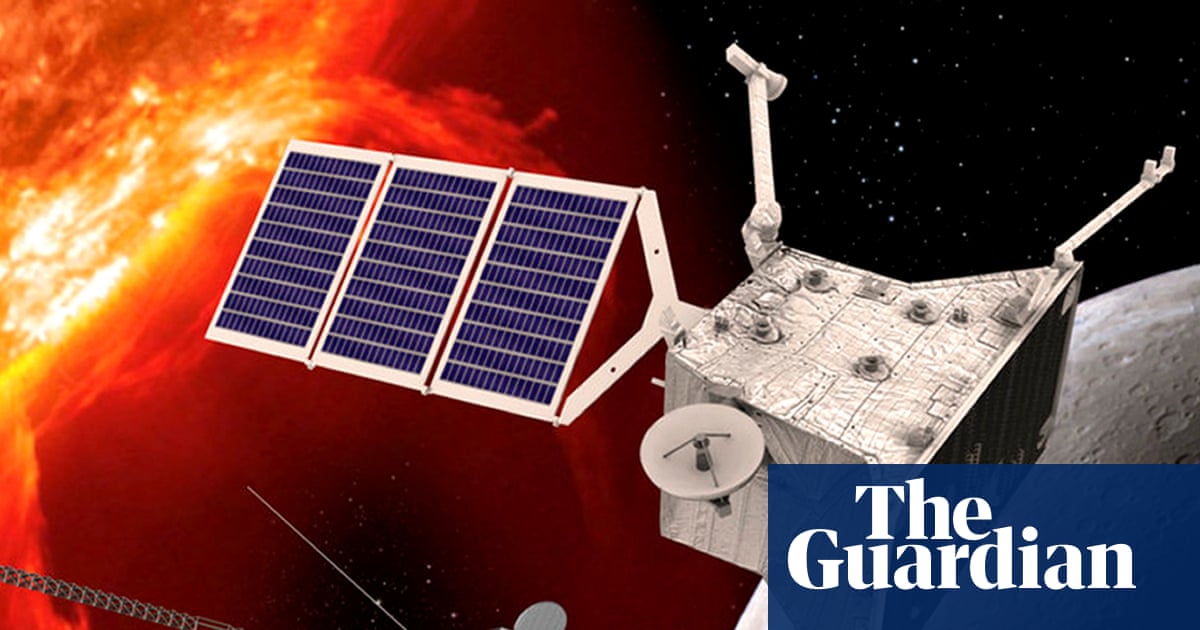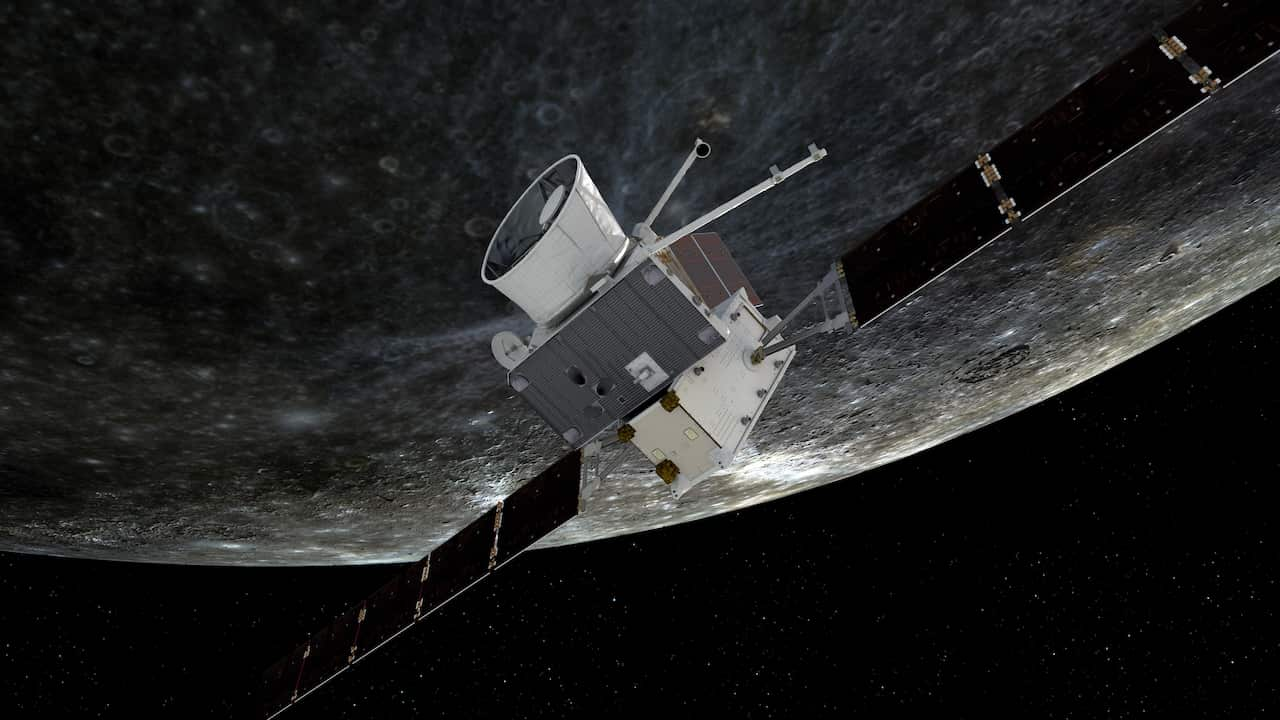
A pair of spacecraft has slipped into orbit around Mercury after an eight-year cruise through the inner solar system to unravel our littlest planet's mountain of mysteries.
The linked robotic explorers — one European, the other Japanese — will separate in December to map and study the scorching little planet from different altitudes.
The $3 billion mission is known collectively as BepiColombo.
The European Space Agency announced BepiColombo's arrival via social media.
A series of thruster firings slowed the spacecraft enough to be captured by the planet's weak gravity.
Your trusted source for staying up-to-date with the world around you. Get free daily news updates and analysis, straight to your inbox.
But it took several anxious hours before flight controllers in Germany — 152 million km away — could confirm that BepiColombo had achieved orbit.
Teams pored over the data streaming back and additional information was not immediately available.
BepiColombo is only the third spacecraft to visit Mercury — the sun's closest planet and barely bigger than our moon — and the first in more than a decade.
NASA's Mariner 10 flew past Mercury three times in the mid-1970s.
The team included the late Italian mathematician Giuseppe "Bepi" Colombo, for whom this latest mission is named.
NASA's Messenger spacecraft entered orbit around Mercury in 2011 and, after running out of fuel, crashed into the planet in 2015.
Launched in 2018, BepiColombo took a slower, more roundabout route to reach Mercury, flying once past Earth, twice past Venus, and six times past Mercury for gravity-assist manoeuvres.
All those loop-de-loops put more than 10 billion km on the odometer. The conjoined spacecraft shed their mother ship in September for the final leg of the journey.
Lead project scientist Geraint Jones said he and others can't wait for all the new data to start streaming down in the northern spring.
The mission will enable comparison of "unprecedented measurements taken by two spacecraft at the planet at the same time", he noted.
Once orbiting separately, the European Space Agency's satellite and the Japan Aerospace Exploration Agency's smaller craft will study Mercury's dense interior and exterior magnetic field, as well as everything in between: impact craters, volcanic plains, mountain ridges and peaks jutting as high as 4.5km.
The mercury at Mercury can hit more than 430C, adding strain to electronic and engineering systems.
Space agency officials want to keep the mission going for at least one Earth year — or the equivalent of four Mercury years.
"The spacecraft and its instruments need to be kept as cool as possible, which is a huge technical challenge in itself," Jones said in an email.
Despite its relative proximity to Earth, Mercury is one of the solar system's least explored planets.
Only outer planets Uranus and Neptune have had fewer visitors — a lone Voyager 2 back in the 1980s.