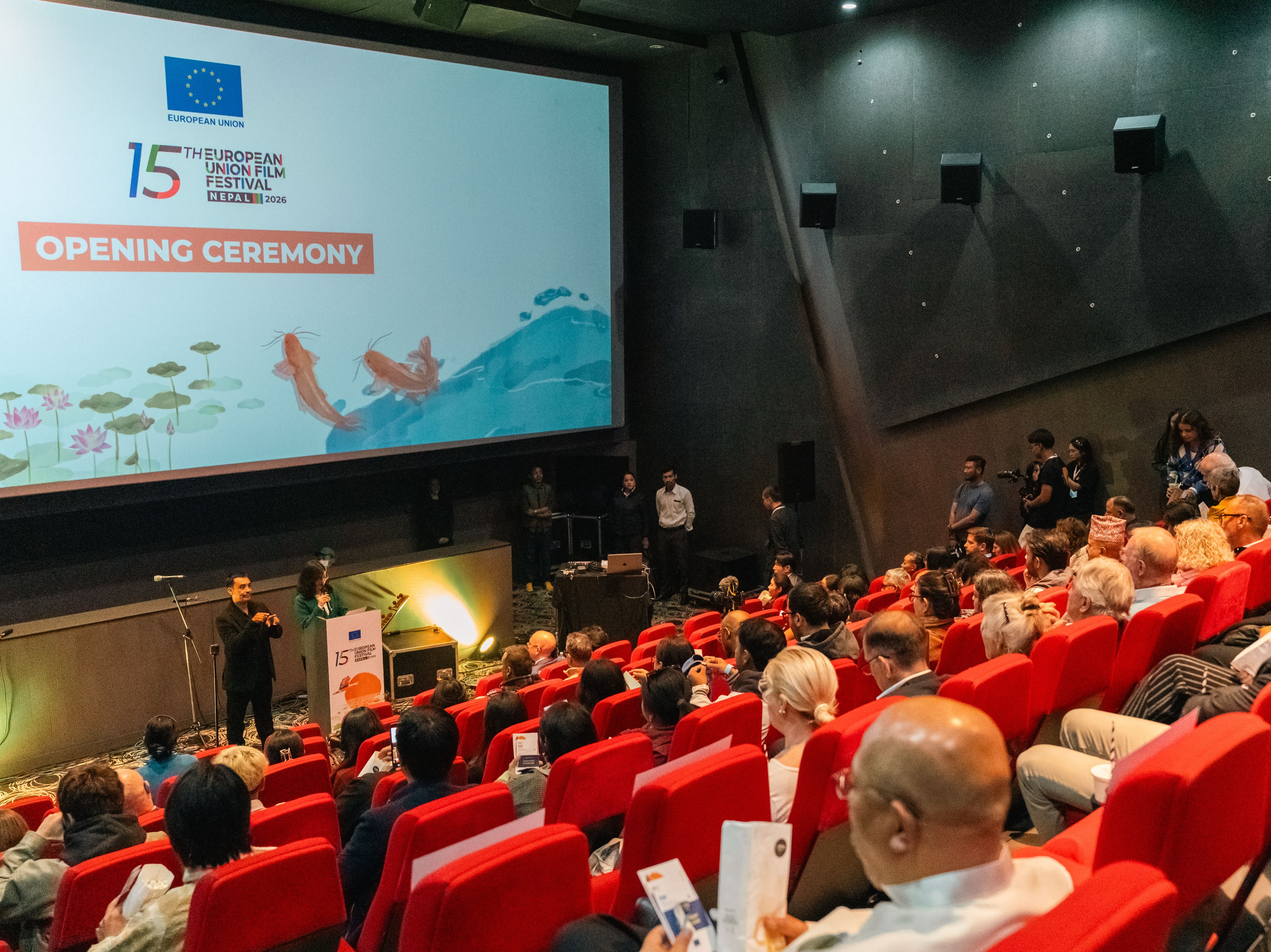
The 15th edition of the European Union Film Festival Nepal kicked off at QFX Chhaya Centre in Kathmandu on Saturday. The two-day festival brings together European and Nepali films alongside panel discussions and learning opportunities for emerging filmmakers.
Organised by the Delegation of the European Union to Nepal, the festival features 29 films from 11 countries. It includes 12 European feature films, six short films from the British Academy of Film and Television Arts (BAFTA), nine Nepali student films, an animated short film by Incessant Rain and the Nepali feature film ‘ Elephants in the Fog ’.
The European selection features films from countries including Ireland, Germany, France, Finland, Austria, Luxembourg and Spain. Titles in the programme include ‘Long Good Thursday’, ‘Rose’, ‘Sirât’ and ‘Silent Friend’, among others. The BAFTA selection features six short films, including ‘Magid / Zafar’, ‘This Is Endometriosis’ and ‘Two Black Boys in Paradise’.
Nepali cinema is also represented by nine student films, including ‘Path to Prosperity’, ‘Seema’ and ‘A Matter of Choice’. The programme also includes ‘Claybird’, an animated short film by Incessant Rain, and the Nepali feature ‘Elephants in the Fog’, scheduled to screen in Janakpur.
Alongside the screenings, the festival on Saturday featured a panel discussion titled ‘The Films We Were Not Supposed to Watch’. Moderated by filmmaker Shashank Shrestha, the discussion brought together screenwriter Biswas Timshina, filmmaker Astha Shrestha and content creator Elena Gurung to examine forbidden films, censorship and how the movies we secretly watch shape our ideas of romance, relationships and society.
To make the panel discussion interesting and interactive, the audiences were given cards with red and green sides to respond to statements posed by the moderator.
Reflecting on how films shape perceptions of women and relationships, Astha Shrestha, director of ‘Khel’ and assistant director of ‘Elephants in the Fog’, said female characters are often written to serve male protagonists rather than exist as independent characters with their own purpose.
“The female character always has to be some sort of tool that fulfils a purpose for the main character who happens to be a man,” she said.
Shrestha also spoke about the importance of respecting actors while making films. Recalling an intimate scene in one of her short films, she said she discussed it with the actors to ensure they were comfortable with how it was filmed.
“Just because I am the director and the writer, I cannot just make people do whatever I want them to do,” she said.
Screenwriter Biswas Timshina , popularly known as BT Kancha, reflected on the need to move away from familiar romantic tropes, particularly the idea of a male hero rescuing a woman. He said he wanted to challenge this pattern in his own writing.
“As a male writer, you would want your hero to be that person who just comes and makes everything right,” he said. “I would love to unlearn that.”
Timshina, who wrote ‘Jerry on Top’, also spoke about how commercial expectations can influence screenwriting. Recalling how the original father-son story of ‘Jerry on Top’ was reshaped to include a love story and a love triangle, he said, “Maybe it wasn’t my best work, but the film made money. So, what is right and wrong? I don’t have an answer.”
Elena Gurung, a mental health practitioner and content creator, questioned how Nepali films portray women and people with disabilities. Drawing on her experience working with autistic children, she criticised ‘Gauthali’ for its portrayal of autism, saying the film’s depiction left her questioning the filmmakers’ understanding of the condition.
She also criticised the film’s portrayal of women’s struggles, questioning why female characters are repeatedly expected to sacrifice their ambitions for their families.
“Why is sacrifice always on the girl’s part?” she asked, challenging the expectation that women should give up their aspirations after marriage.
Gurung also questioned the popularity of films centred on poverty and suffering in Nepali cinema, describing the trend as ‘ poverty porn ’. Referring to films such as ‘Gauthali’ and ‘Purna Bahadur ko Sarangi’, she argued that audiences are drawn to stories in which characters endure prolonged hardship before finally finding success. She suggested that filmmakers seeking commercial success often rely on emotional, tear-inducing stories to attract viewers.
“Sad sells. Emotion sells,” she said. “Instead of the filmmaker influencing the audience, the audience is influencing the filmmaker.”
The panel also turned to censorship and the influence of the internet on what people can and cannot say. Responding to a question from moderator Shashank Shrestha, Gurung argued that banning content does little to stop people from accessing it. Instead, she suggested that educating audiences about potentially harmful material would be more effective.
Timshina said the internet has made censorship increasingly difficult by giving everyone a platform to express themselves and find an audience. Even creators making controversial content could find viewers online.
“I think censorship is impossible in the age of the internet,” he said. “The internet doesn’t censor. It just divides.”
Shrestha, meanwhile, argued that adults should be free to access content across different forms of media, suggesting age restrictions as an alternative to censorship. She questioned why content that reflects real-life experiences, including violence and political issues, should be restricted.
The discussion also touched on how algorithms and online reactions influence creative freedom. Gurung said comment sections and algorithms can make creators hesitant to explore subjects that might invite criticism. She pointed to an increasing expectation for creators to become ‘ four-quadrant ’ creators, producing films and content that appeal to everyone rather than following a particular creative direction.
Following the Kathmandu screenings, the festival will travel to Janakpur on November 28 and 29, where 17 films are scheduled to be screened at Girija Chalchitra Mandir. The event in Janakpur will also feature a panel discussion titled ‘Emerging Voices in Nepali Cinema’, bringing together emerging Nepali filmmakers to discuss their creative journeys and experiences in the film industry.
Shrestha is an intern at the Post's Culture and Arts desk. She is studying journalism and English literature at St. Xavier's College.