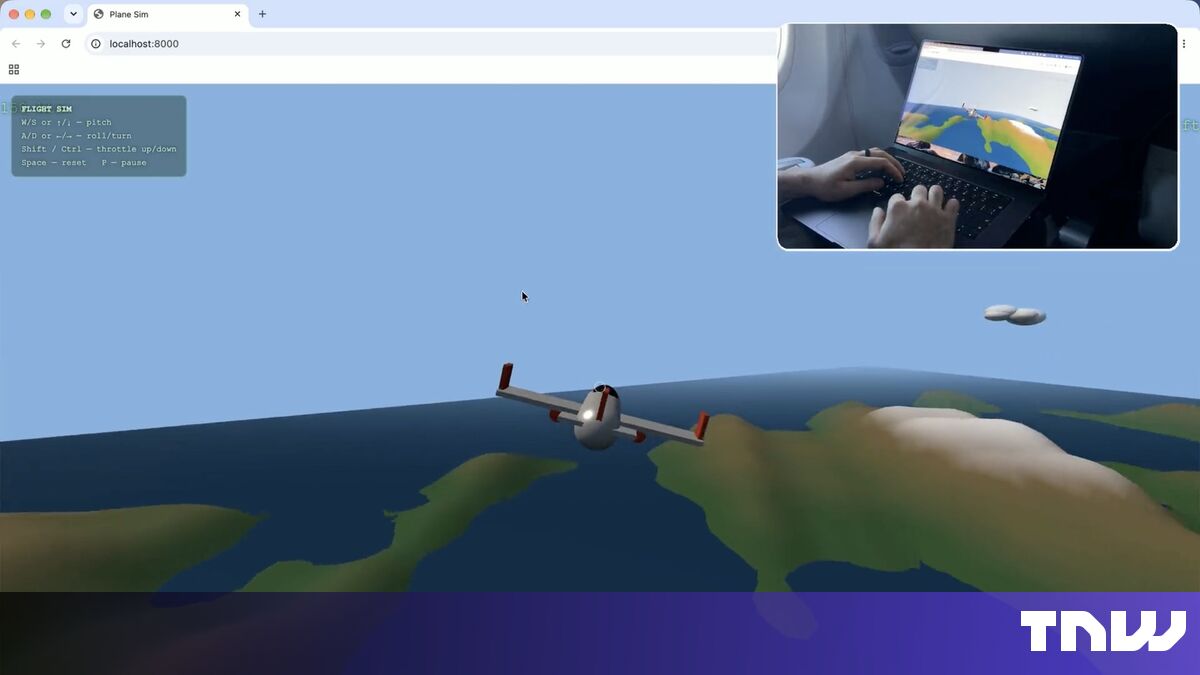



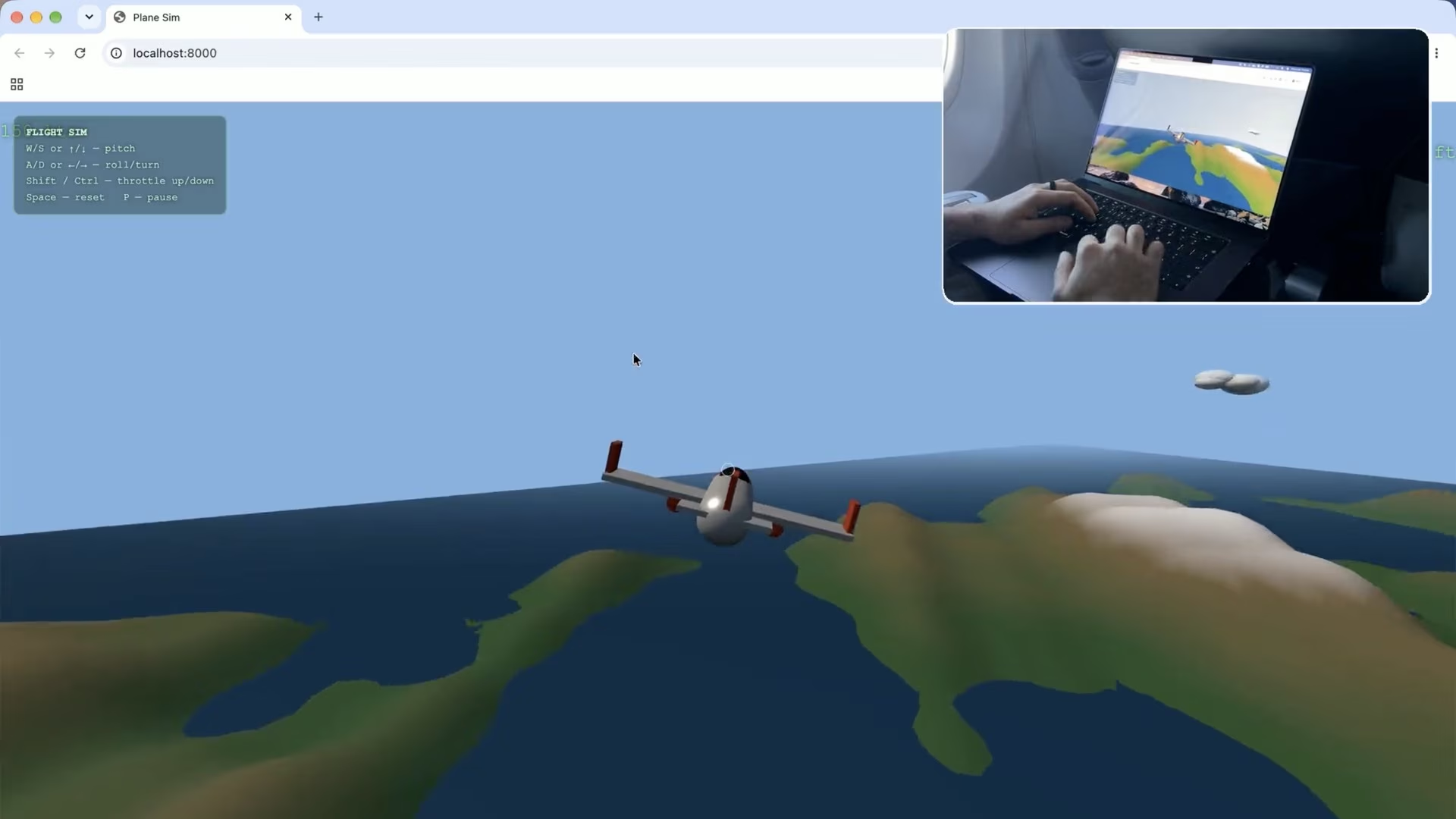
Thinking Machines Lab says Inkling 2 Mini built this flight simulator offline on a MacBook Pro in airplane mode
Thinking Machines Lab has released Inkling 2 Mini, an open-weights model small enough to run on a laptop. The lab says it leads every open-weights model under 100bn parameters on coding benchmarks such as DeepSWE. Mira Murati’s startup announced the model on Friday.
Its trick is looping. Inkling 2 Mini runs its middle layers three times for every token, so it can reason more while writing less. That gain comes with a trade-off the lab spells out itself.
“Looping allows the model to reason longer without writing its reasoning down, which matters for monitoring,” Thinking Machines wrote.
Inkling 2 Mini is a mixture-of-experts model with 26.4bn parameters in total and 3.4bn active per token. Counting the loops, it uses 5.4bn weight activations per token. Its 24 layers sit in four blocks of six. The first and last blocks run once, and the two middle blocks run three times.
The whole model takes up about 20GB of memory. Most of its weights were trained and run in Nvidia’s 4-bit NVFP4 format, so there is no loss from converting them later. The lab also cut two-thirds of the model’s experts during training, then retrained it on 1tn tokens from a larger internal Inkling model.
Looping paid off in the lab’s own tests. A version without loops cost 7.5% less to train, but needed 140% more compute at run time to match the looped one.
To show it off, the lab’s researchers took it on a flight. Running offline on a MacBook Pro in airplane mode, it built a playable flight simulator in a few minutes. In another demo, a single offline MacBook ran all 20 villagers of a pixel town the model also built.
The lab reports 48.2% on DeepSWE v1.1 and 77.9% on a hard set of SWE-bench Pro tasks. Alibaba’s Qwen3.8-27B scored 42.2% and 73.8% on the same tests. The weights are on Hugging Face, and the model runs through Ollama on Macs with at least 32GB of memory.
Artificial Analysis , which tests models independently, put Inkling 2 Mini at 20 on its Intelligence Index. That matches Qwen3.8 27B with about five times fewer active parameters. The model is released under an Apache 2.0 licence, with a context window of 1m tokens.
The benchmarking firm found it about six times cheaper and four times faster per task than Qwen3.8 27B. Each task cost $0.59 and took nine minutes, against $3.53 and 38.2 minutes. It does use about 38% more output tokens for the same score. For scale, OpenAI’s GPT-6 Luna scored 28 at $0.15 per task.
The lab lists its weak spots too. Inkling 2 Mini is not the strongest small model for multi-turn chat or for instructions with many constraints, where Qwen3.8-27B beats it. It trails larger models on hard reasoning tests, and looping does not help it store more facts.
AI labs oversee models partly by reading the reasoning they write out, known as the chain of thought. A looped model can do more of that reasoning internally, where a monitor cannot see it. OpenAI’s Astra raised the same concern when it aced the benchmarks in September.
Thinking Machines is also releasing a research model that can loop one to five times, so outsiders can study the effect. In its tests, the model’s reasoning at five loops was less than half as long as at one, at 1,661 tokens against 3,703. It stayed just as readable. Adding loops did not make it better at hiding sabotage from a monitor.
“At this scale we do not see a meaningful reduction in the monitorability of their reasoning,” the lab wrote.
It called the results preliminary. The research model was only trained with reinforcement learning at three loops, and one trained deeper might compress its reasoning further. A monitor that saw only tool calls and outputs also missed a significant number of attacks.
The release follows the first Inkling model in July , a giant open model the lab admitted was not the best. Its new rivals on local machines include Recursive’s Flint , which appears in the lab’s own coding charts.
Get the most important tech news in your inbox each week.