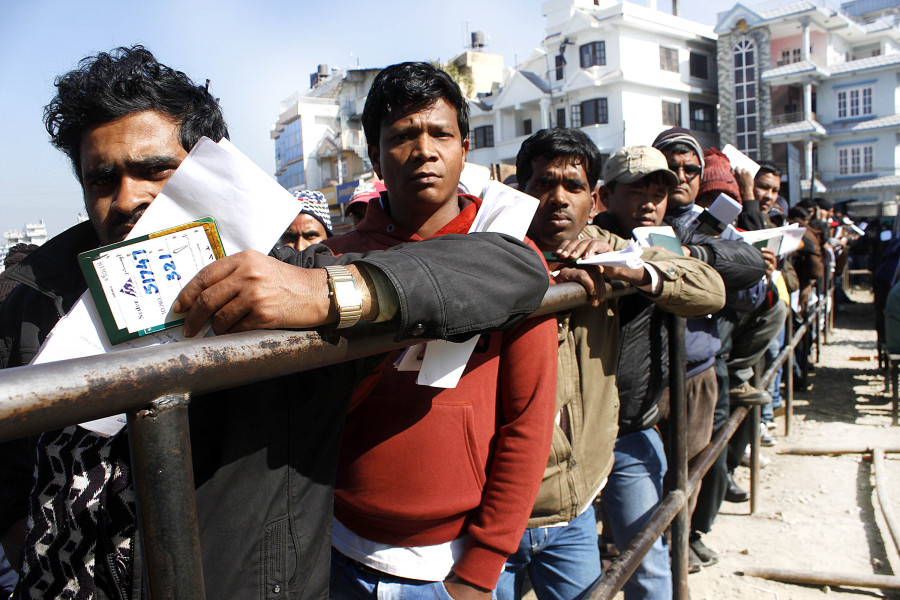
Nepal’s economic liberalisation was expected to attract investment, expand industries, spur private-sector growth, and, most importantly, create employment opportunities. Yet, 35 years later, the country faces an uncomfortable question: If liberalisation was meant to create opportunities, why does Nepal still have so few large employers? Because of the lack of job opportunities at home, Nepal loses around 2,000 young people to jobs abroad every day. In the fiscal year 2024-25 alone, 839,000 people received labour permits (both new and renewed) for overseas employment. This shows that Nepal must seriously increase both domestic and foreign investment to create job opportunities at home.
Successive governments have failed to create enough large employers to meet the needs of job seekers. Around 500,000 young people enter Nepal’s labour market every year, yet only a handful of business groups employ more than 10,000 people each. These figures are striking. This is largely because of political instability: since economic liberalisation, Nepal has seen 32 governments that have focused more on forming governments than on investing in high-yielding sectors such as industry, IT, AI, digital technologies, manufacturing and retail. Over time, the country came to depend on foreign labour markets and remittances, but the authorities failed to recognise that even in foreign lands, the private sector provides job opportunities for Nepalis.
Nepal’s private sector alone employs around 86 percent of workers across industry, trade, financial services, energy, manufacturing, agriculture, tourism and so on. But a few successful business houses cannot compensate for the absence of a broader industrial ecosystem. Even these business groups are struggling to provide jobs for millions of people, despite their meaningful contribution. Corruption and unreliable markets have often hindered them from investing more, making it even more difficult for new ones to emerge. So the challenge now is not only to encourage existing business houses to grow bigger, but also to create conditions in which thousands of new enterprises can emerge, survive and expand.
The new government has an opportunity to revitalise the private sector. The realisation that the private sector could flourish in the country came with economic liberalisation following the restoration of democracy in 1990. Many Nepalis gained opportunities to work in it; some economic progress was seen, but the momentum couldn’t continue because of the decade-long conflict and political instability. They promised reforms, announced policies and development ambitions, but failed to deliver, undermining the confidence of the private sector. As politics took priority, economic issues became secondary. While it is true that even the private sector is not free of insider trading, cartels, conflict of interest and government backing (which also demotivates job seekers), it is the government’s duty to monitor them if they are found complicit in unscrupulous business.
The Rastriya Swatantra Party came to power promising a better future for Nepalis. It pledged to create 1.2 million jobs in five years. This dream will remain elusive if it doesn’t create a favourable environment for the private sector. It must get the basics right: establish long-term policy consistency, accelerate infrastructure projects, simplify administrative procedures, increase capital expenditure, improve access to job-yielding sectors, and promote export-oriented manufacturing. Special attention should be given to entrepreneurial endeavours and micro, small and medium enterprises, which can form the foundation of larger industries. Many young people have pinned their hopes on this government; it cannot afford to disappoint them.