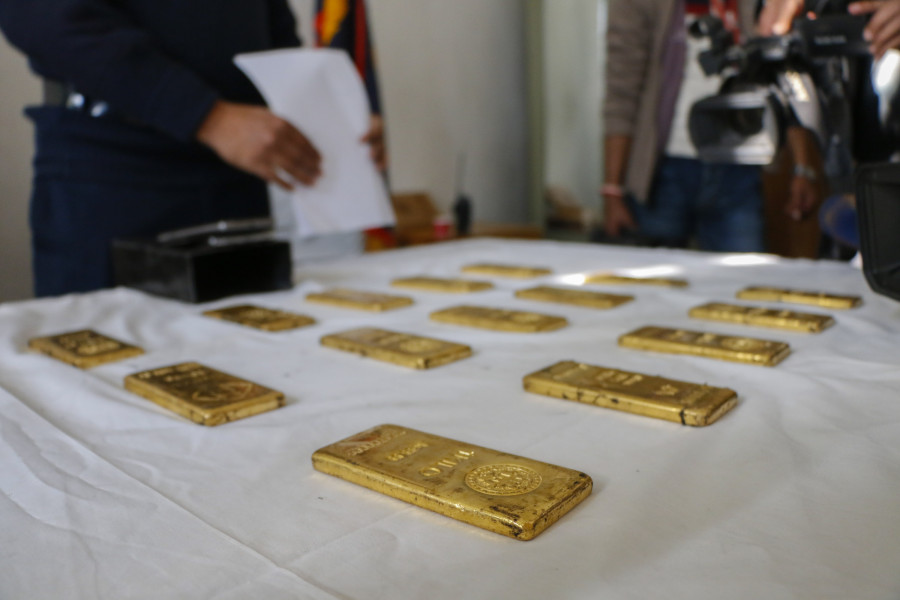
The government has moved the Supreme Court against a high court ruling in the 33.5kg gold smuggling case and the related murder of Sanam Shakya in Urlabari, Morang, arguing that the verdict exposed serious flaws in the investigation and prosecution of customs offences and organised crime.
The Office of the Attorney General filed its appeal on October 30, nearly nine months after the Biratnagar High Court’s February 8, 2026, ruling. The Supreme Court will now schedule a hearing to decide whether to grant leave to appeal.
The Morang District Court delivered its verdict in the 2018 murder of Shakya, which was linked to the smuggling of 33.5kg of gold earlier that year, on October 5, 2021.
The district court had ruled that the prosecution failed to establish charges of organised crime and customs offences linked to the gold smuggling case. The High Court in Biratnagar upheld that ruling.
The government took longer than usual to appeal the ruling, the attorney general’s office said, because it received the full text of the high court judgment late. The judgment was lengthy and involved a large number of defendants, requiring additional time to study the case and prepare the appeal.
“We filed the appeal within the statutory deadline, calculated from the date we received the full judgment,” a deputy attorney general said. “The large number of defendants also meant it took time to prepare the appeal.”
The district court had earlier acquitted most of the accused, including former police officers and businessmen. The high court upheld that decision. Those acquitted included former Deputy Inspector General Govinda Prasad Niraula, then-Senior Superintendents Shyam Bahadur Khatri and Dibesh Lohani, Deputy Superintendent Sanjay Bahadur Raut and Prajit KC and Sub-Inspector Bal Krishna Sanjel, among other senior police officers.
The government’s appeal describes the acquittals as a serious legal error, arguing that they were handed down despite evidence of large-scale illegal gold trading.
Although some defendants were convicted in connection with Shakya’s murder and abduction, the government is dissatisfied that the judgments did not address the alleged illegal trade in gold worth billions of rupees or the organised crime charges. It has also challenged the decision to acquit the main accused of gold smuggling and what it considers lenient sentences for other offences.
After a lengthy police investigation, charges were filed against 77 people. The indictment alleged that large quantities of gold had been smuggled into Nepal, but said the 33kg consignment at the centre of the case had never been recovered.
On that basis, a bench led by Judge Bharat Lamsal convicted eight people, including Chudamani Upreti, known as Gore, of murder and sentenced them to prison. On October 26, 2021, Gore was also sentenced to an additional ten years in prison and fined for kidnapping and unlawful confinement.
The district court acquitted 56 other defendants and put the cases against 21 people who remained at large on hold. The government subsequently appealed to the high court.
A joint bench of then high court judges Mahendranath Upadhyaya and Prakash Chandra Adhikari partially upheld the Morang District Court’s verdict. The government is now seeking to have that ruling overturned as well.
The Supreme Court has two options if it grants leave to appeal: it could issue a fresh interpretation of the case or uphold the high court’s decision.
The government says the lower courts misapplied the law and assessed the evidence incorrectly by acquitting the defendants on the core charges of gold smuggling, handling and managing the illegal trade, and operating an organised criminal group. It argues that the verdicts could undermine the ability to identify the true nature of organised crime, weaken the examination of links between criminal activities and hinder the recovery of proceeds and assets used in crime.
The appeal also warns that the decisions could undermine victims’ access to justice and the effectiveness of legal remedies, increase the risk of impunity, weaken enforcement of the law and erode the institutional accountability of investigative and prosecutorial agencies. It says the rulings could also damage public confidence in the judiciary and the wider criminal justice system.
The high court had ruled that the prosecution failed to establish the organised crime and customs offences linked to the gold smuggling case against any of the defendants. Of the 65 people prosecuted in the case, Chudamani Upreti, known as Gore, Tek Raj Malla Thakuri and Lakpa Sherpa were convicted of offences related to murder but acquitted of the gold smuggling charges.
Under the high court ruling, Gore’s life sentence for murder was upheld, along with an additional sentence for kidnapping and unlawful confinement, a fine and compensation payments. But the court found the charges against him under the Customs Act and the Organised Crime Prevention Act were not established.
The life sentences imposed on Tek Raj Malla Thakuri and Lakpa Sherpa for murder were also upheld. However, the court acquitted them of charges relating to kidnapping and unlawful confinement, customs offences and organised crime.
The high court reduced the life sentences imposed by the district court on Mohan Kafle, Narendra Karki, known as Krishna, and Bhojraj Bhandari, known as Bhoje Mama, to ten years each.
The three-year prison sentence imposed on another defendant, Rajan Kumar, was upheld. The high court increased Madan Prasad Ghimire’s sentence from six months, as imposed by the district court, to three years.
The high court upheld the district court’s decision to acquit most of the other defendants. It found that the prosecution had failed to substantiate the gold smuggling charges against them.
Five grounds cited in the government’s appeal
The government has cited legal precedents and several grounds in its appeal seeking to overturn the decisions of both the district and high courts. The Office of the Attorney General has set out five main arguments.
At the centre of its appeal is the claim that Shakya was murdered because the smuggled gold had gone missing. The government says the two courts were wrong to conclude that the gold smuggling charges had not been established.
The government argues that statements made during the investigation and in court, seized diaries, identification records and other evidence included in the case file collectively establish that gold was illegally imported. It says the courts wrongly acquitted the defendants solely because the physical consignment of gold could not be recovered.
The appeal also argues that the verdicts have adversely affected the right of the victims and their families to justice and increased the risk of impunity.
“The criminal acts uncovered in these cases have had consequences for the criminal justice system as a whole,” the appeal states. It argues that the decisions of Morang District Court and the Biratnagar High Court are flawed and should be overturned because they failed to take those wider consequences into account.
The government says the courts accepted that Shakya had been tortured with electric shocks and murdered, and that the root cause of his killing was the disappearance of the smuggled gold. It argues that acquitting those accused of gold smuggling while accepting the link between the missing gold and the murder was contradictory.
The appeal says the absence of the physical gold itself cannot be treated as the sole basis for proving or disproving the offence. It argues that the courts should have assessed more independent evidence, including statements made voluntarily in court by Gore and other defendants, seizure records detailing the movement of gold, and account books recording payments for transporting it.
It also cites evidence of repeated large-scale illegal gold imports involving a network of Indian nationals, airport employees, Thai Airways staff and police personnel. The government argues that the network operated in a structured manner.
The appeal says the high court’s decision to accept that the gold had gone missing and that Shakya was murdered as a result, while rejecting the illegal gold-importation charges, was seriously flawed in its assessment of the evidence.
The government further argues that the prosecution’s case involved the establishment and operation of a group for financial gain through illegal gold trading. The courts should have examined the group’s objectives, division of responsibilities, continuity of its operations and the roles played by those involved in bringing gold into the country, transporting it, managing its movement, buying and selling it, and distributing it.
Although the district and high courts discussed the elements of offences under Sections 3, 5 and 9 of the Organised Crime Prevention Act, 2013, the government says they failed to assess all the evidence submitted by the prosecution and examine the role of each defendant as part of the wider operation.
The appeal also says the courts should have examined the legal liability of those who helped confine Shakya or played a role in the operation, including people involved in taking him into custody, moving him between locations, tying him up, beating him and torturing him.
The government side argues that Section 31 of the National Penal (Code) Act, 2017, incorporates the established criminal law principle that all members of a group can be held liable for an offence committed by the group. It says the district and high courts failed to take this provision into account in their judgments.
On January 23, 2018, a consignment of 33.5kg of gold smuggled from Dubai went missing as it was being taken out of the Tribhuvan International Airport.
While searching for the missing gold, Gore’s group tortured Sanam Shakya with electric shocks and killed him on March 2, 2018, in ward 1 of Urlabari Municipality.
The investigation found that the group had illegally brought about 3.8 tonnes of gold, or 3,799,563 grams, into Nepal between July 2015 and August 2016.
The government formed a special investigation committee led by joint secretary Ishwar Raj Paudel to investigate the case. Its report was never made public. Some time later, another inquiry was formed into gold-smuggling. The report by the panel led by former high court judge Dilli Raj Acharya, too, remains confidential.
Durga Dulal is a journalist associated with Kantipur Daily, covering law, justice, and constitutional affairs.