Seeking a path of action in history is a serious subject. Nepal is going through a process of retrospection and introspection in matters of political processes and experiments. We are also facing the double whammy of ecology and economy today. Tackling with a strange mix of natural calamity and political experiments is not a smooth process to go through for a country like Nepal. That demands a high degree of dedication, honesty and openness on all fronts. The dominant metaphors that are rife today are political in nature. Other issues of morality, conspiracy, intrigue, and even the open use of post-truth practices mark the most challenging and intriguing moment in history that people are experiencing today. It is a debatable question—when do the events become historical, and when are we able to see and review them? We have to seek solutions to all problems through our own mechanisms. I take the example of politics in this essay.
A few very debatable and what appear to be the crucial questions in Nepali politics have struck me in recent times. That makes it a more interesting, challenging and sometimes inspiring subject for anyone who wants to understand the present texture of politically defined society. The reason for my own interest in this subject is shaped like this. I am neither a dabbler in politics nor has it ever become a subject of preoccupation. But as an academic with literature, cultural studies and art as the principal topics of engagement and pedagogical practice, the concept of politics comes to lodge with me as a subject imbued with the meaning charged with the spirit of presentism, to use a philosophical term. Nepali politics and the little unsettled and ongoing sense of history make me evoke this philosophy. It seems, despite a pretty long history and experiments with ideologies, that contemporary Nepali politics is shaped by presentism. That is to say, the thrust of all Nepali political discourses and concerns is shaped by the tides of presentism. For that reason, I simply want to allude to the gist of this philosophy in a few words.
According to the concept of presentism, only the objects that exist now are real. The past is also important, but the history and the future should be judged from the present. I feel inundated by presentism in Nepal because it seems our discussions and interactions are shaped by what is happening now, and not by what happened yesterday and what may happen in the future. The claims are interesting. Nepali political parties and ideologies mostly use a few metaphors and themes of history. What I find interesting is that the Nepali political parties have inadvertently made the important themes of history, mostly of Western origin, the principal guidelines of their actions. They include Marxism, liberalism, democracy, humanism with rights as the focus, and an independent judiciary.
What is remarkable is that in a short period of time, Nepali political parties and their architects have made experiments with the principal themes of history. The above themes constitute the philosophy of discussions among the Nepali politicians and thinkers. The political and historical aspects of this subject is remarkably discussed by scholars and media analysts. I have read some works of academics like Lok Raj Baral, his erstwhile students Krishna Khanal and Krishna Hachethyu, and historians like Triratna Manandhar, Pratyoush Onta and John Whelpton. The works of earlier historians like Rishikesh Shah, Leo Rose and Bhuvan Lal Joshi are helpful readings. There is no dearth of cogently presented interpretations by writers in Nepali printed media, online portals and podcasts run by experienced media people.
One other thing should be mentioned here. The political parties themselves have developed an interest in interpreting some aspects of the major schools of thought and the trends in politics. That involves the personas and the writings and rhetoric of the leaders of the political parties they represent. The political leaders of the parties took up the cudgel of interpreting current political situations through their manifestos. What is interesting is that the political parties made political ideologies the guiding principles of their actions. There is a history of that. BP Koirala and his party adopted a philosophy of social democracy with liberal ideas, a multiparty system and an independent judiciary as guiding principles and ethics. Socialism was considered the goal of the political party that we find enshrined in the writings of BP Koirala, Ganesh Man Singh, and Krishna Prasad Bhattarai. Their successors appear to reiterate those principles, some brilliantly, and others very poorly. The communists use Marxist lingo in their political discourses more than any other political parties. The volume of Marxist-Leninist principles is quite large in their discourses. The Maoists used the concept of revolution in a classical sense.
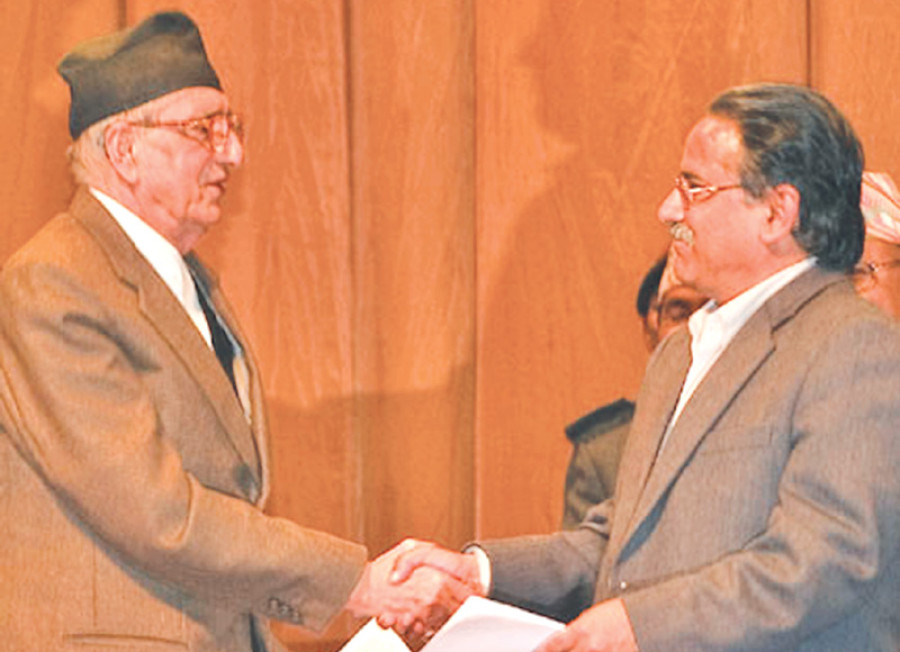
The political parties of different orders meet on the concept of democracy. One example is here. The Maoists, after coming out of the jungle in 2006, entered politics known under the nomenclature of democracy espoused by the 'seven' major political parties and their leaders in Nepal. A short reference is eloquent. Hindustan Tim e s , in its news of November 18, 2006, quoted the Maoist leader Prachanda as saying at the Hindustan Times conference in Delhi, "I have lived my life in the jungle; now I will lead my life in light". Prachanda and Girija Prasad Koirala signed the Comprehensive Peace Agreement after a week on 26 November. The paper further writes, "Nepal's firebrand Maoist leader Prachanda on Saturday said the political battle in the 21st century will be fought over democracy, which at present is in deep crisis." It is interesting to see the Maoist guerrilla leader showing anxiety over the crisis faced by democracy. The newspaper Kantipur of 20 November 2006 reported former Indian prime ministers VP Singh and I.K. Gujral calling Prachanda as one who was representing to them the archetype of a revolutionary read in history books.
The above Prachanda episode and the subsequent ups and downs in Nepali democracy show how the political parties made experiments with political systems and how they adopted and flaunted the norms of democracy during this time in the country. We should see the modern history of achievements and failures in Nepal. As a theatre person, I tend to see the dramatic and theatrical meaning and energy of historical events. Struck by what BP Koirala said at his court testimony from April 29 to May 17, 197, I wrote a play titled Sandajuo Mahabharat . I believe we should earnestly look at the history related to democracy and political parties in this country, especially those that are directly related to the modern times. I would call upon all political parties that were mandated to rule yesterday and today to look at the history seriously and work with vision and a sense of mission.
Abhi Subedi is a poet, playwright and a columnist.