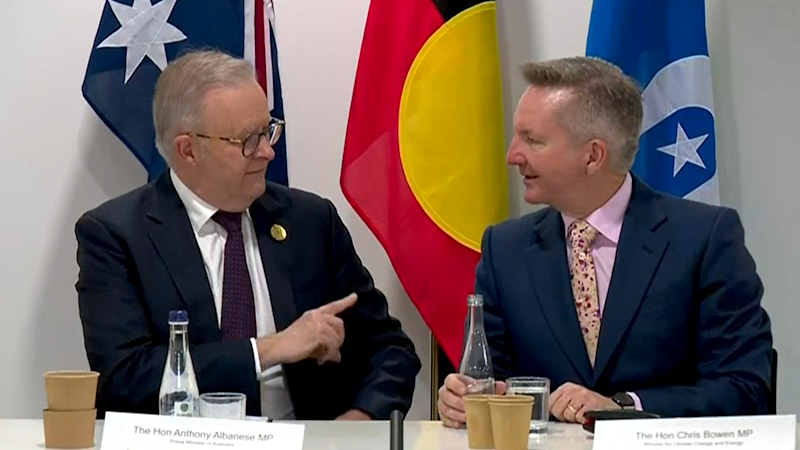
Prime Minister Anthony Albanese was caught on a hot mic joking with Energy Minister Chris Bowen about phone radiation and penises at the COP31 climate summit.
The prime minister was recorded speaking to Bowen on Friday evening as they waited for a roundtable discussion to begin in Antalya, Türkiye.
"Do you keep your phone here? Don't," Albanese cautioned Bowen, gesturing to his left breast pocket, sparking an exchange about the potential impact of mobile phones on the body, including the heart's rhythm.
"I'm more conscious ... I've stopped putting it in my pants pocket," Bowen began before Albanese interrupted.
"Because of your d--k," the prime minister said.
Your trusted source for staying up-to-date with the world around you. Get free daily news updates and analysis, straight to your inbox.
"It's rather important — arguably more important than the heart," Bowen replied as the pair laughed.
Channel Seven initially broadcast a clip of their private banter on Friday evening.
A spokesperson for Albanese downplayed the leaked moment, saying the pair "were having a joke in between meetings," according to Nine newspapers.
However, the joking exchange raises questions about the impact of mobile phones on health, including common concerns they can cause cancer.
A large number of studies have investigated these links, with some studies raising concerns and others finding little convincing evidence of harm.
The current available research does not indicate using a mobile phone is associated with harmful health effects, according to the Australian Radiation Protection and Nuclear Safety Agency (ARPANSA).
Mobile phones emit radiofrequency electromagnetic fields (EMF), a form of non-ionising radiation.
Unlike ionising radiation, such as X-rays, this type of radiation does not have enough energy to directly damage DNA.
Research published in 2024 led by the International Agency for Research on Cancer (IARC) looked at data from over 250,000 mobile phone users and found use of mobile phones was not associated with risk of developing brain tumours.
However, there are some concerns about whether prolonged exposure could have other biological effects.
Some research has suggested possible links between mobile phone use and changes in testosterone levels, sperm motility and cardiac activity.
These findings have fuelled concerns, particularly around carrying phones close to the reproductive organs or heart.
But the evidence is far from conclusive.
Most studies examining electromagnetic radiation and its effects on human organs, including the heart, have found little evidence of a direct relationship.
However, one major UK longitudinal study found an association between longer weekly mobile phone use and an increased risk of cardiovascular disease.
The research found that sleep patterns, psychological distress and neuroticism accounted for between 2.25 and 11.5 per cent of the association.
Importantly, researchers suggested that the way people use their phones could be part of the problem.
Late-night scrolling, disrupted sleep, constant notifications and the psychological stress of an endless stream of digital information can all affect the body's circadian rhythms, hormone regulation and metabolic health.
Poor sleep and chronic stress are already well-established risk factors for cardiovascular disease.
The researchers noted that these factors could help explain the relationship, although the study could not establish causation.
— With additional reporting by the AAP.