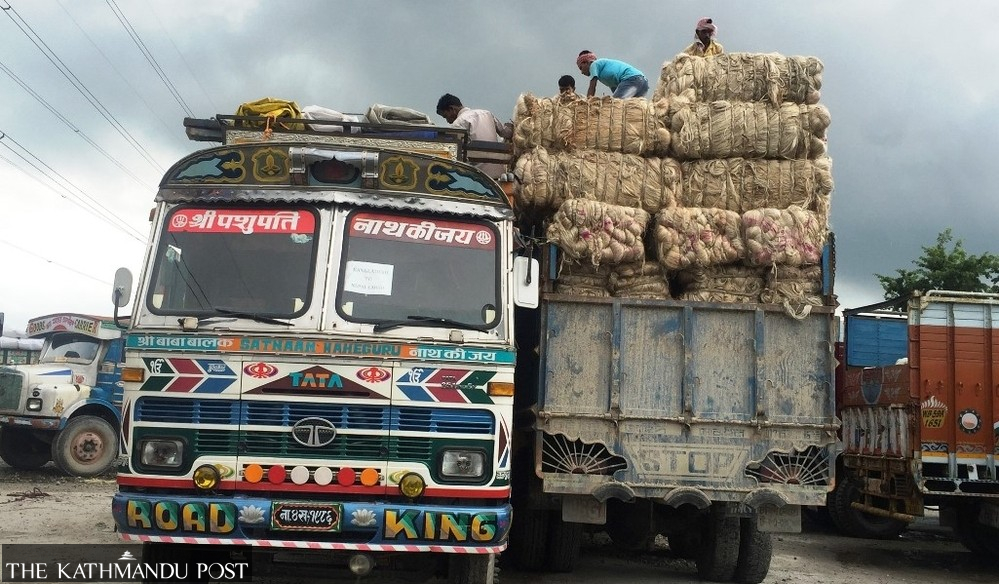
India is the biggest market for jute products manufactured in Nepal. But Nepali manufacturers now face higher charges to sell their products in the very market on which they depend most.
India’s decision to increase anti-dumping duties on Nepali jute products has added to the pressure on the industry, particularly in eastern Nepal, where most of the country’s jute mills are based.
Anti-dumping duties are additional tariffs imposed to protect a country’s domestic industries from imports sold at prices below their normal market value or production costs. Such duties can be levied when a foreign company is found to be selling goods at artificially low prices to gain an unfair advantage in another country’s market. This practice is known as dumping.
India has increased the duties on Nepali jute products under this provision. According to a notification issued by India's Ministry of Finance on September 24, 2026, anti-dumping duties on hessian fabric, jute bags and jute yarn and twine have been set at different rates depending on the product and manufacturer.
The revised rates are about four times higher than those previously imposed on some Nepali manufacturers. Swastik Jute Mills in Biratnagar, for instance, previously paid $8.18 per tonne in anti-dumping duties on hessian fabric exported to India. Under the new arrangement, the rate has risen to $132 per tonne. Similarly, the duty on hessian fabric exported by Baba Jute Mills has increased from $6.30 to $64 per tonne.
For some manufacturers, however, countervailing duties are higher than anti-dumping duties. Countervailing duties are additional tariffs imposed to offset the impact of subsidies provided by a foreign government to its domestic industries, which may give exporters an unfair advantage over producers in the importing country.
India’s Directorate General of Trade Remedies (DGTR) has recommended countervailing duties ranging from $54.77 to $60.54 per tonne on jute products imported from Nepal. India began the process of imposing such duties on jute products imported from Nepal and Bangladesh in 2025.
Rajkumar Golchha, president of the Nepal Jute Industries Association, said the industry had repeatedly drawn the government’s attention to the anti-dumping duties.
“We expect this issue to be discussed seriously during the prime minister’s upcoming visit to India,” Golchha said. “There is little possibility of resolving the problem without an understanding between the two governments.”
Nepal accounts for less than 1 percent of India’s total jute production. Golchha argues that Nepali manufacturers cannot realistically be accused of undercutting Indian producers, as they depend on India and Bangladesh for raw materials and spare parts.
Golchha, who also runs two of Nepal’s major jute manufacturers, Raghupati Jute Mills and Arihant Multifibres, said India had initiated trade remedy proceedings based on the impact of imports on its domestic industry and the effects of subsidies provided by foreign governments.
Anti-dumping and countervailing duties are two distinct trade measures. The former seeks to protect domestic industries from imports sold at unfairly low prices, while the latter addresses the effects of subsidies provided by foreign governments.
Nepal’s jute industry exports products worth around Rs11 billion annually. Exports of jute products reached Rs10.89 billion in the last fiscal year, with hessian fabric shipments to India accounting for the largest share.
In the last fiscal year, Nepal exported hessian fabric worth Rs7.2681 billion to India. Exports of jute bags exceeded Rs2.74 billion, while those of ropes amounted to around Rs880 million.
The figures underline the industry’s heavy dependence on the Indian market. With duties rising, Nepali manufacturers may have to increase the prices of their products in India or absorb the additional costs themselves. Raising prices could make their products less competitive, while absorbing the duties would increase production costs and squeeze profit margins.
According to Golchha, the prospects for exporting Nepali jute products to third-country markets are also limited. Nepal is farther from seaports than India and Bangladesh, making transportation more expensive. Finding an alternative to the Indian market in the short term would therefore be difficult.
The industry is also losing export incentives previously provided by the Nepali government. A 4 percent export subsidy on jute products is no longer available. Golchha said the facility had been suspended for around a year and a half.
With export duties rising in India and government support withdrawn at home, Nepali manufacturers face mounting pressure on both production costs and their ability to compete in the international market.
The jute industry is not merely an industrial activity in eastern Nepal; it is also closely linked to agriculture and employment. Jute is cultivated in districts including Jhapa, Morang and Sunsari, involving around 100,000 farmers. Farmers and workers are engaged in various stages of the supply chain, from cultivation and processing to retting, washing and packaging.
Golchha said Nepal’s jute industry currently employs between 10,000 and 14,000 workers directly, more than half of whom are women. A prolonged crisis in the sector could therefore affect not only factory workers but also farmers and labourers involved in cultivation and processing.
According to Golchha, 12 jute mills were operating in the Morang-Sunsari area until recently. Only six are now in operation.
Industry representatives have urged the Nepali government to pursue high-level diplomatic efforts to persuade India to reconsider the increased duties. Golchha said the government should give the jute industry the same priority it had given to resolving problems faced by the tea industry.
Representatives of business organisations in Morang have also called on the government to intervene diplomatically to prevent India from imposing anti-dumping duties on Nepali jute products at rates up to four times higher than the existing ones from October.
A delegation from the Morang Industry Organisation met Industry, Commerce and Supplies Minister Deepak Kumar Sah on September 27 and urged him to initiate diplomatic efforts.
“The government must raise the issue firmly through diplomatic channels and work towards the complete removal of anti-dumping duties,” said Nanda Kishor Rathi, president of the Morang Industry Organisation.
India remains the largest market for Nepal’s jute industry, meaning the impact of higher duties extends beyond the export earnings of individual manufacturers. It could affect product prices, market competitiveness, employment and the wider economic chain linked to jute cultivation. Finding alternative markets and reducing dependence on India remain longer-term challenges for Nepali manufacturers.
Parbat Portel is the Jhapa correspondent for Kantipur Publications.