A major IT system meant to underpin Victoria’s mental health reforms and replace fax machines, paper and couriered patient records will be delivered two years late – and the final product might not be compatible with all the state’s health services.
A leaked briefing obtained by The Age shows the $64.7 million system might be only partially compatible with services that already have a “moderate digital maturity”, and almost not compatible at all for services that have “high digital maturity” – such as public hospitals and those services catering for the bulk of Victoria’s acute inpatients.
The royal commission into mental health in 2021 recommended that the overhaul of the sector, which the government accepted in full, include a new statewide electronic Mental Health and Wellbeing Record.
This would replace the 27-year-old client management system currently used by services across the state, which the royal commission said was useful but had significant limitations, including the reliance of fax and pen and paper by some services.
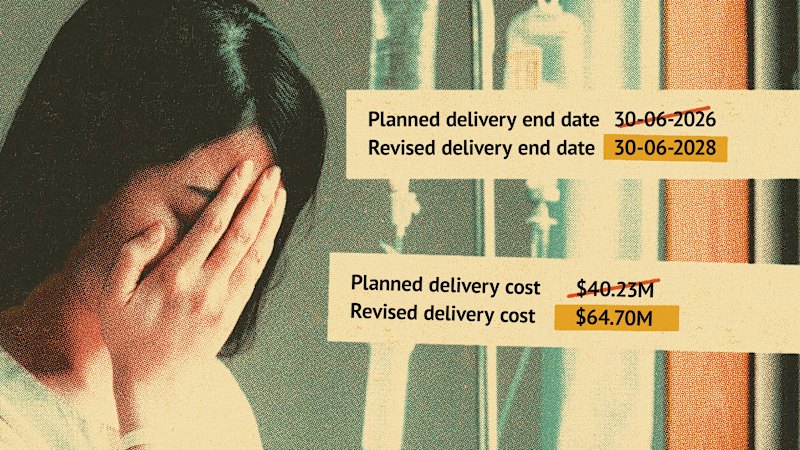
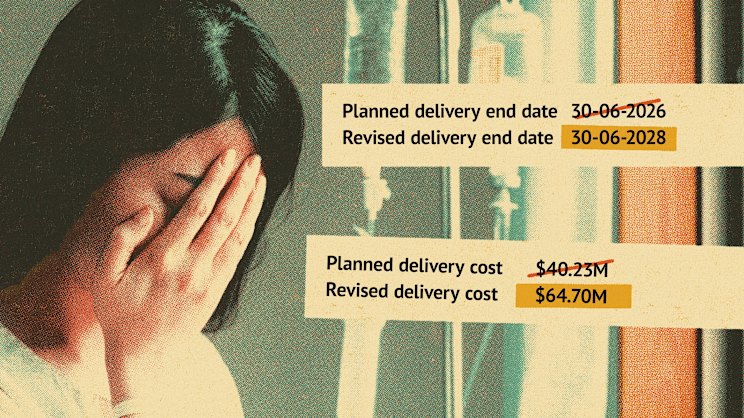
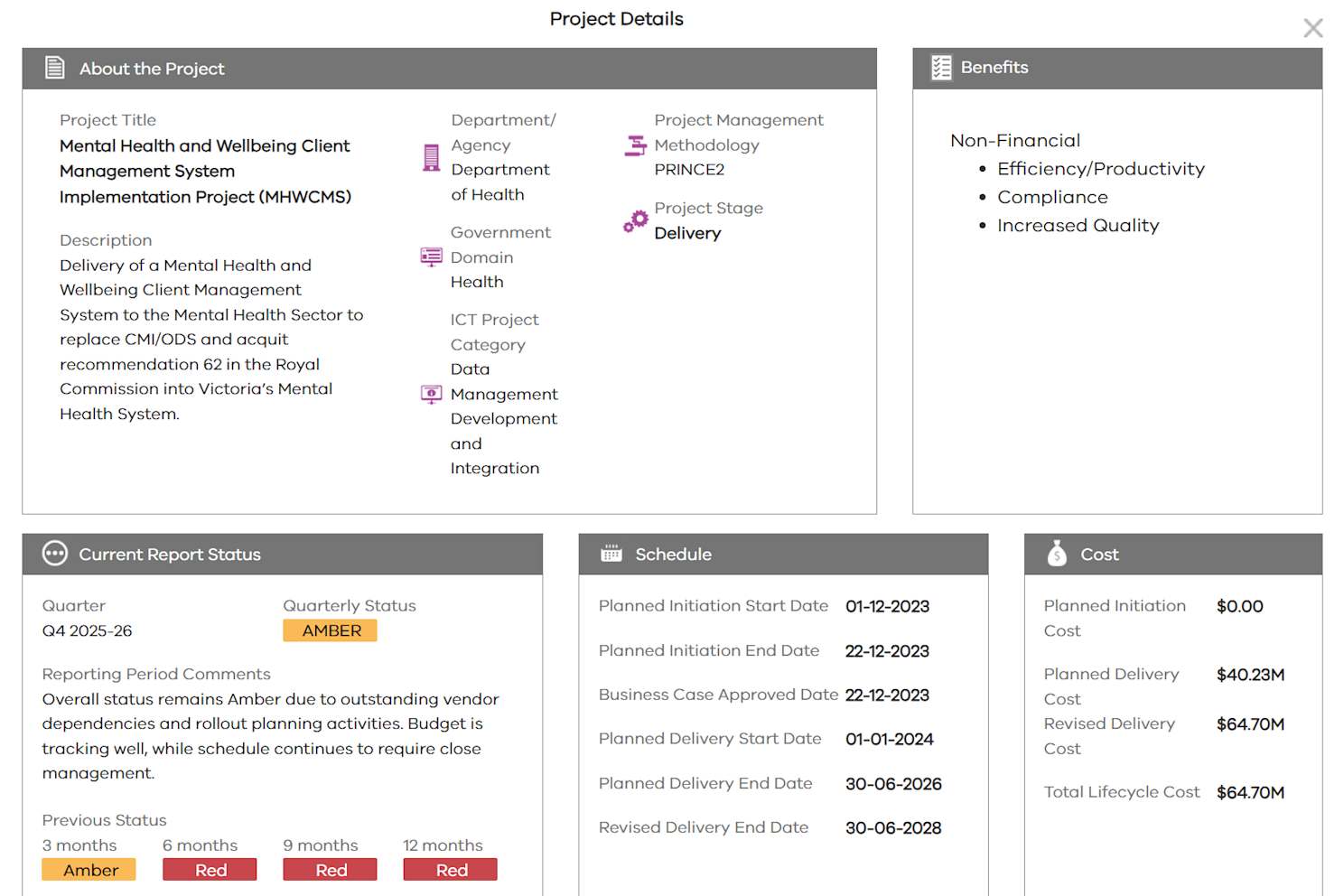
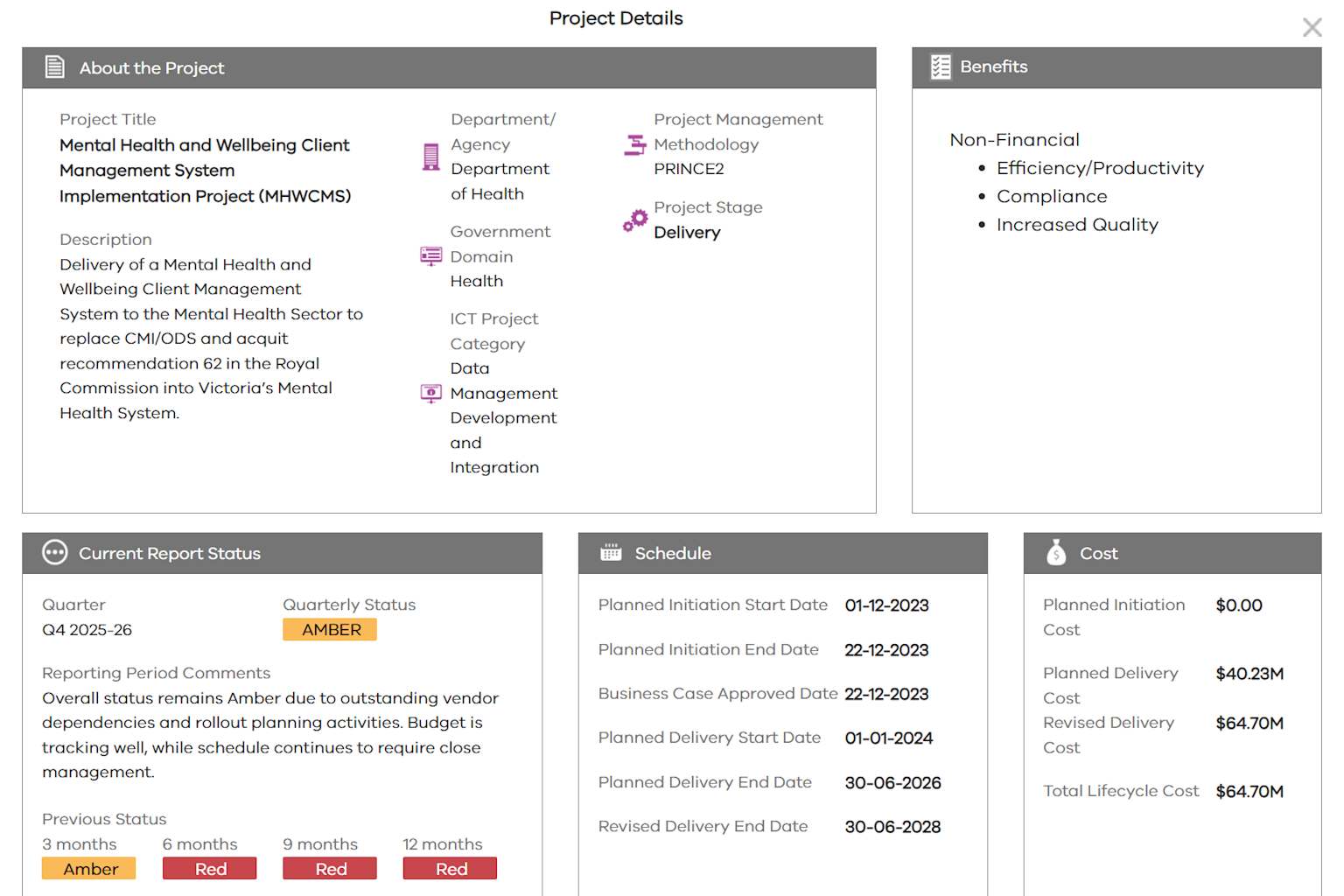
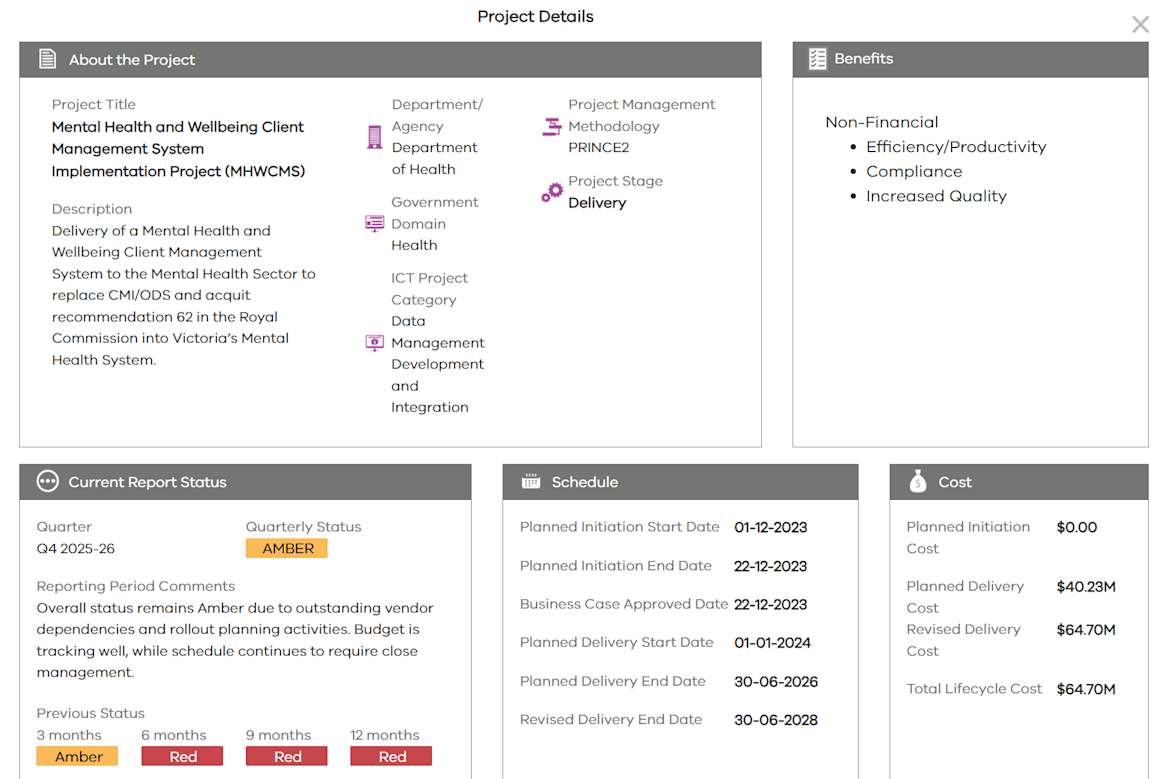
The modernised system was meant to be delivered by June 30 this year, but is now advertised on the government’s IT dashboard with a completion date of June 2028.
And, although the new client management system was initially listed with a planned delivery cost of $40.23 million, the allocation has now been revised to $64.7 million.
The dashboard lists the client management system project as “amber” – indicating that issues exist – and notes there has been “significant schedule slippage caused by solution implementation issues and constraints in accessing required services”.
The royal commission called for a Mental Health Information and Data Exchange to be incorporated into the system so it can interact with other major ICT systems and allow vital information to be securely shared.
However, leaked project briefing documents obtained by The Age show the upgrade is not yet compatible with services that have a “high digital maturity”, such as hospitals.
As a result, the $64 million new system can only be “used primarily for reporting and providing data to the department for funding purposes”, rather than managing patient information and delivering health services.
A trial of the system at a Frankston mental health service, which has a “low digital maturity”, is expected to begin later this year, with a full rollout still years away.
A Victorian government spokesperson told The Age the government was working with mental health services on a staged rollout to ensure the new system was safe, reliable and worked with existing technology,
“The new system will improve how mental health services access and share information, supporting better continuity of care for Victorians experiencing mental health challenges,” the spokesperson said.
“Existing systems remain in place while the new system is introduced progressively, with the first implementation planned for late 2026 and statewide delivery scheduled for mid-2028.”
The government said the revised price tag increase to $64.7 million was a reporting adjustment to fully demonstrate the amount of money allocated to the royal commission’s recommendation.
Wider mental health sector reforms continue to be delayed despite the government generating more money than ever to pay for them, with $1.35 billion earned from the Mental Health Levy last year – up from $1.26 billion in 2024-25 – according to the Health Department’s recently released annual report.
Health and Community Services Union state secretary Paul Healey said mental health consumers and workers need a responsive, timely digital system.
“Without this, people’s lives and mental health are at risk,” Healey said.
“There is a real opportunity to create a system that is easily accessible for everyone who needs it when interacting with the public mental health system including accessibility for police and ambulance services.”
Healey said the new IT system would also be needed for the government to implement its recently announced plan to impose 12-month bans on violent and abusive patients.
The delayed IT rollout is the latest revelation in a months-long investigation by The Age , which has laid bare a system in crisis and a watchdog stripped of the ability to oversee it, more than five years after the state government accepted every recommendation handed down by the Royal Commission into Victoria’s Mental Health System in 2021.
Revelations have included two recent youth suicide clusters , services failing to meet their targets for admitting acutely mentally unwell patients, escalating violence against workers , spiralling rates of psychosis-fuelled homicides, and the resignation of the fly-in, fly-out boss of the state’s flagship youth mental health service.
Whistleblowers have also sounded the alarm that efforts to fix the system, as promised in 2021, are being abandoned or falling behind.
In its most recent report on the government’s implementation of the royal commission recommendations, the Mental Health and Wellbeing Commission found there had been only “partial progress” in delivering modern IT systems. It found work had not yet commenced on a related recommendation to develop statewide digital services for public mental health services.
While the delays continue, Victorian mental health services are still using the Clinical Management Interface/Operational Data Store (CMI) system deployed in 1999, which is managed by the Department of Health.
Mental health workers, who were not permitted to speak publicly, this week confirmed they are still using paper records due to limitations with existing IT systems, particularly in regional areas.
Five years ago, in its final report, the royal commission found Victoria’s CMI was already well out of date and could put patients at risk because it did not allow any sharing of information between health systems.
It found that in 2021 the CMI was “largely administrative and is not used for day-to-day service delivery”, noting it had a very limited capacity to record or share clinical notes and was limited to the initial assessment of a person.
“This is inefficient, and not consistent with how modern health record systems work, such as those used in hospitals and by GPs, where a person’s data is entered directly into the system and replaces paper records,” the royal commission found.
The royal commission heard the state’s longstanding mental health IT system did not store prior histories for people who sought but were not receiving care in a public service, and that emergency department and non-designated workers generally could not access vital patient information.
“Further, [the system] also does not allow for any sharing of information with other health systems, including hospital electronic records or primary care systems,” the royal commission found.
“Area mental health services advised the commission that due to the lack of shared electronic records, they mostly use phone, fax or hard copy to share clinical records during transitions and care coordination. In regional settings, a courier is sometimes needed to transport paper information.”
Opposition mental health spokeswoman Emma Kealy said the delayed mental health IT system rollout was another example of Labor’s failure to implement the mental health royal commission’s recommendations.
“Every delay means vulnerable Victorians are waiting longer for the mental health care they desperately need, putting more pressure on families and an already overstretched system,” Kealy said.
You have reached your maximum number of saved items.
Remove items from your saved list to add more.
You've used all of your gift articles. 3 more will become available on the 1st of every month.