A delightfully different one-bedroom apartment renovation in Roy Grounds’s Quamby flats is testament to the creativity and critical thinking of its Gold Medal-winning architect.
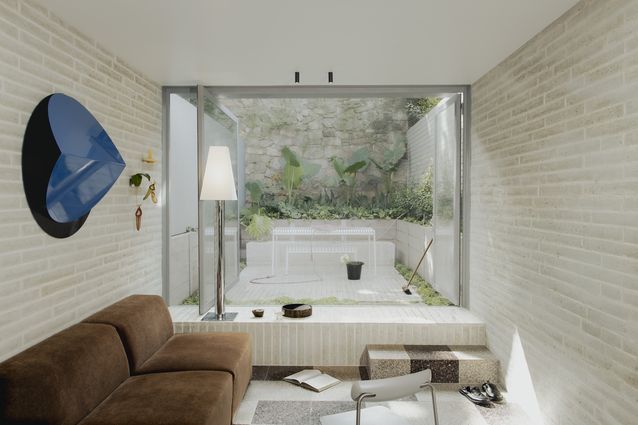
The compact apartment is located in a below-ground space in Roy Grounds’s 1941 Quamby flats. Artwork: Justin Smith.
It is only 45 square metres, but to poach a quote from Fawlty Towers, “There’s enough material there for a conference.” At a time when apartment design threatens to become smoother, larger and more formulaic, Partners Hill’s Studio 8 is a dense built manifesto for revolution. This one-bedroom dwelling in Roy Grounds’s 1941 Quamby apartment block in Toorak, Melbourne demonstrates big ideas beyond its size. The renovation is also testament to the critical thinking and creativity of its Gold Medal-winning architect, Timothy Hill.
But it is not an easy project, challenging habitational, constructional and aesthetic norms, just as Timothy would have it do. He cites three themes: smallness, no waste, and building as lobbying for reform. Yet another emerges during our site visit: the importance of authorship to the continued relevance of the design profession.
A garden pavilion extends living into the garden.
Studio 8 saw Timothy working again with the client from Partners Hill’s nationally awarded Daylesford Longhouse. Compared with that 110-metre-long, greenfield-greenhouse, community-minded project, it is a miniscule urban hideaway in heritage fabric, for two people at most. The two projects are radically different typologies, but each one is crafted with similar meticulous compactness, ergonomic precision and specificity to place. The client wanted something “authored” – not selected and assembled.
Studio 8, however, still bears Grounds’s obvious signature, particularly in its radical radial planning and straightforward economy. “It’s so brave!” Timothy exclaims, identifying Grounds as a neo-classicist, and the building as one in which “dignity is an abstract imperative.” Partners Hill prioritised and perpetuated this attitude, but was not obsequious to the heritage fabric, noting the lower-ground-floor apartment was originally an undercroft laundry and service area. Modified in the 1960s with a “dad’s reno,” it was essentially a project from waste space. Timothy declares, “Rather than rebuild, we just got rid of the ‘dad lumps.’”
Experimentation with compact pied-à-terre typologies renders a playful cocktails space.
He’s disingenuously underselling the intervention, for apart from doggedly clearing the accretions of cover mouldings, clumsy sills and a parasitical tangle of conduits, the new work has amplified the space with a remarkable, almost perverse manipulation of circulation. Grounds experimented with compact pied-à-terre typologies, espousing a more European lifestyle of compact living, cocktails and eating out. Partners Hill’s planning embraces that model, with the crucial task of “room-making” within the small footprint. Each functional area has distinct character and enclosure, with every opportunity taken for a rich architectural promenade from one room to another.
There is no casual slipping between vaguely defined spaces, in the fashion of contemporary kitchen-dining-living rooms (the “ki-di-lis” that Timothy abhors). Thirty percent of the place is quasi-hallway, deliberately prolonging routes with changes of direction, levels, textures and lighting to make the transitions between psychologically profound. But there is nothing wasted in the space, with every fitting and area doing double or triple duty. This is only possible with an obsessional interrogation of ergonomics and dimensions, both in the luscious visible elements and in the resolution of pragmatic services. The whole construction was brokered toward smallness: in choice of materials, limits to trades on site and considered logistical assemblage. Studio 8 is a tangible manifesto of Partners Hill’s crusade to reform excess in the building industry.
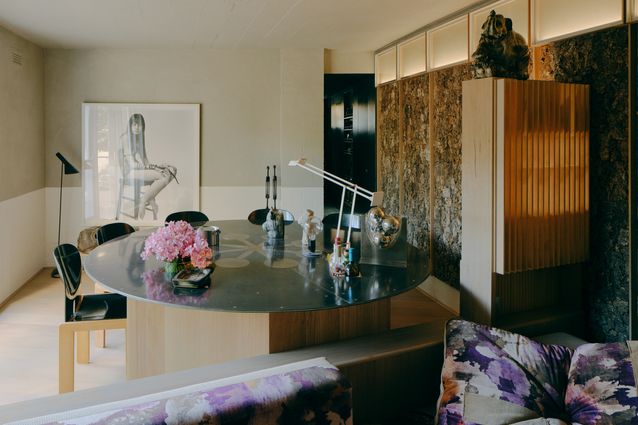
An approach of “deferential exuberance” guided the response to a non-original space within heritage fabric.
Two elements encapsulate the project. The “public square” of the table receives and directs traffic around its 2,360-millimetre diameter. Working sequentially as hall table, work-from-home desk, dining table and cocktail cabinet, this satiny steel disk is acoustically buffered with cork, edged with snakeskin for comfort, and embellished with a mandala to invite curation of everyday things. Storage and power are concealed in its central pillar. A faux clerestory (one of Grounds’s signature devices) and craggy cork wall make an ambiguous backdrop. Is this the inside or outside of the parent building? Is it day or night beyond?
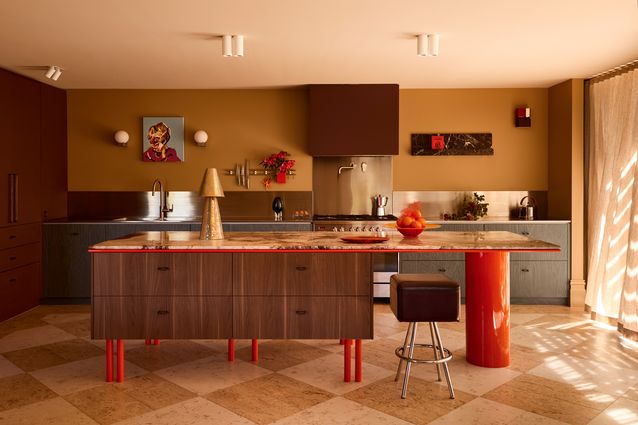
The kitchen similarly “improves on reality,” suggesting a massive hearth that was never there. All the orthodox components are gathered into one very unorthodox installation. Its Lutyens-inspired steel bulk incorporates an expansive sink, chopping boards, five hierarchies of shelves and a sunny spot to sit between an original and an ersatz window. Only the dishwasher and tiny Aga are proprietary items; everything else is germane to Partners Hill.
The small-scale kitchen includes chopping board-benches and an end table for optimum functionality.
This playfulness with scale, unexpected materiality and allusion remind me of Carlo Mollino’s opulent apartments, yet the workability of the singular table and kitchen are undeniable. And like Mollino’s intense, reasoned and metaphorically laden designs, it is difficult to cover the detail (in anything short of a conference). I’ve focused, instead, on Studio 8 as a deft provocation to rethink how we treat space, material and time in an era of confrontational change in the construction industry. Study the images, study the pathways, study the section, for the sheer insight into “a free mind at work” – an epithet originally applied to Grounds in 1949, but equally apt here for Timothy Hill’s agile imagination.
Published online: 20 Oct 2026 Words: Rachel Hurst Images: Tom Ross
Set in a rising neighbourhood of north-west Sydney, a new apartment tower trades generic glass-box urbanism for an expressive form carefully attuned to sun and …
As Australia continues to grapple with the housing crisis, a number of projects delivered under Victoria’s monumental Big Housing Build banner are demonstrating that welcoming, …