You have reached your maximum number of saved items.
Remove items from your saved list to add more.
You've used all of your gift articles. 3 more will become available on the 1st of every month.
If you love chocolate or you are on the Reserve Bank’s interest rate setting committee, turn away now.
Just before Donald Trump’s ill-advised attack on Iran, cocoa beans were selling for just under $US2900 ($4140) a tonne.
Last week, a tonne of cocoa beans was being sold for more than $US5600.
Heavy rainfall across the Ivory Coast, the world’s largest cocoa bean producer, upset local harvests and transport. That rainfall followed below-average rain which had stressed (and reduced yields) from the plants that, to many chocolate addicts, make the world go round.
Not only have prices almost doubled since February, there are growing concerns that the super El Niño which is affecting global weather patterns will bring drier conditions to West Africa for the coming season while contributing to floods across key Latin American coffee producers.
It’s not just cocoa beans on a tear.
Global rice prices have soared by 63 per cent since February. Exports out of India, which accounts for 40 per cent of the global rice trade, are expected to fall 4 per cent in the coming year while its total output is forecast to be down almost 5 per cent because of a weak monsoon.
Prices for oats and sugar are up by more than 30 per cent. Wheat is up by 31 per cent, canola by 30 per cent, soybeans by 24 per cent and corn by 12 per cent. Arabica coffee beans have also surged by 29 per cent since June.
Global cheese prices are down by 7 per cent year-on-year, but they have lifted by 15 per cent since the war against Iran started.
From bread to biscuits, cornflakes to coffee, global food prices have climbed exceptionally quickly this year. And it will all translate into more expensive dinners, lunches and breakfasts across the world.
Throughout this year, the Reserve Bank – along with every other central bank – has struggled to deal with the re-emergence of inflation.
There is a range of reasons for that spike in prices.
Government spending is clearly not helping (the US is about to register a $US2 trillion deficit or 6 per cent of American GDP).
Here in Australia, loose federal fiscal policy (a deficit in the just finished financial year of 0.8 per cent of GDP after a 0.4 per cent shortfall in 2024-25) is adding to economy-wide demand pressures.
In a moment of “hold my beer”, the states and territories are making the situation far worse. For instance, the promises over the past week out of the Victorian Labor and Liberal parties on road tolls and public transport fares are extraordinarily economically reckless.
Government spending is increasing during a period of flat or falling productivity and a surge in expenditure by companies on AI which is approaching mining-boom levels. That will always end in inflationary tears.
But the biggest driver of the inflationary surge has been high oil prices unleashed by the war against Iran.
For those who might have forgotten, domestic petrol prices jumped by a third in March when Brent Crude jumped from less than $US70 to $US112 a barrel. There was respite through the middle of the year but Brent is back at nearly $US110 a barrel.
The jump in oil prices fed directly into a key part of the agricultural production chain: fertiliser. They surged in the weeks after the war but eased through to June. Since then, they have pushed up by more than 30 per cent.
Oil is vital to farming. But good weather is more important. And we’re now seeing the inflationary fallout from the current super El Niño.
The European summer was a scorcher with temperature records broken from Malaga in southern Spain to Moscow in Russia. London’s traditionally green parks looked more like Benalla or Dubbo in mid-January.
It wasn’t just the northern hemisphere feeling the heat. Victoria, NSW and Tasmania had their warmest Augusts on record. September was little better, the third-hottest on record with minimum temperatures nationally at an all-time high.
This is all being watched closely by the Reserve Bank which knows that a spike in food prices is their next inflation headache.
Bank critics have noted that higher interest rates will do little to bring down the price of oil. The same argument holds for expensive bread, jam and hamburgers.
In fact, food inflation is an even bigger problem for the Reserve Bank than oil.
We know that consumers and businesses are adapting to high-priced fuel. The surge in EV purchases and the rollout of batteries by households and businesses is evidence, if any were ever needed, that a big price signal can change long-term spending patterns.
But it’s much tougher to change the population’s eating habits.
You can ask the population to forgo a holiday or extra presents at Christmas to help bring down inflation. However, driving up interest rates so they forgo a meal is Dickensian.
The bank has expressed concern that high inflation hurts those on the lowest income the hardest.
Who spends the greatest proportion of their income on food? Low-income earners.
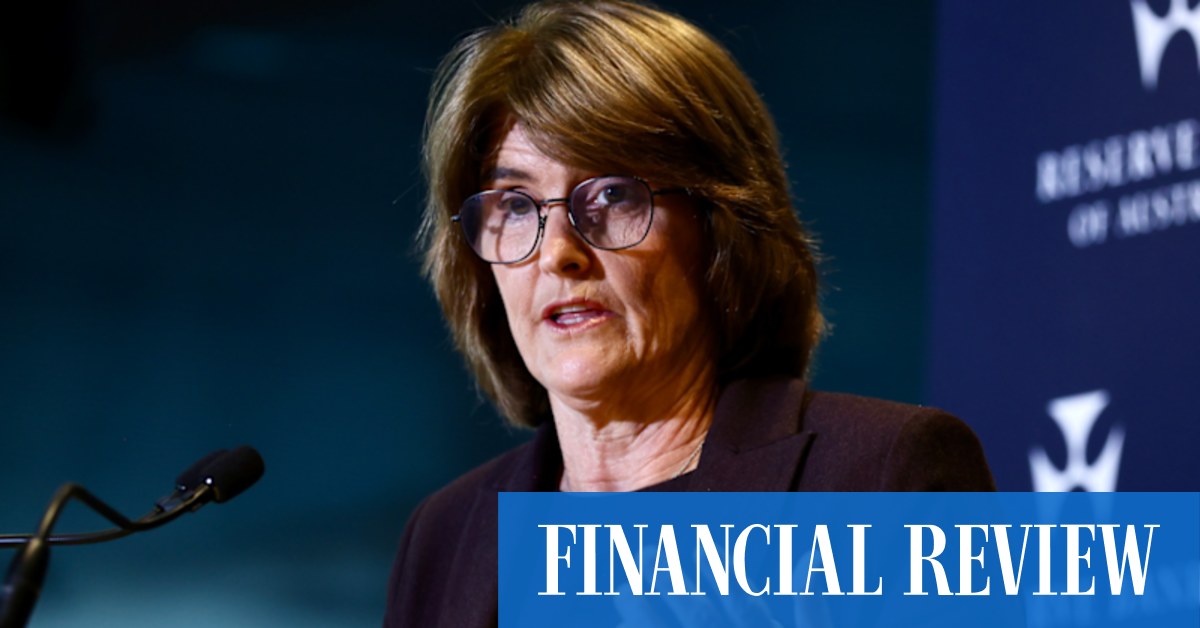
It’s not impossible to imagine RBA governor Michele Bullock using a press conference early next year to announce a lift in interest rates in part to deal with inflation on the nation’s supermarket shelves.
Equally, it is possible to imagine the public’s response to a governor trying to justify those higher interest rates to deal with something so completely out of the bank’s control – the weather and its impact on food production.
Telling a hungry public that can’t afford its daily coffee fix that interest rates are the only lever it has to deal with inflation would not go down well at all.
Without a break in the weather, the coming months could be the ultimate test for Bullock and her team at the Reserve Bank.
Shane Wright is a senior economics correspondent.
The Opinion newsletter is a weekly wrap of views that will challenge, champion and inform your own. Sign up here .
You have reached your maximum number of saved items.
Remove items from your saved list to add more.
You've used all of your gift articles. 3 more will become available on the 1st of every month.