In Hibiscus rosa sinensis (2010), Sāmoan Australian artist Angela Tiatia subverts a traditional Pasifika symbol. ( Supplied: Sullivan+Strumpf/Angela Tiatia )
Artist and former model Angela Tiatia places a red hibiscus flower in full bloom in her mouth — and devours it.
"When you're in the Pacific, if you wear the hibiscus on the left or the right ear, it signals the availability to men," Tiatia says of this image from her 2010 video work, Hibiscus Rosa Sinensis.
"I wanted to subvert that imagery."
Since colonisation, the hibiscus has been famously co-opted by artists such as Paul Gauguin in the sexualisation of Pasifika women.
Angela Tiatia was born in New Zealand and studied visual arts at Auckland University of Technology. ( Supplied: Kieren Cooney )
"I'm looking back into the ways Pasifika bodies have been represented in … film and through visual culture," she tells ABC Arts.
By consuming the hibiscus flower, Tiatia explains she is "refuting that signage of availability".
Hibiscus Rosa Sinensis is one of the works to appear in Muse, the Sāmoan Australian visual artist's first major survey, currently on show at Newcastle Art Gallery.
Muse charts Tiatia's growth as an artist over the last 20 years as she explores Pasifika representation and issues such as climate change, drawing on the Pacific's pre-colonial history.
"I'm trying to find my voice," she says of her early work.
"I started with the fragmented body and then turned to more documentary-style making where it's about place."
Eventually, she turned the camera back on herself — although it wasn't easy.
"I had been modelling for 20 years so I've had a very complicated relationship with my body," she says.
"I had spent so long being in front of the camera being an object."
Dark light (2017) was Angela Tiatia's first foray into set design. ( Supplied: Sullivan+Strumpf/Angela Tiatia )
In works such as Dark Light — a single-channel video depicting a chandelier suspended over the artist's nude body, lying prone against a backdrop of tropical foliage — Tiatia offers a critique of colonialism.
The work also reconfigures her relationship with objectivity.
"My gaze is directed towards me behind the camera, so there's that duality there, refuting objectivity, and turning the subject into the object," Tiatia says.
The Newcastle-based artist seeks a fresh creative challenge with each new project.
After working with a team of three on the set design of Dark Light, Tiatia led a 50-strong crew on her next project, The fall.
"I really wanted to do something that absolutely terrified me," she says.
Commissioned by the Australian War Memorial and the National Museum of Singapore, The fall — winner of the 2018 Ravenswood Australian Women's Art Prize — is a response to the Fall of Singapore in 1942.
An oral history project initiated in the 1980s recorded survivors' accounts of the violence that unfolded as Japanese forces took the city from the British.
Tiatia drew on these archives during a one-month residency in Singapore.
"I listened to every single oral history. It was horrific," she says. "Human beings are so cruel."
The fall (2017) is a silent film, evoking the silence people described in the aftermath of Singapore's fall.
She listened to accounts of looting, soldiers gorging on food and discarding uniforms, civilians burning family photographs and pouring oil on dead bodies in the street to delay the putrefaction process.
Given a broad brief — her only instruction was to avoid displaying dismembered bodies — Tiatia spent months designing the 30-metre set, with each element referencing a specific detail she heard in a witness account.
Filming, however, took just one day.
"Producing is the heavy lifting of the work," she says. "It was four o'clock the night before the film shoot that I started thinking about the choreography."
The day before the shoot, Tiatia brought the actors on set to talk them through the significance of the design and its elements.
"My brief to everyone was, 'Imagine it's the collapse of Sydney,'" she says.
Filmed at Carriageworks, the finished work — a single five-minute shot — is a silent tableau unfolding in slow motion as the moving camera captures a continuous chaotic scene.
"This is the first take that we used," she says.
"For video artists, there are no mistakes. You've just got it get on camera."
In a feat of choreography, the actors reappear in different roles.
"I had 28 actors and I had to recycle them down the track to fill out each scene because of the limited budget I had to hire more people," Tiatia says.
Near the end, Tiatia is visible behind the camera as it rolls past a mirror.
"You have the reflection of the artist because it's my retelling, [showing] how much of history is distorted," she explains.
Tiatia's work also explores her connection to Sāmoan culture.
The Dark Current is part of a video trilogy that includes The Pearl (2018) and Render (2025).
A finalist in the 2024 National Photographic Portrait Prize, the 17-minute work is divided into three parts: past, present and future.
It opens with footage of a young Pasifika woman in an intricately embellished pink dress, submerged in water, a single pearl resting in the corner of her eye.
The sequence is an homage to Tiatia's mother, part of a generation of women who led a wave of migration from the islands to New Zealand, Australia and the US.
"They worked often two, three jobs relentlessly in the factories and cleaning to send money home to the islands to support their families," Tiatia says.
Angela Tiatia's The Dark Current reflects on the experience of her mother's generation, who left the Pacific Islands to find work in the 60s. ( Supplied: Newcastle Art Gallery/Ben Adams )
In the next section, set in the present, footage of young Pasifika women and fa'afāfine is interwoven with recordings of pre-colonial archaeological sites in the Pacific.
"This is a work that formally presents aspects of our ancient culture that have been lost," Tiatia says.
"These young people are really hungry for that knowledge."
At one point, the camera pulls back, breaking the fourth wall as the crew and the set surrounding the actors are revealed.
"Here you're really starting to see what it takes to create the image," Tiatia says.
"My art practice is decolonising in the image but it's also decolonising on set.
The final section features a futuristic animation comprising a mix of human actors and AI-generated imagery, building on Tiatia's use of AI in works such as The pearl.
Tiatia is an enthusiastic proponent of AI, arguing that the technology enables her to fulfil her artistic vision.
"It's so useful," she says. "It brings the work alive … where ordinarily it would be virtually impossible due to space or finance or logistics."
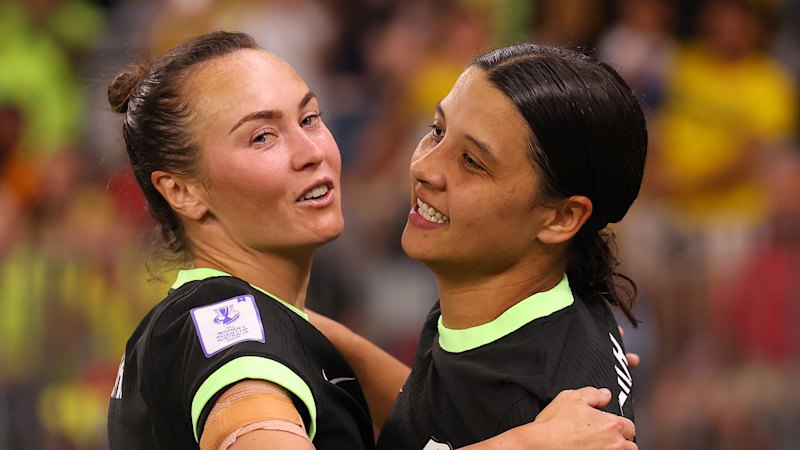
Also on show is The Matildas, Tiatia's 2025 moving-image portrait of the Australian women's national football team.
Commissioned by the National Portrait Gallery, the 23-minute video work immortalises the 23-player squad that competed in the 2023 FIFA Women's World Cup.
While the team finished fourth in the tournament, the support they garnered from the Australian public was unprecedented.
It was a transformative moment for women's sport in Australia and made the Matildas stars in their own right.
"The aim of this portrait was to see them in a way the fans and audience members haven't seen them before," Tiatia says.
The Matildas (2025) is the first portrait commission of a sporting team to enter the national collection. ( Supplied: National Portrait Gallery of Australia )
The work was filmed in seven shoots across three continents over 10 months.
She filmed the largest group of 14 athletes in a four-hour shoot in Houston. After travel time and hair and makeup, she had as little as two minutes to film each athlete.
"It was incredibly challenging. You have to be so on your game and disciplined," Tiatia says.
"That's why my training with making mistakes and not being obsessed with perfection came in handy when making this work.
Tiatia was struck by the players' professionalism, presence and humility.
"Sam [Kerr] has such an incredible charismatic aura," she says.
"She's well-aware of what she represents image-wise. They are all so savvy with their image."
Tiatia captured candid footage of the players when she kept the camera rolling but they thought she'd cut.
"We have guarded and the unguarded moments, which adds dimension to their personalities," she says.
Tiatia wanted to portray the resilience of the players, who each made sacrifices and endured hardship on their respective roads to the World Cup — some more high profile than others.
"It's knowing different things that they've gone through and … representing joy in the face of such a hard time in a male-dominated sport."
Angela Tiatia: Muse is at Newcastle Art Gallery until February 7, 2027.