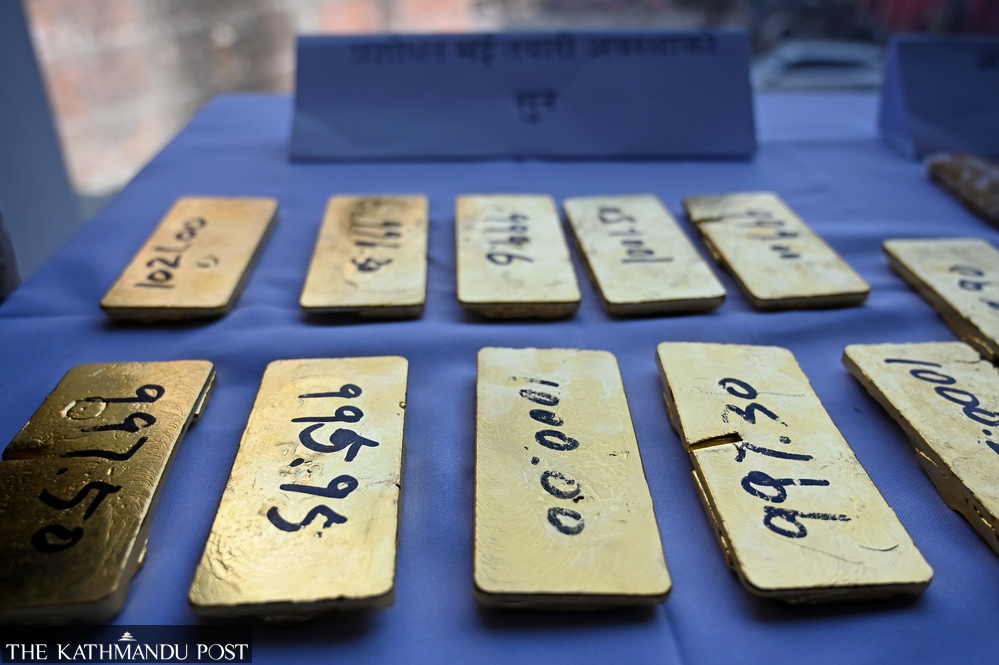
Police have launched an organised-crime investigation into the seizure of 21.75 kilogrammes of gold from Budhanilkantha, Kathmandu, as they seek to identify others involved in the suspected smuggling network.
The Kathmandu Valley Crime Investigation Office in Teku has begun investigating the three Chinese nationals arrested with the gold under the Organised Crime Prevention Act, 2013, in addition to the customs-related charges they already face.
Senior Superintendent of Police (SSP) Santosh Khadka said preliminary findings suggested the gold was being smuggled as part of an organised operation and was intended for onward shipment to a third country. The investigation will focus on identifying other members of the network and establishing how the operation was conducted.
The office has formed a team led by Deputy Superintendent of Police (DSP) Anil Ghimire to investigate the case under the law.
The team has been tasked with establishing the gold’s country of origin, how it entered Nepal and how it was to be transported to another country.
An investigator involved in the case said preliminary findings suggested that the gold had arrived in Kathmandu by air from Hong Kong in a semi-solid form. “We have also received some information about the airline that carried the gold, which we are verifying,” the officer said. “The seized gold was destined for India, and that aspect is also being investigated separately.”
Police seized 21.75 kilogrammes of gold from a rented house in Budhanilkantha on October 8, arresting three Chinese nationals who had allegedly been operating a gold-processing facility there. Police identified the suspects as 47-year-old Zhou Langqing, 37-year-old Han Fei and 36-year-old Wang Jianzheng.
Following their arrest, police handed the suspects and the seized gold to customs authorities for further investigation and legal action. They have since been remanded to prison pending trial under the Customs Act.
The Chinese nationals have been largely uncooperative with investigators. When questioned through an interpreter, they refused to answer several questions and claimed that the main person behind the operation was in China.
Police had sent their mobile phones to the digital forensics laboratory under the Crime Investigation Department at Nepal Police Headquarters. Investigators hope the forensic report will provide clues about how the gold was smuggled and identify others connected to the operation.
“Once the report comes in, we expect it to provide information about others linked to the case as well as the methods used in the smuggling operation,” another investigator said. “We will move ahead with the investigation based on the findings.”
Police had already begun looking for Nepali accomplices in the suspected smuggling network, but investigators say the Chinese suspects’ lack of cooperation has made the task difficult.
Investigators are examining whether Nepali nationals helped store the gold, sell it or transport it across the border into India. Although foreign nationals may be responsible for bringing in or processing smuggled gold, police say local contacts are often needed to distribute it in the market and move it across the border.
Police are analysing the suspects’ digital devices, movements and contacts to establish whether they had local assistance. Investigators have also examined GPS records from a vehicle seized during the operation and CCTV footage from several locations.
The vehicle’s GPS records show that it entered the parking area of Tribhuvan International Airport at least six times. Based on these movements, police suspect the gold may have been brought out of the airport in a semi-solid form.
Han Fei had rented the vehicle soon after arriving in Nepal. Records show that he hired it from September 26 to October 11.
He had earlier visited Nepal with his family on August 4 to assess the gold market and prices before returning to China on August 29. Police suspect that he may have established contacts with Nepali nationals and sought their assistance during that visit.
According to the Nepal Gold and Silver Dealers Association, Nepal consumes around 30 kilogrammes of gold a day. However, Nepal Rastra Bank releases only 25 kilogrammes into the market daily through commercial banks, leaving an apparent shortfall of five kilogrammes.
Former Additional Inspector General of Police Basanta Lama, who served on a high-level committee formed in 2017 to investigate gold smuggling, said illegal imports were meeting the shortfall. “All gold beyond what Nepal consumes is destined for India,” he said. “Even if Chinese nationals bring the gold into Nepal themselves, they cannot take it to India without help from Nepalis.”
Lama said Indian nationals might also be involved in the operation, but there was likely to be Nepali involvement at some level of the smuggling chain.
Investigators, however, say they have yet to establish the involvement of any Nepali nationals in the latest case.
“We are investigating that aspect as well, but we have not yet found anything that we can disclose,” SSP Khadka said.
Over the past decade, police have seized 579 kilogrammes and 218 grammes of gold smuggled into Nepal through air and land routes.
According to Nepal Police data for fiscal years 2016-17 to 2025-26, a total of 768 people suspected of involvement in gold smuggling were arrested during the period. The seized gold generated Rs5.62 billion in government revenue.
Pokharel is a journalist at Kantipur Media Group covering national security, defence, and good governance.