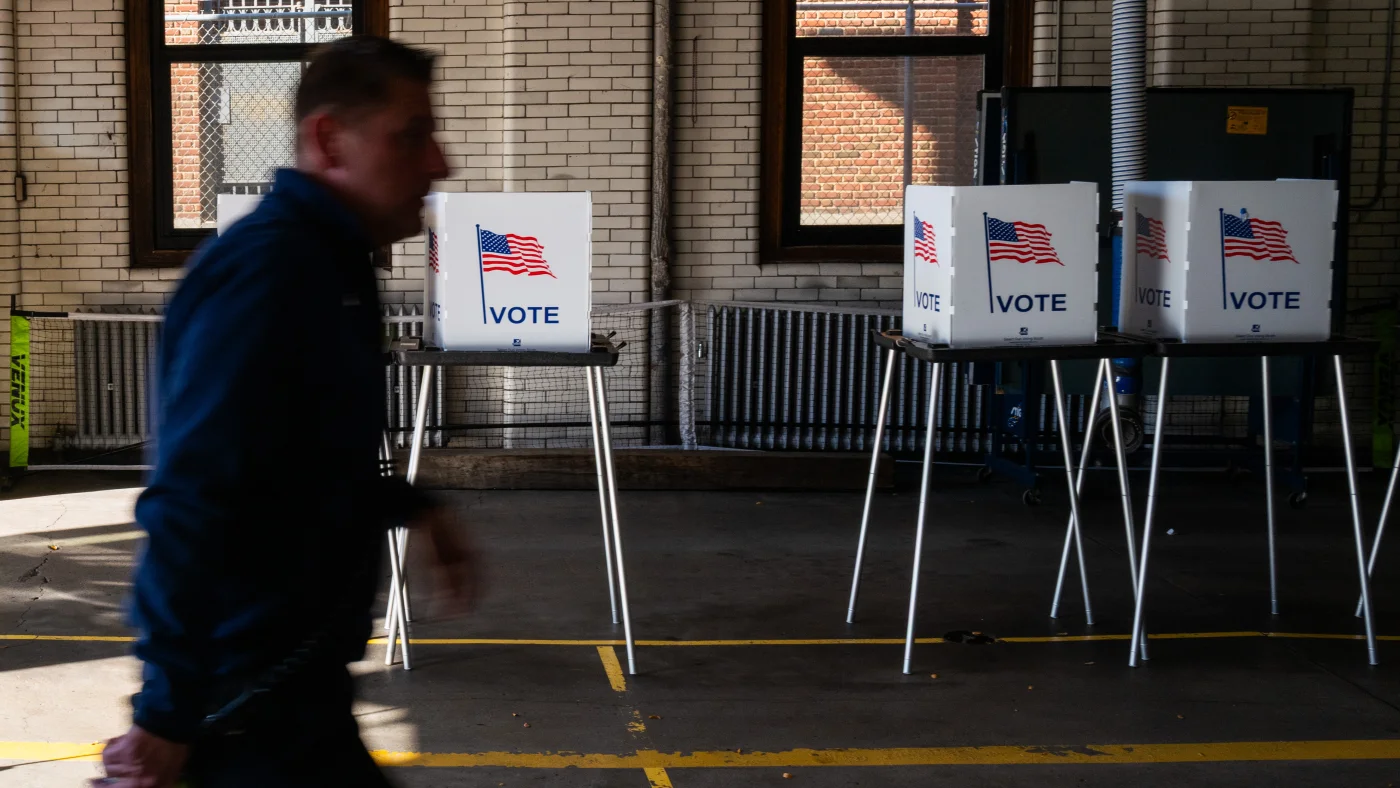
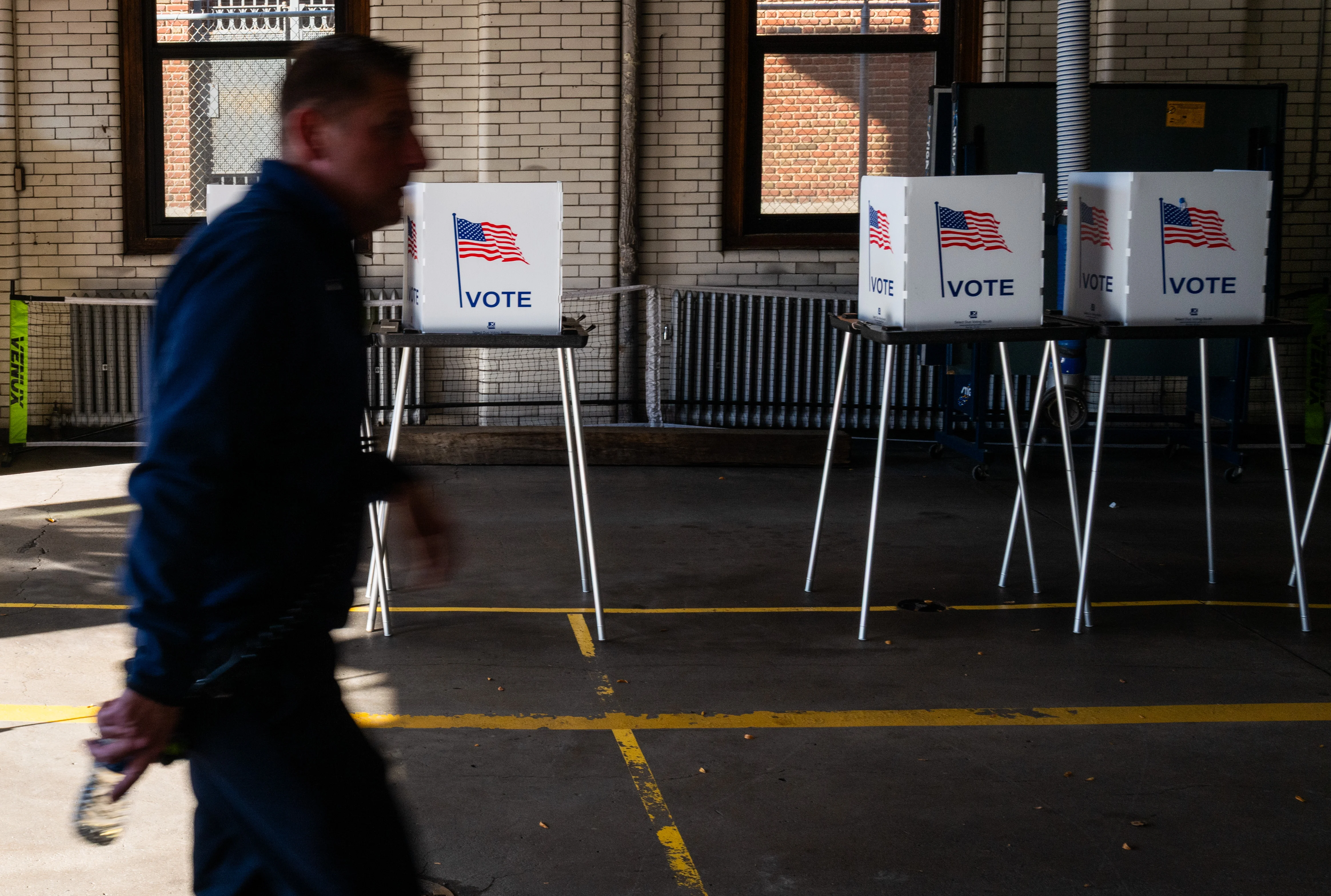

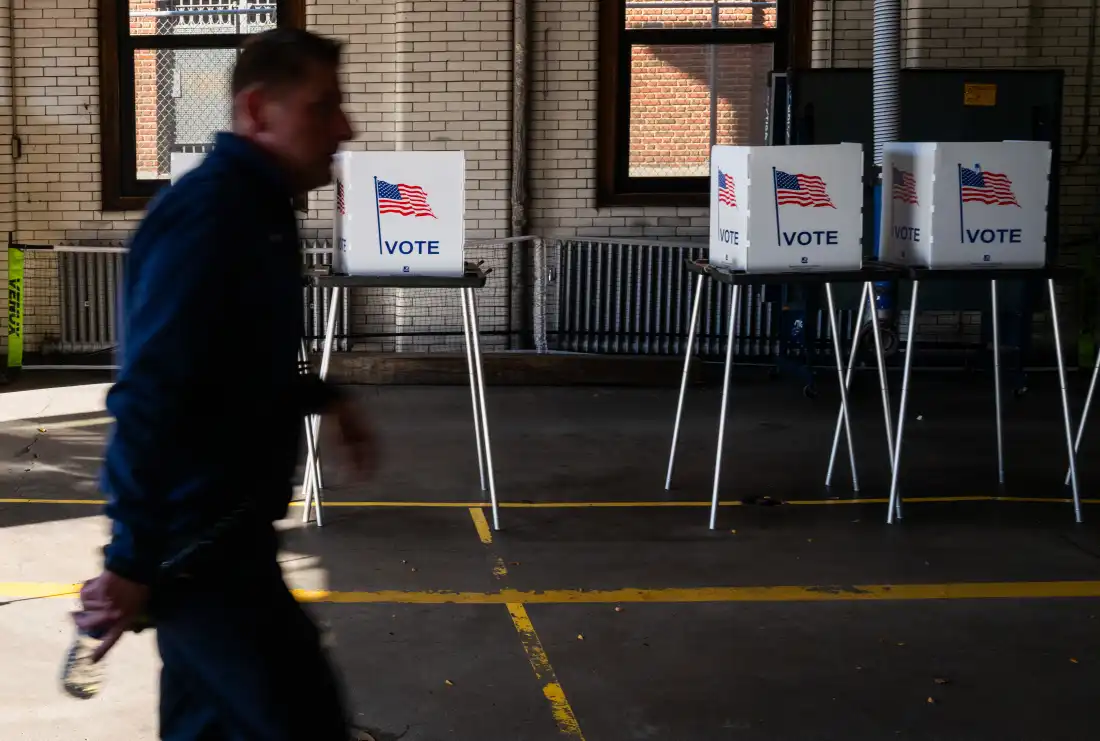


A firefighter walks past voting booths at a firehouse serving as a polling location in Detroit on Nov. 3. Spencer Platt/Getty Images hide caption
President Trump may have initially accepted the results of his party's midterm losses , but data released Friday shows there is still broad distrust in the elections process among Republicans.
Less than half of Republican voters nationwide considered the midterm elections "free and fair," according to new polling by the University of California San Diego. Just 52% of Republicans said they trusted votes were counted accurately.
In comparison, after the 2024 election that Trump won, more than 80% of Republicans said they had confidence in the vote-counting process.
While trust in elections often dips for voters of the losing party, the GOP has seen bigger swings in confidence in recent years, as Trump has falsely claimed that U.S. elections are corrupt.
"There are still a lot of people who remain unconvinced that they can trust elections," said Thad Kousser, a co-director of UC San Diego's Center for Transparent and Trusted Elections. "And they're predominantly located in one [political] party."
Overall, a wide majority — 66% — of Americans said they think the midterms were fair. That represents an improvement from before the election , when less than half of U.S. adults said they expected free and fair contests.
But that post-election increase in trust was buoyed by Democrats and independents — many of whom worried before Election Day about potential federal interference at the polls that didn't come to pass .
"It would be a mistake to [look at the 66%] and think, 'Oh, everyone has a pretty good view of the election,'" said Lauren Prather, also a co-director of UC San Diego's election center. "It really buries the lede a little bit about the partisan gap."
The widespread doubt among Republicans may be a reality check for those wondering whether Trump's brand of election denial has run its course in American politics.
On the one hand, there will be fewer politicians who deny or question election results in office next year. And the vast majority of election-denying candidates running for positions involved in overseeing statewide elections lost their races this year, according to tracking by the advocacy group States United Action.
Election experts have also celebrated as Trump and high-profile losing candidates on the ballot this year conceded their losses.
"Sure, I'll accept [the results]," Trump told Fox News' Bret Baier on election night, as it became clear Democrats would retake the House and Senate. "Why wouldn't I?"
But just a few days later, he began conspiracy theorizing about those same results.
"Does anybody really believe that this 'Election' was honest," Trump posted online .
The new polling from UC San Diego shows that among Republicans, there still may be a receptive audience to such claims. When asked if politicians are discussing voter fraud too much, too little or about the right amount, just 15% of Republicans answered "too much."
"There is both demand among the Republican base for continued focus on this issue, and as we saw even after the election, politicians are continuing to supply it," Kousser said. "As long as those two dynamics are there, there's still going to be a market for these concerns."
To be clear, in most elections — domestically and internationally — supporters of the losing party usually see a dip in trust.
"It's sort of like asking people after an overtime basketball game, do you trust the referees?" Kousser said.
But in an ideal world, he said that oscillation would be more like 10 percentage points in either direction. Not the 30-point swing seen among Republicans between 2024 and 2026.
The numbers do still represent an improvement from 2020, however. At that time, leading up to the Jan. 6 riot at the U.S. Capitol in 2021, just 22% of Republicans said they had confidence in the nationwide vote count, according to similar polling done by MIT's Election Data and Science Lab.
NPR does not offer or accept money for coverage or interviews. Anyone who makes such an offer or request is not an NPR employee and does not represent NPR.