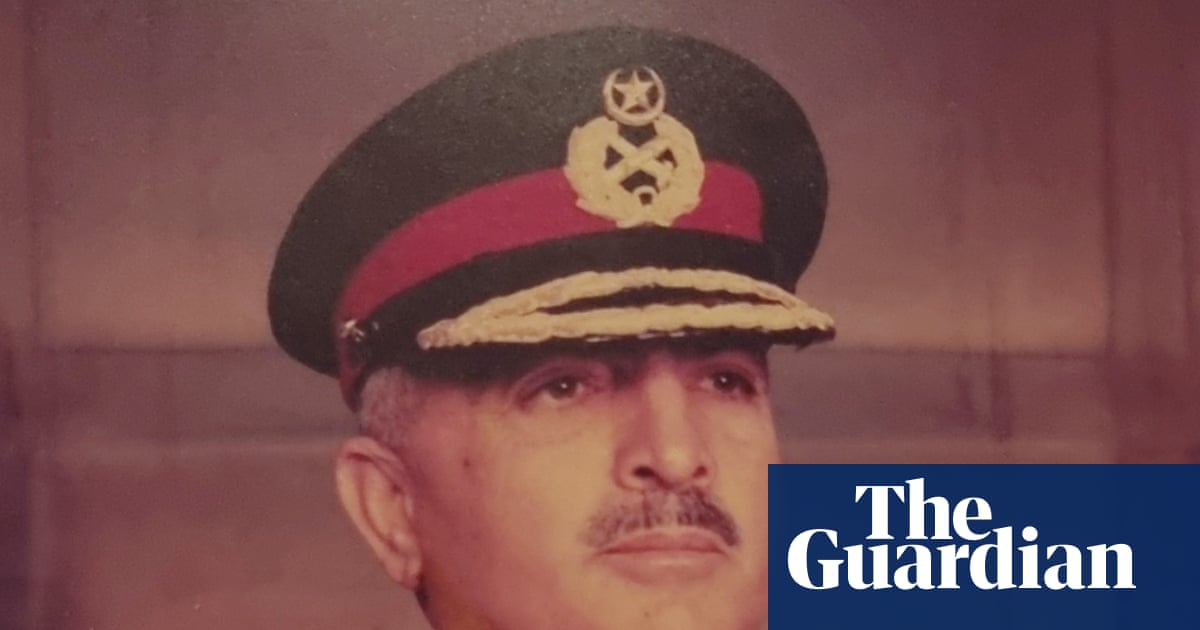
Waheed Kakar, the chief of army staff in the Pakistan army from 1993 until 1996, who has died aged 89, was notable for refusing to seek power outside his official role, in a country with a long history of military rulers.
In July 1993, confronted with a political crisis between the prime minister, Nawaz Sharif, and the president, Ghulam Ishaq Khan, instead of taking power himself and dissolving the civilian government as other military chiefs before him had done, Kakar secured the resignation of both civilian leaders and allowed elections to be held.
This chapter in Pakistani history is remembered as the “Kakar formula” – a rare occasion when a military chief distanced himself from civilian politics.
The general elections that were held as a result brought Benazir Bhutto to power. Just before Kakar’s term was due to finish in 1996, Bhutto sent repeated offers, direct and indirect, to him to continue as the army chief. But Kakar refused and said: “I am going home.” Bhutto described him as “a totally non-interfering army chief. He was an honourable man.”
His rise to power had in itself been unexpected, and came after the sudden death of Gen Asif Nawaz Janjua in January 1993. There was a deadlock for the selection of his successor as army chief, and both Sharif and Khan had their own favourites.
In seniority, Kakar was the fifth general in line for the powerful position. As the deadlock persisted, and since he was the only one to have no connections to either man, Kakar was nominated. According to Mariana Babar, a journalist with the English-language daily the News, who interviewed him soon afterwards, Kakar could hardly believe he was the new military chief.
It was Kakar’s first and last interview. Unlike other military leaders, he chose to stay out of the spotlight. “Remaining apolitical was part of his personality from the early days of his services. We don’t know who his favourite politician or political party was. Even after his retirement, he gave no clue,” Babar told me.
The son of Sardar Abdul Hameed Khan, a civil contractor, and Anwar Sultan, Kakar was born in British India, in the north-western city of Peshawar, which became part of Pakistan at partition. His uncle was the independence campaigner and politician Abdur Rab Nishtar. The family belonged to the Pashtun Kakar tribe and had moved to Peshawar from the south-western province of Balochistan.
Kakar studied at Edwardes College in the city, and joined the Pakistan military in 1956. Rising through the ranks, he saw combat and wars with India in 1965 and 1971, attended the Command and Staff College in Canada, and later studied at the National Defence College in Rawalpindi.
During his time as head of the army, Kakar forced the retirement of two powerful generals: Asad Durrani, who was accused of interfering in politics and distributing funds to an election alliance led by Sharif; and Gen Javed Nasir, former chief of Pakistan’s powerful ISI military intelligence agency, who was alleged to have supported fundamentalists and extremists.
In 1995, at least 38 military officers, including Maj Gen Zahirul Abbasi, planned to assassinate Kakar, Bhutto and other members of the senior military and civilian leadership, and to impose a military coup. They also plotted to proclaim a caliphate, with Abbasi as Amirul Momeneen – “leader of the faithful”. But the plan was thwarted, their arms were confiscated and they were arrested.
After his retirement in 1996, Kakar disappeared into the shadows. He did not take any political positions or head any government department, as would be the norm for former military officers. Former chiefs were occasionally invited to give their insights and suggestions at military headquarters, and Kakar would take part in those gatherings to share his opinions. According to Babar, his advice would always be: “Please keep religion out of the army.”
He is survived by his wife, Yasmin, whom he married in 1966, and their son and daughter.