Long before it earned the nickname ‘Himalayan gold’, yarsagumba was valued in traditional Tibetan medicine. Known in Tibetan as ‘yartsa gunbu’—or “summer grass, winter worm”—the fungus ( Ophiocordyceps sinensis ) grows in Nepal’s Himalayan pastures at elevations of 3,500 to 5,100 metres above sea level. Its first written record dates back to around 620 AD, during China’s Tang dynasty.
For generations , yarsagumba has been woven into the livelihoods of Himalayan communities. Now its story is making its way to the silver screen through ‘Himalayan Gold’, the directorial debut of Nepali filmmaker Dhiraaj Rajvanshi. The action-thriller is set to hit the theatres on November 20.
Rajvanshi says that the idea for the film took shape while he was working as the chief assistant director on ‘ Khusma ’, the 2024 romantic-drama that featured the viral megahit ‘ Rukum Maikot ’. During the film’s shoot in Rukum, locals told him about robberies targeting yarsagumba collectors returning from the highlands with their harvest, Rajvanshi said during an interview with the Post recently.
To understand the lives of yarsagumba collectors, Rajvanshi travelled on horseback with locals to the collection areas in Rukum, where he stayed at a highland camp and observed the seasonal harvest . He learnt that entire families, including children, spend three months collecting yarsagumba, with the income sustaining them for the remaining nine months. Schools in some villages even closed during the season.
‘Himalayan Gold’ transports viewers back to an earlier era. Set in the 1990s, it follows Sonam (Pariksha Limbu), who survives after robbers attack her family for their yarsagumba harvest. The gang, led by veteran actor Sunil Thapa as Ratey Dai plays the film’s central antagonist. Rajvanshi describes the film as an underdog story that moves away from the conventional male hero. Rather than relying on physical strength, Sonam uses her emotional intelligence to turn the four villains against one another and seek revenge.
The trailer creates an ominous atmosphere, contrasting the tranquillity of the Himalayan landscape with the violence and tension among characters. Cinematically composed shots of snow-covered mountains and open slopes capture the region’s beauty, while a Bhavachakra (Wheel of Life), appears among the Buddhist imagery. The symbol, which represents the cycle of existence, adds another layer to the film’s visual portrayal of life, suffering and conflict.
After studying at the Los Angeles Film School and spending five years in the film industry, Rajvanshi wanted to move beyond the themes and genres he felt dominated Nepali cinema. Rather than following the more familiar narratives of village life or foreign employment, he chose to tell the story of yarsagumba through a thriller, with the aim of reaching a global audience.
Since filming took place during the off-season in November 2025, the production team used 3D-printed replicas of yarsagumba. When asked whether the yarsagumba shown in the trailer was real, Rajvanshi explained the props were systematically used to depict the collectors’ search and harvest.
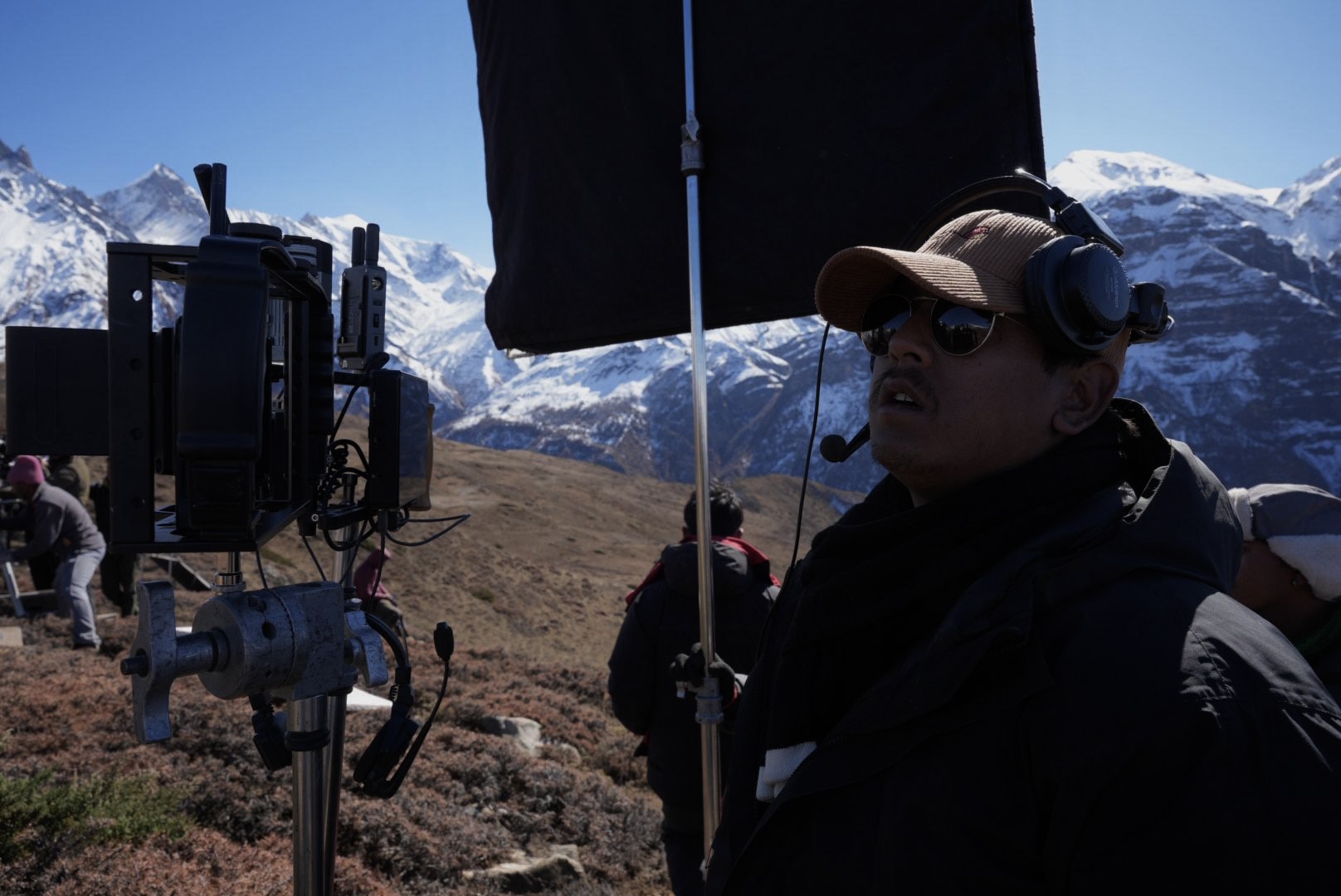
The film was shot entirely above 3,800 metres across six locations including Muktinath, Lo Manthang, Chhusang Cave, Bhinthang and Annapurna Base Camp. Filming in these remote, high-altitude areas brought challenges for the cast and crew. In Bhinthang, a 15-member crew had to hike for 10 hours in a single day, climbing from 1,800 metres to 3,900 metres to reach the filming location, Rajvanshi recalls.
Shooting inside Chhusang Cave in Mustang was another challenge. The crew spent four days filming inside the multi-storey cave, where dust and low oxygen levels made the work physically demanding.
“The scene was originally three pages, but we had to rewrite it after exploring the cave,” Rajvanshi says, adding that the location offered several possibilities for the stunts.
The film’s production involved a total of 275 people working across different stages. Post-production was completed at Annapurna Studios in Hyderabad, India. Rajvanshi says the team included a colourist and sound-mixing engineer whose previous credits included Indian productions such as ‘Baahubali’, ‘RRR’, ‘KGF’ and ‘Pushpa’.
Beyond Nepal, the film is also set for release in several international markets, including India, UAE, Qatar, Japan, US and UK.
Rajvanshi says around 90 percent of the locations used in the film are ‘virgin locations’, places where films have not previously been shot. The film captures eight mountain peaks including the eight-thousanders Everest, Manaslu, Dhaulagiri and Lhotse.
“It’s the mountains,” Rajvanshi says. “I want a global audience to see Nepal’s Himalayan range and understand the way of life shaped by the yarsagumba collection.”
Shrestha is an intern at the Post's Culture and Arts desk. She is studying journalism and English literature at St. Xavier's College.