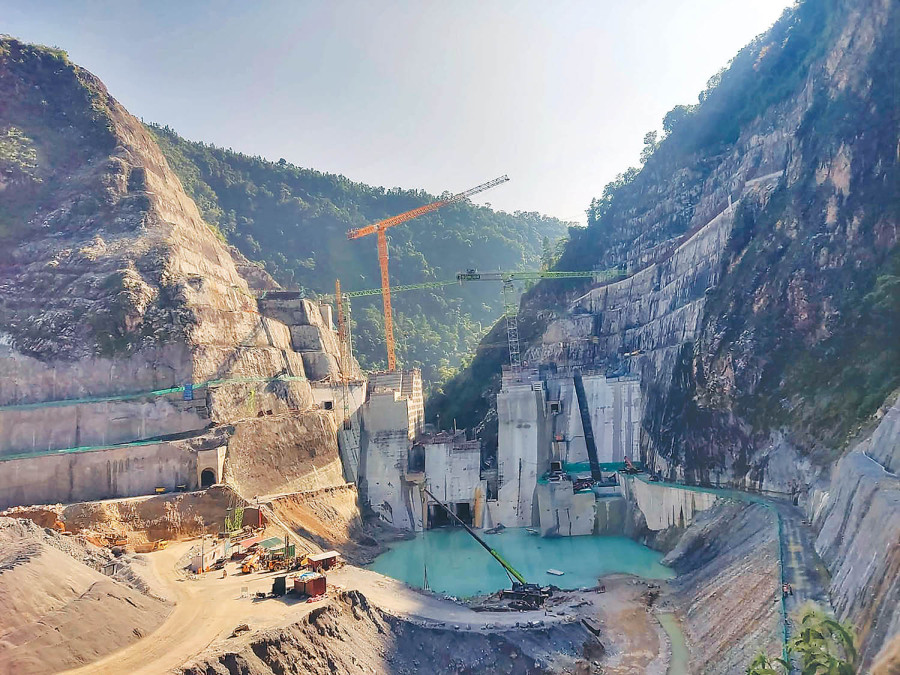
The government is considering requiring hydropower projects to achieve at least 50 percent physical progress before they can issue shares to the public.
The provision is included in the draft of the “Ordinance to Amend Some Nepal Acts Related to Investment and Infrastructure, 2026”. However, this remains only a draft, and the government has yet to decide whether to introduce the changes through an ordinance or via a bill in Parliament.
The draft proposes amending the Securities Act, 2007, alongside other investment and infrastructure-related laws, to formally establish the 50 percent physical progress threshold for hydropower companies seeking to issue initial public offerings (IPOs). While this requirement already exists under the “Directive on Prior Approval and Regulation for Public Share Issuance of Electricity Companies”, issued by the Electricity Regulatory Commission (ERC), it was not included in the Securities Act or its regulations.
Section 4, Sub-section (5) of the directive mandates that hydropower projects under construction achieve at least 50 percent physical progress before issuing shares. Incorporating the rule directly into the Act will make it harder to change, as any amendment would require parliamentary approval, whereas a directive can be revised by the concerned regulatory body.
Investors are divided over the proposed amendment. Keshav Koirala, a share investor, said allowing projects to issue IPOs after completing only 50 percent of construction would negatively affect the stock market.
“Hydropower companies should be permitted to issue shares only after they begin generating electricity,” he said.
Investors’ concerns also stem from a separate draft directive recently published by the Securities Board of Nepal (Sebon) on general eligibility criteria for public offerings. It proposes requiring companies to have a track record of continuous business operations before issuing shares, though it allows for different standards across sectors.
Earlier, a high-level commission chaired by former Finance Minister Rameshore Khanal had also recommended that hydropower companies be allowed to issue IPOs only after they begin generating electricity.
Developers, however, have opposed the proposal, arguing that it would restrict their access to capital at the stage when they need it most.
Hydropower companies require substantial funding in the early stages of project development, said Ganesh Karki, former president of the Independent Power Producers’ Association, Nepal (IPPAN). He argued that preventing them from raising capital through IPOs at this stage would be misplaced.
Karki said the government should instead strengthen oversight of construction processes and ensure that investors’ funds are protected even after a company receives approval to issue shares.
Share investor and analyst Subas Chandra Dhungana said applying the same standard to all hydropower projects would be inappropriate.
“Some large projects take years to build. Requiring them to finish the remaining 50 percent of construction after receiving approval could take several more years and drive up project costs,” he said, adding that different projects should be subject to different criteria.
Dhungana said companies should not be barred from issuing IPOs simply because they have yet to begin generation. Instead, eligibility rules should take into account factors such as a project’s generation capacity and the deadline for starting production.
A study committee coordinated by Phanindra Gautam, a former director of the Securities Board, had also recommended allowing hydropower companies to issue shares only after completing at least 50 percent of physical construction.
The committee’s report, titled Study on the Existing Shareholding Structure of Listed Hydropower Companies and Its Implications , found that the conversion of most promoter shares into ordinary shares immediately after the lock-in period expired had created operational difficulties for listed companies outside the banking, financial services and insurance sectors.
The report also cited problems at hydropower companies, including years without dividend payments, financial performance falling short of projections made at the time of their IPOs, and rising project costs. It argued that such issues warranted tighter restrictions on IPOs by companies that had yet to begin electricity generation.
Other proposed requirements for hydropower IPOs
The draft amendment also proposes requiring hydropower companies to:
Have their construction progress verified by an independent and qualified technical evaluator.
Disclose total project costs, outstanding construction work, additional funding requirements and confirmed sources of finance.
Clearly outline construction progress, potential delays, cost overruns and other major risks in the prospectus.
Disclose the status of power purchase agreements, generation licences and other necessary regulatory approvals.
Provide a clear plan for how proceeds from the public offering will be used.
State the estimated project completion date and when commercial electricity generation is expected to begin.
Ensure that proceeds from the IPO are spent on the approved purposes of the project.
Meet other requirements set by the Securities Board of Nepal to protect investors.
Khanal works in the economics bureau of Kantipur Media Group and writes on the stock market, banking and investment.