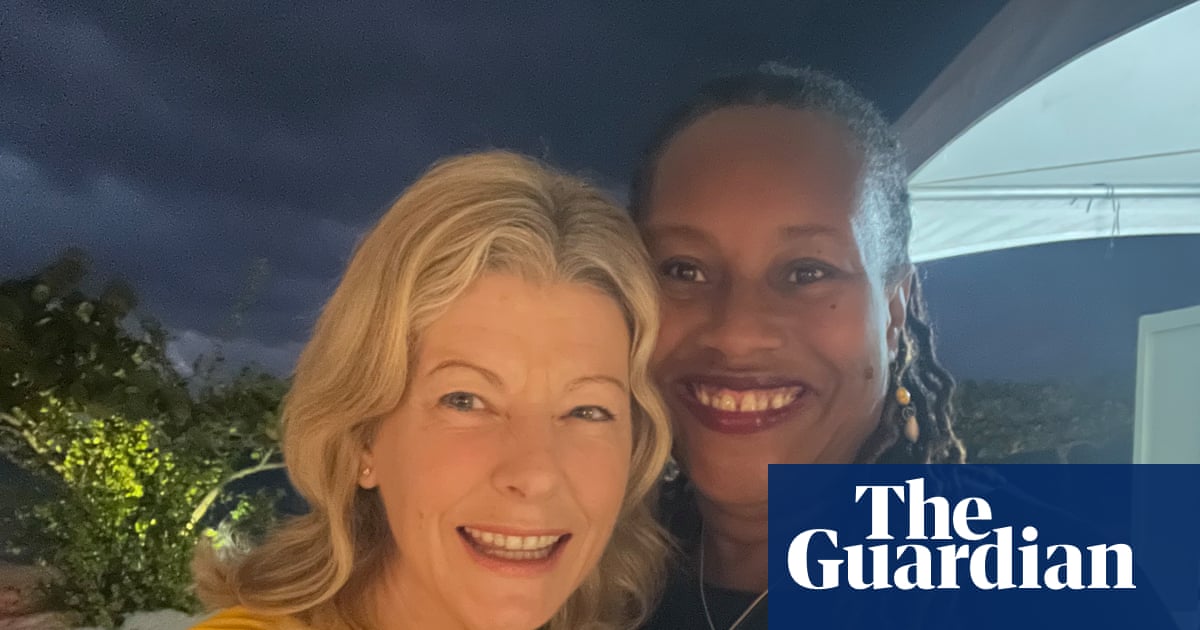

When the Grenadian historian Nicole Phillip opened an email from the then BBC journalist Laura Trevelyan in 2022, she uncovered a connection that stretched back centuries.
Their ancestors had stood on opposite sides of enslavement in Grenada: Phillip’s among Africans forcibly taken from their homes and enslaved, Trevelyan’s among the British families who profited from a system that inflicted unspeakable cruelty and inhumanity on generations of enslaved Africans.
That email sparked a journey of acknowledgment, reconciliation and repair that Phillip and Trevelyan say powerfully illustrates how slavery reparations can work in practice. Their new book, Entangled Past , outlines that journey and argues that their experience can offer a model for others.
The book was published in the same week that the UK prime minister, Andy Burnham, said he was open to a formal British apology while ruling out financial reparations, and announced that Britain would enter a structured dialogue with the Caribbean, which is due to take place over the next year.
It describes the Trevelyan apology , the first of its kind in the British Caribbean, as “a concrete example of what can be achieved, when descendants of the enslaved and descendants of enslavers sit down together and ask how to confront the past and work towards a better future”.
Speaking to the Guardian, Trevelyan recounts how she first discovered her family’s involvement in enslavement when a cousin she had never met emailed her to say their ancestors had been identified as enslavers in a University College London database .
Her own research later revealed that Trevelyans had held shares in plantations in Grenada and enslaved more than 1,000 people. They were also compensated when enslavement was abolished.
“For me, as a journalist, it was just really a fascinating and absorbing story, because this is, right there, Britain’s hidden past. There’s Britain sweeping slavery under the carpet, and there’s our family part of it,” she says.
Six years on, Trevelyan was sending an email to Phillip.
“With some trepidation, I wrote to her saying that I was a descendant of absentee enslavers in Grenada and I’d like to talk to her about this because she’s both a historian and vice-chair of the reparations committee.
“And then I pressed send and I thought, what on earth is she going to think of this? I was a little bit anxious and I was pacing around.”
But in Grenada, Phillip was excited to receive it. “I wrote her back immediately. And I said, there is a big smile on my face. You are my favourite BBC journalist,” she says.
Phillip grew up surrounded by relics of Grenada’s colonial past, including plantation houses, mills and artefacts collected by her father. As a young adult, she looked out from her veranda at Beausejour plantation house and wondered about the secrets it held. She never imagined that one day she would visit the house with Trevelyan, a descendant of the family that once part-owned it.
But the journey between that first contact and the bond they now share was anything but comfortable or smooth.
Trevelyan described tough conversations with her family: “There were family members who disagreed entirely with the idea of apologising, feeling that it was nothing to do with them, all a long time ago, why dig up the past, and no good could come of it. Some worried about being sued, saying there had to be a good reason why Britain’s government had never apologised for slavery.”
Entangled Past does not shy away from uncomfortable aspects of the experience. In it, Trevelyan describes arriving in Grenada in 2023 for the apology feeling “extremely anxious and trepidatious”, and being “immediately alarmed” when the driver who collected her from the airport revealed why he had not displayed her name. “There’s a Rasta fellow on the radio denouncing your apology,” he told her, “and my wife doesn’t want any trouble.”
Trevelyan recalls being advised to expect the unexpected: people were still angry about enslavement and, as a descendant of an enslaver, she was putting a “face on enslavers”.
“And I thought that phrase, the gale is unavoidable, just really summed it up … People have every right to express their views in whatever way they wish, because it’s a complicated subject,” she says.
The day of the apology, Phillip says, was defined by protest and praise for the Trevelyans.
In their book, Phillip recounts arriving at the ceremony “purposefully adorned in the purple robes of my ancestors”, only to be greeted by Rastafarian protesters waving placards to the beat of drums. Some read: “Why sell us out again?”, “Stay focus on reparations not the sideshow” and “No house slave cannot negotiate for the Rastaman”.
Arley Gill, the chair of the Grenada reparations commission, was involved, alongside the Caribbean Community Reparations Commission, in discussions with the family. He recalls protesters arguing that the Trevelyans’ offer of £100,000 was insufficient.
“Now our position, of course, is that £100,000 is a drop in the ocean,” he says. “But … we really don’t expect individual families to pay for all of the sins of the British empire.” But he said he believed that following the 10-point plan for reparations set out by the Caribbean community (Caricom) with regards to investment in education and health, it was a step in the right direction.
The £100,000 payment from Laura Trevelyan, with the Trevelyan Grenada Reparations Fund subsequently established by the wider family, is helping fund university education for Grenadian students.
Phillip says the benefits reach beyond individual recipients, who come from parishes where the Trevelyans part-owned sugar plantations.
“For these students, they are the first in their family to have a university degree,” she says, adding that many come from struggling households where women are the breadwinners.
“So it’s not just the person, it’s their family and their extended family, and by extension, the community that benefits when one person gets that opportunity to advance their education.”
Gill believes the process that preceded the payment offers lessons for the wider reparations movement. The dialogue, he says, was conducted on the basis of mutual respect. The Trevelyan family, he adds, were “not talking down to us”.
“So yes, I would say in short that that model is a workable model for families and institutions having a structured conversation with the ancestors of the enslaved.”
For Phillip, however painful and complicated the process may be, conversation remains essential. “Not talking about something doesn’t make it go away. It doesn’t help with healing.” Conversation, she says, is “a way of reconciling with the past and trying to find ways to move forward”.