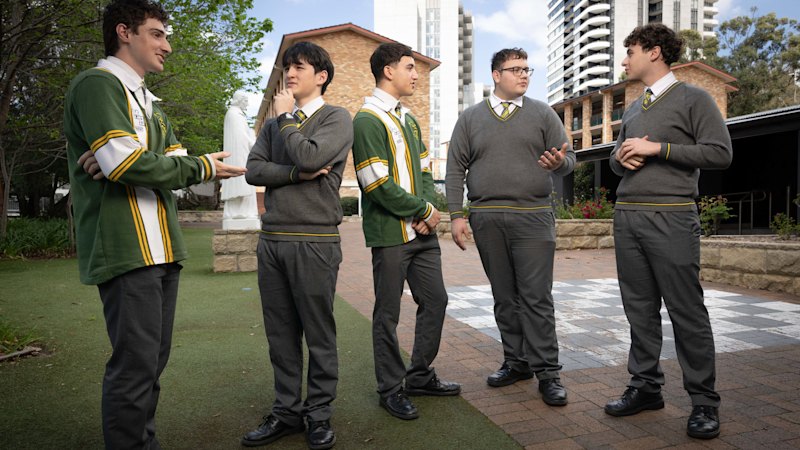
What does a 2000-year-old public notice banning the dumping of human faeces near water fountains reveal about political life in Pompeii and Herculaneum? It’s the four-mark question that had Parramatta Marist high school student Daniel Barletta grinning on Friday as he tackled his ancient history HSC exam.
“There’s something comedic about people dumping waste in the street ... how they are declaring that you must stop doing this because it’s such a problem,” the 18-year-old said. “It brings a smile to your face.”
Over three hours, 7755 students tackled short-answer questions about Pompeii and Herculaneum, as well as three other in-depth topics of choice. At Parramatta Marist, students studied Sparta, Hatshepsut of Egypt, and New Kingdom Egypt to the Death of Thutmose IV.
The students said a string of coincidences left them in good shape.
At the end of year 11, the class visited a Pompeii exhibition in Canberra. As they stared at the plaster casts of the voids left by victims killed in the 79AD eruption of Mt Vesuvius, they had no idea that, almost a year later, the exhibition would feature in their HSC exam.
“It was pretty neat, it goes full circle,” student Lachlan Doan-Vance said. The exam question: Should the display of human remains from Pompeii and Herculaneum be stopped? It referenced an article written about the Canberra exhibition. Doan-Vance said it helped to have seen the exhibition in person.
“I talked about the source and how while it does still show the horrific remains, [the museum] partially obscured them,” he said. “It brought to this greater idea of while there is an inherent human dignity to each of the victims of Pompeii, there’s also value in their study, in that they should be preserved.”
Barletta agreed: “Witnessing firsthand how they display [remains] with the warnings on the walls, and putting them in a separate area because it can be disturbing to some to see ... ethically we have come a long way.”
Ancient-history teacher Grace Harley described the exam as very fair and was excited about the Canberra coincidence.
“It’s such an interesting subject, but a hard subject. I love it,” she said. She pitches ancient history as a “puzzle with less of the pieces”.
“With modern [history] you have all the pieces – more than you want and that can be overwhelming – whereas with ancient, a lot of it comes from interpretation and analysis,” Harley said. “Where does the source come from? Why are there gaps in the sources? That can be really fun for kids to fill the blanks in.”
Asked why they enjoyed studying ancient history, the students pointed to their teacher, Harley.
“Whenever we had a substitute [teacher], it never felt the same. We didn’t have that charismatic character in the room teaching us,” Barletta said.
The HSC continues until November 5.
You have reached your maximum number of saved items.
Remove items from your saved list to add more.
You've used all of your gift articles. 3 more will become available on the 1st of every month.