
Angela Nguyen, a senior at Stanford University, has been on a mission to make sure her school doesn’t use automated license plate readers, like those made by Flock Safety, for mass surveillance. The 21-year-old computer science major helped collect hundreds of signatures earlier this year from students, faculty, alumni and residents to demand that Stanford drop its current Flock contract and codify safeguards for similar tech tools the school may use in the future. The fear, Nguyen says, is that these cameras, which show where a vehicle was at a certain point in time, can be exploited to victimize vulnerable people.
Stanford cut ties with Flock this summer, and it’s not alone. The privacy reckoning over the company’s surveillance cameras is gaining momentum at schools nationwide. Since April, at least ten university campuses across seven states, have scrapped contracts with Flock. That includes Cornell University , Penn State University , Elgin Community College , Emory University , Binghamton University , Kent State University and the University of Wisconsin’s Madison , Milwaukee and Oshkosh branches. Last week, the University of Buffalo announced an indefinite pause on its plans for a 60-day pilot program.
Elgin Community College tried, unsuccessfully, to cancel its Flock contract before it expired in April. School officials said they resorted to placing black plastic trash bags over the cameras “out of an abundance of caution” until the company removed the cameras after the agreement lapsed.
A few schools – Appalachian State University and the University of North Carolina’s (UNC) Charlotte and Chapel Hill campuses – have kept Flock contracts but restricted national access to the cameras’ records. UNC Charlotte made the change after local news outlet WBTV found that the Houston police department had searched the school’s Flock camera network more than any other agency between March and May 2026: a total of 183,000 times.
Schools that haven’t yet restricted what agencies can access Flock or dropped contracts are feeling the pressure. At the University of Florida and Florida State University , activists have turned to protests, online campaigns and petitions to express their discontent. The state of Florida recently banned Flock cameras and other license plate readers from its highways, but those laws don’t extend to private property or local rights-of-way.
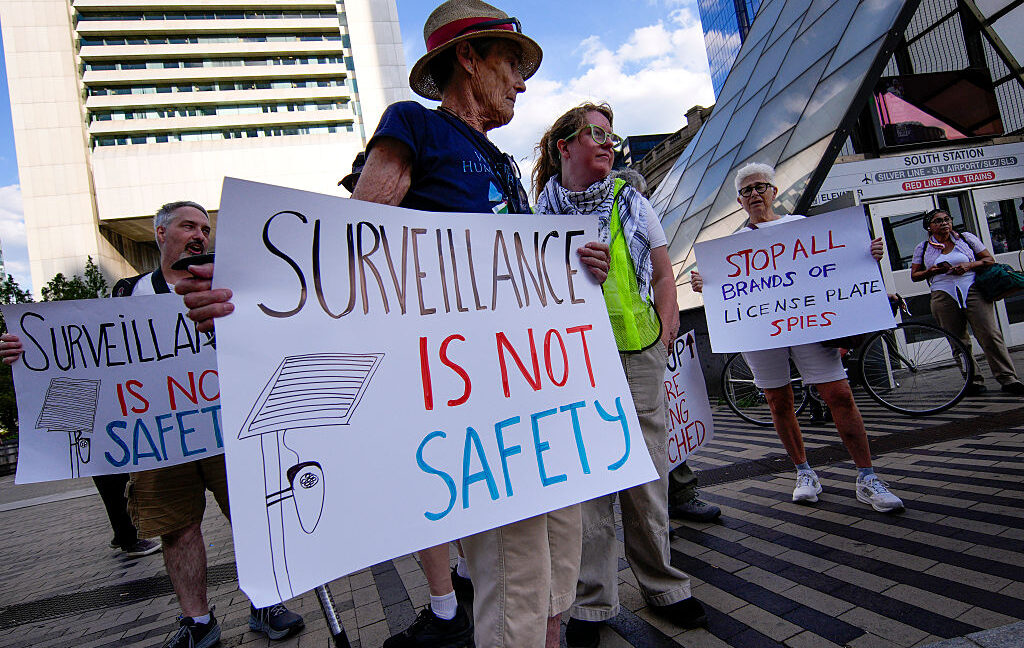
The uproar on campuses reflects a broader uprising. This year, dozens of cities have deactivated, canceled or rejected Flock contracts. Vigilantes have damaged and destroyed the devices to the delight of their social media followers.
Flock Safety said in an emailed statement that its cameras help solve crimes and increase public safety by giving campus police credible leads. The company highlighted cases in which local law enforcement said Flock cameras helped track down a shooter at Brown University, arrest a person who shot a gun in the parking lot of a high school in Colorado and find a suspect in an investigation about more than $100,000 in stolen equipment from an on-campus construction site at UNC Charlotte.
“We understand that schools and universities must evaluate public safety technology, and we respect each institution’s authority to make those decisions, but taking away these tools could impact the safety of students,” the company said in an emailed statement.
Flock also denies that its cameras fuel mass surveillance and that it partners with federal immigration authorities, although news reports have documented indirect ways that local police have used the network to help US Immigration and Customs Enforcement . This summer, Flock also introduced updated policies around auditing, as well as data retention and sharing.
Student protesters are confronting many of the same challenges organizers in cities that have dropped Flock have faced: most commonly, a pivot to license plate readers from other vendors .
Stanford is already installing replacement automatic license plate recognition (ALPRs) from the Canadian company, Genetec. Nguyen, the Stanford student, still counts the move away from Flock as a win but says there’s still work to be done, as student organizers’ goal is “to prevent any possibility of mass surveillance on campus”. She’s speaking with the university’s transportation department to push for transparency around who can access the data captured by the cameras.
On the opposite coast, in New York state, Binghamton University has announced a switch to Axon , an even larger police tech company, after dropping Flock. Claims of police abuse have not dogged Axon’s cameras in the same way as Flock’s , although many activists still have data privacy concerns.
Hatim Husainy, a junior at Binghamton who canvassed in dining halls to get more supporters for a petition to drop Flock, said removing the company was a “huge win” but added that students’ goals are to push the university to end the use of any ALPRs.
At UW-Madison, Bradley Keenan, who protested Flock on campus, has said the devices are “a signal from the police and university that everybody is under suspicion”. But the sophomore didn’t celebrate when he learned that his university had dropped its contract with the company because UW-Madison indicated that it would be immediately looking for alternatives .
Keenan said organizers have since updated their demands to push the university not to pursue a contract with any ALPR company.
Stanford did not respond to a request for comment but has said that Genetec, a Canadian company, will continue to store data on its internal servers for 30 days and that the new system is “ designed for use within a single institution ”. UW-Madison did not respond to a request for comment. A spokesperson for Binghamton University, Ryan Yarosh, said in an emailed statement that school officials have met with concerned faculty and students, and respects their “right to express their concerns”.
High schoolers are getting in on Flock activism, too.
In northern Colorado, high school senior Gabe Sayer and a friend started a petition to ban Flock cameras in the city of Loveland, and took particular issue with devices placed outside three high schools, including his own. Gabe said he first learned about Flock last year in his government class when discussing constitutional rights. His research led him to believe that the network is a dragnet that violates the fourth amendment. Sayer has been tabling outside a local grocery store to get signatures on the petition and meeting city councillors to share his views on Flock cameras.
In Georgia, two seniors at Alpharetta high school created a petition to remove Flock cameras from their campus. Aditya Manchanda and Henry Jones, who are part of their school’s Young Democratic Socialists of America chapter, made a video on TikTok about ALPRs and their petition attracted local news coverage.
“Schools should be a safe place, and we don’t feel safe,” Aditya said. “We feel our privacy being violated with the presence of these cameras.”
After gathering signatures, the duo emailed the school’s principal. “I know he wasn’t too pleased because we got media attention, and that’s not a great look,” Aditya said. The principal referred the boys to Fulton county school board members. Their emails have so far gone unanswered, so they’re planning to show up to an upcoming board meeting to relay their concerns.