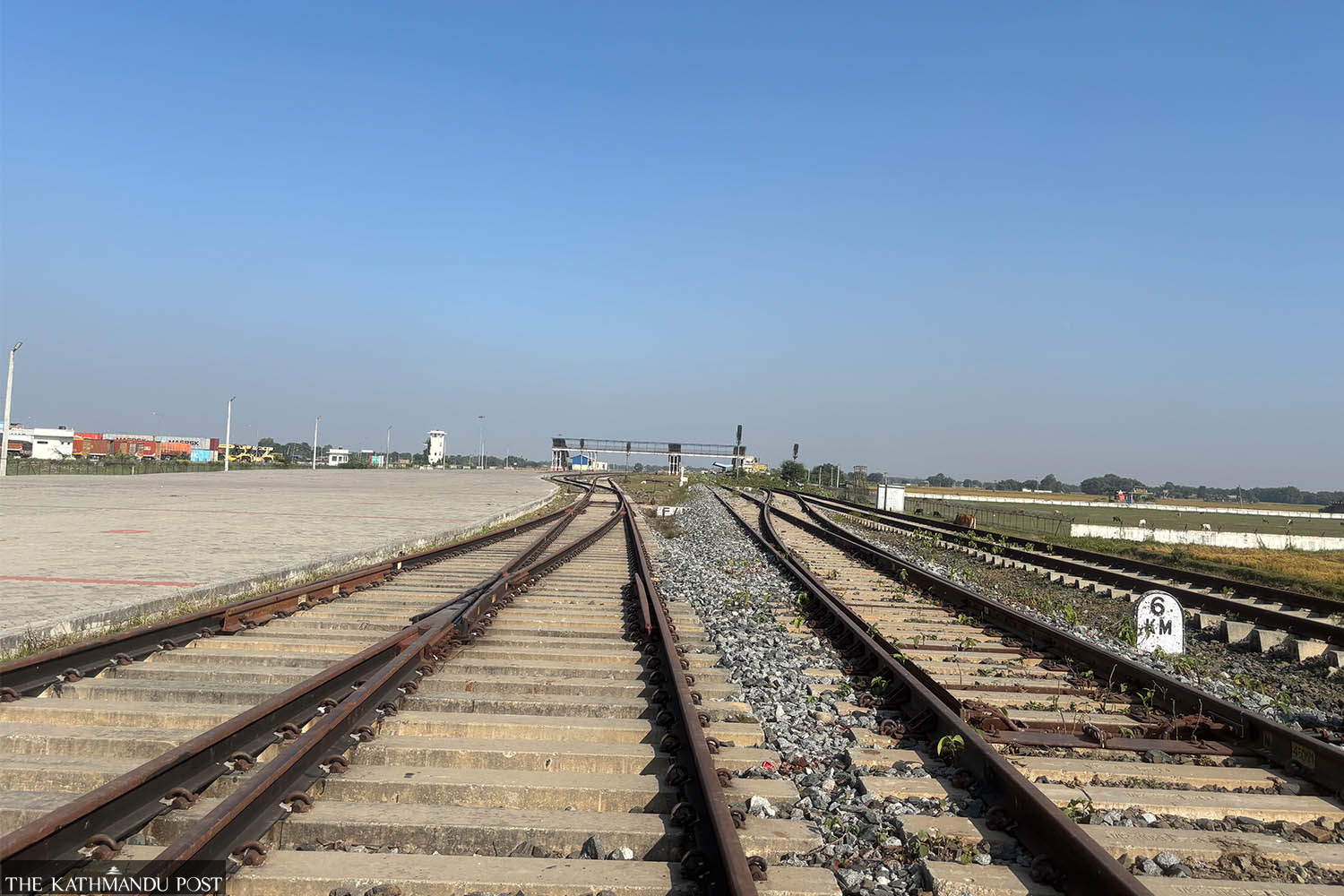
Industrialists and traders in Biratnagar have long dreamed of reducing transportation costs by importing industrial raw materials from India by rail and turning the city into a logistics hub. But the condition of the yard where goods brought by train are unloaded remains deplorable.
The yard surface has sunk, the asphalt pavement has peeled off, and roads and storage areas inside the Integrated Check Post (ICP) have deteriorated.
At a time when businesses are demanding regular cargo train services, the worsening condition of the associated infrastructure has raised questions about the usefulness of the facilities built to facilitate trade.
The 18.1-kilometre railway line connecting Bathnaha in India to Katari in Morang was built by Indian construction company IRCON. Inaugurated in May 2023, the railway currently operates from Bathnaha to the ICP in Biratnagar.
The Nepal Customs Yard, built alongside the railway line, has also been handed over to Nepal.
However, in the three years since its inauguration, cargo trains have arrived in Biratnagar only five times. According to TransNepal Freight Services Pvt Ltd, the company awarded the contract to operate the ICP, the first cargo train arrived on June 20, 2026. It was followed by arrivals on August 13, September 10, September 27 and, most recently, on November 7.
After the railway line came into operation, industrialists had expected it to ease congestion on roads, reduce the cost of importing raw materials, and ensure smoother supplies of goods.
However, despite the availability of a facility capable of transporting large volumes of cargo by rail, the railway’s potential has not been fully realised because the condition of the associated yards, platforms, and roads has not improved, said Anil Kumar Sah, president of the Morang Merchants’ Association.
“About one kilometre of the railway yard used to unload goods from trains is damaged,” Sah said. “The weight of heavy equipment [cranes] used to unload containers and move them from one place to another has caused the yard surface to sink and crack, with potholes forming in several places.”
In some sections, the asphalt pavement has peeled off. Sah said operating heavy equipment had become difficult under these conditions, creating problems in handling and transporting containers and cargo.
The infrastructure was built by Indian company IRCON with a grant from the Indian government. “Looking at the condition of the yard, it clearly needs immediate repairs,” said Umesh Shrestha, chief of the Biratnagar Customs Office.
“It appears there may have been negligence during construction itself.”
With the structures linked to the railway line not in a condition suitable for efficient operation, plans to expand freight transportation by rail have failed to gain the expected momentum. Building a railway line alone cannot make the freight transportation system effective; the condition of the yard, platforms, storage areas, and internal roads must also be improved, Sah said.
Industrialists and traders have also questioned the materials used in constructing the yard and the methods employed. They allege that the structures have deteriorated prematurely because the surface was laid without adequate groundwork and quality materials were not used.
They say that infrastructure designed to withstand the weight of heavy equipment, containers, and cargo must be built with sufficient load-bearing capacity, but the current condition has raised doubts about the quality of construction.
Although the deterioration has made repairs necessary, there is no clarity over who will bear the costs or which agency is responsible. Since the management of the ICP and Nepal Customs Yard involves various government agencies and the operating company, responsibility for structural maintenance remains unclear.
The Nepal Transit and Warehousing Company Limited is preparing a plan to repair the railway yard and other areas, said its chief executive officer, Prakash Prasad Pokharel. “A budget of Rs300 million has been allocated, and we are planning to begin repairs soon,“ he said during a discussion with business representatives.
Along with the railway yard, the container storage area, the platforms used to store goods transported in sacks, and roads inside the ICP have also deteriorated.
The poor condition of facilities used for loading and unloading cargo, storage, and customs clearance could affect the entire freight management system.
Businesspeople are concerned that further deterioration could increase the time required to handle goods, make it difficult to operate equipment and disrupt transportation.
A parliamentary committee recently conducted an on-site inspection of the ICP infrastructure and directed the concerned agencies to make arrangements for repairs.
However, no improvement work has moved forward despite the directive. Sah said the indifference of government agencies towards infrastructure improvements and confusion over management responsibilities had increased the risk of facilities built to facilitate trade becoming unusable.
Finance Minister Swarnim Wagle also conducted an on-site inspection of the area on Friday.
Under the concept of developing Biratnagar into a logistics hub, the railway line, ICP, customs facilities, warehouses, road network, and cargo management system are all complementary components.
Although the facility to bring goods by rail is available, the transportation system cannot function effectively if the infrastructure needed to unload, store, and deliver those goods to their destinations remains inadequate, said industrialist Amit Sarada.
Industrialists and traders say regular cargo train operations, physical infrastructure improvements, and an efficient management system are essential to expanding freight transportation by rail.
Businesses expect rail transportation to reduce both costs and delivery times. However, they say it will be difficult to achieve returns on the investment if the infrastructure already built is not properly maintained and repaired on time.
Anil Sarada, senior vice-president of the Morang Merchants’ Association, said priority should be given to repairing and maintaining the yard, platforms, storage areas, and roads alongside the demand for regular cargo train services.
“If the infrastructure of the ICP, which was built to facilitate trade, continues to deteriorate, the plan to develop Biratnagar into a regional trade hub could also be undermined,” Sarada said. “That would be a loss for the entire country.”
Parbat Portel is the Jhapa correspondent for Kantipur Publications.