Millions of rupees go into making films, many of them only to get consigned in the dustbin of cultural history. Most of Nepali films endure this fate every year, fail as they do to follow the basics of filmmaking and storytelling. Lately, screenwriting has appeared as one of Nepali cinema’s biggest headaches.
The new ‘Jalaki’, directed by Ashok Thapa Magar and released last Friday, is a case in point. The film has little by way of a compelling story. It instead strings together one incident after another without giving audiences a convincing reason to care about what’s going on on the screen.
Four central characters—Lisara, Lasim, Alok and Asmita—are young people navigating love, relationships and the problems life throws at them. But their stories never develop into a cohesive narrative. Their relationships lack emotional depth, their choices rarely make sense, and there is little to explain why they come together or drift apart. They come from different economic backgrounds, but class differences never become a meaningful source of conflict.
The film struggles to move beyond the routine, with the same situations repeatedly played out. The main characters spend much of their time wandering around the shores of Phewa Lake, but these scenes do little to move the story forward. The narrative feels stuck. It goes around in circles rather than gathering momentum. Repeated scenes can work when they reveal something new about the characters or show how their circumstances are changing. Here, however, there is little development to give them meaning. The film also keeps shifting between different characters’ perspectives without establishing whose story it is primarily trying to tell. The result is a narrative that feels unsure of its own priorities.
Several scenes could have been removed without making any difference to the story. Lasim’s childhood illness, for instance, has no apparent bearing on the events that follow. The college peon’s presence and antics add little to the narrative, while a sequence involving a student cheating in an exam serves mainly to slow things down. These moments feel like attempts to inject comedy into a film that does not know quite what to do with its characters.
The flashbacks involving Lisara and Lasim take up a considerable portion of the film, but their relationship with the present-day story remains poorly defined. Lasim’s past, in particular, does little to illuminate his current relationship with Lisara. As a result, audiences have little reason to become emotionally invested in the people appearing in these sequences. Lisara’s difficult childhood and her strained relationship with her mother do have some bearing on her present, but the film spends so much time on these episodes that their eventual purpose becomes unclear.
In one flashback, Lasim’s father is shown building a ‘jalaki’, a traditional stone pillar erected in the Magar community to commemorate someone. Associated with faith, love and remembrance, the structure carries considerable cultural and emotional significance. Given that it provides the film with its title, one would expect it to have a deeper connection to the story. Regrettably, however, its significance is barely explored.
The central romance is equally unconvincing. The film never shows how Lisara and Lasim gradually fall in love. Their relationship jumps from its initial stages to an apparently deep attachment without allowing audiences to see how that intimacy develops. Their actions and decisions often feel dictated by the demands of the plot rather than by any recognisable human behaviour.
The treatment of cancer is another major weakness. The film presents the illness and its consequences in ways that are difficult to believe. Doctors’ responses and the events surrounding the patient’s treatment lack credibility, while basic hospital protocols appear to have been overlooked. Such a casual approach to portraying a serious illness risks giving audiences a misleading impression of the disease and the way it is treated.
The sequence immediately before the climax is perhaps the film’s most frustrating moment. It relies on an implausibly dramatic turn of events, the kind of contrivance that Nepali filmmakers seem reluctant to leave behind.
The background score is similarly heavy-handed. It often feels as though the music is attempting to do the emotional work that the story itself has failed to do. The director repeatedly pushes the characters into situations of suffering, but the soundtrack does not always sit comfortably with the emotional arc of the narrative. Instead of deepening the audience’s engagement, it often feels like an attempt to manufacture tears.
The dialogue offers little relief. Characters repeatedly say “Forgive me”, but the film rarely gives them convincing reasons to apologise or seek forgiveness. The lines often feel disconnected from both the characters’ emotional states and the situations they are in. Almost everything is spelt out through dialogue, leaving little room for subtext. Characters tell audiences what they feel instead of allowing those feelings to emerge through their actions, silences or interactions.
Weak writing also takes a toll on the supporting characters. Lisara’s aunt, for instance, is portrayed as an intensely negative figure without any convincing explanation for her behaviour. Her daughter is equally thinly sketched. Lisara's parents, too, feel like familiar stock characters borrowed from conventional Nepali melodramas.
Ironically, the supporting cast often comes across as more convincing than the leads. Lisara's uncle and aunt, Alok's parents and Lasim's parents all deliver natural performances. Even the college peon and the student who cheats in the exam, despite their seemingly unnecessary roles, manage to make their characters believable. Asmita's mother and Lisara's parents are also more convincing on screen than the four central characters. The supporting actors bring a degree of naturalness that the leads struggle to match.
Upasana Singh Thakuri, who plays Lisara, spends much of the film looking unhappy. The film offers little explanation for her persistent gloom. Interestingly, she is more convincing when Lisara falls in love, as her expressions then convey genuine warmth. Her dialogue, however, lacks the regional flavour of the village Lisara supposedly comes from. Her delivery also frequently sounds forced.
The performances of Sonam Topden, Saraha Hangma Limbu and Astittwa Bhattchan are similarly uneven. Their portrayals often feel theatrical, with happiness and sadness rarely registering convincingly through their expressions or body language. The emotions remain on the surface rather than drawing audiences into the characters' experiences.
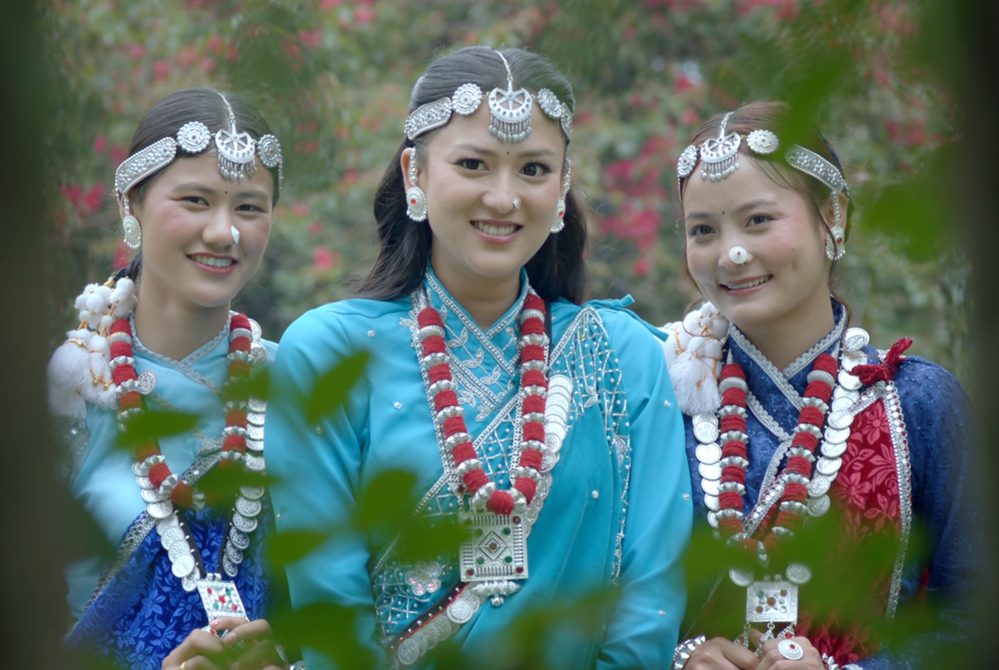
Where ‘Jalaki’ does considerably better is in its visual storytelling. The cinematography is beautiful, particularly in the scenes around Pokhara's lakeside and the surrounding villages. The film captures the traditions of the Magar community, the jalaki and the hill landscape in expansive, evocative frames. The camera work also gives the flashback sequences considerable visual appeal.
But beautiful images cannot compensate for a story that never finds its footing. By recycling a familiar romance and relying on conventional storytelling, ‘Jalaki’ fails to make itself memorable, much like the meaning suggested by its title.
Samarpan Shree is an Arts and Culture Correspondent for Kantipur Media Group, covering film, theatre, music, and contemporary social issues.