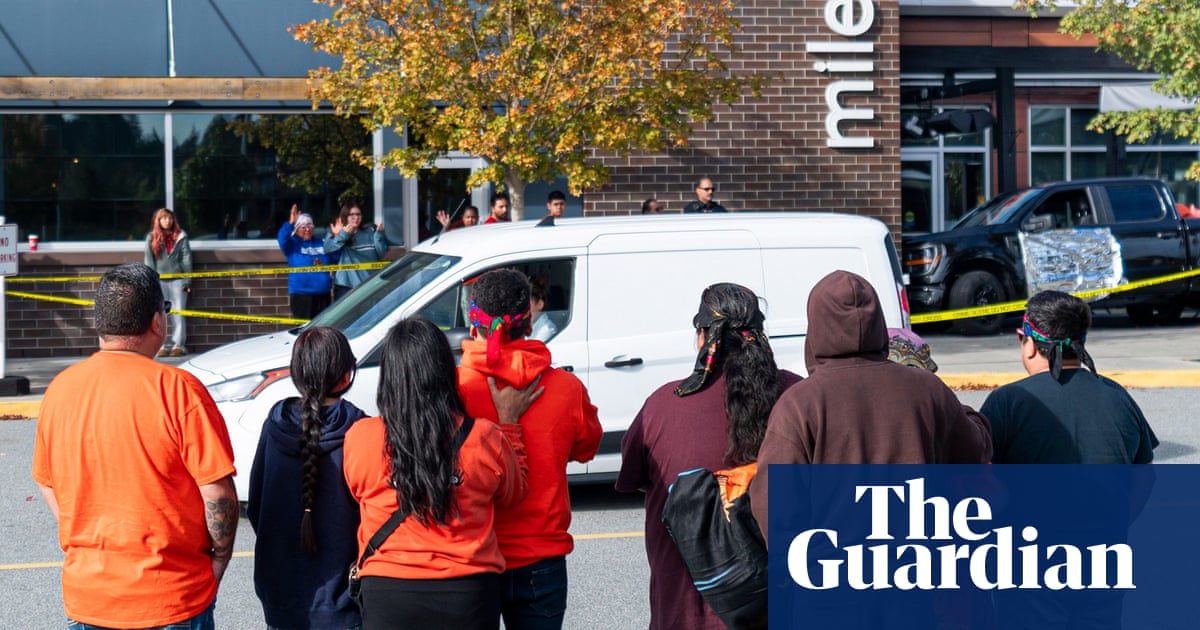


It was a cool, overcast morning in late September when members of the Tsawwassen First Nation gathered outside a shopping mall near Vancouver.
Two hand-carved house posts, carrying the history and identity of the community, were to be raised in a ceremony marking the National Day for Truth and Reconciliation.
Earl “Junior” Holland was among the people who arrived early to the Tsawwassen Mills mall, joining his wife and 12-year-old daughter, who had been asked to brush the posts with cedar and bless them.
“It was a very special day for her and the family,” said Holland. “This would be the first cultural work she was going to do for the community as a youth.”
She would also be under the watchful, proud gaze of her grandmother, elder Virginia Splockton, a fixture of Tsawwassen gatherings who often provided blessings and songs for major events.
“If you knew her, chances are she had cooked for you,” said Holland. “She was immensely proud of her community and family. She was someone just overflowing with love and kindness.”
Roughly 800ft away, Manpreet Singh, who knew nothing of the First Nations gathering, had arrived at the mall with his family, including his 11-month old daughter. He had just stepped out of his vehicle when a black pickup, towing an equipment trailer, backed into it, crunching it against another parked car.
Singh thought it was an accident and tried to wave down the truck, he told the local Sher-e-Punjab Radio station . But the driver, who briefly made eye contact with him, backed the trailer once more into Singh’s vehicle before driving off. Terrified, Singh called his cousin and then 911.
Less than 15 minutes later, the preparations for the First Nations pole-raising were shattered as a black truck towing an equipment trailer breached the curb, hit the unsuspecting group and eventually smashed into a wall.
Splockton was killed. So was wilapiya (also known as Barb Joe), a key knowledge keeper of the Tsawwassen First Nation. Two other people were rushed to hospital by helicopter, where one would die from her injuries.
Later that day, police issued a news release saying that “preliminary information” from the scene suggested the driver had experienced a medical emergency.
The incident was “not related” to the Truth and Reconciliation Walk, they said, adding: “There is no ongoing risk to public safety.”
The driver was brought to the hospital and released later that day. No charges have been filed.
In the weeks since, what was meant to be a celebration of identity and resilience has instead become a maddening search for answers.
Delta police did not return multiple phone messages or to a contact by email to discuss the incident, the investigation, or a timeline of the police response. Mike Whiteley, staff sergeant of the department’s media relations team, said in a statement that police “are not in a position to provide additional details beyond what has already been released publicly”.
Holland said the moments leading up to the crash have weighed heavily on his family.
He recalled his excitement and pride at his daughter’s participation in the event. But then he saw the pickup truck approaching.
“As he veered towards us, fear set in. I worried something bad might happen.”
He rushed his wife and daughter inside the mall to safety.
Then he returned outside to see crumpled bodies. An ambulance dispatcher directed him how to triage the wounded, including Splockton.
“It was really traumatizing because I saw my mother-in-law lying on the ground. At that moment she was breathing. She was alive. I wanted to stay with her. But they told me I needed to go to the next person and check on them. It was so hard to leave her,” he said. “But we needed to see who we could save.”
Neither the crowd nor emergency crew could save wilapiya, a matriarch who had spent years working to protect and pass on Tsawwassen First Nation language and traditions. Community members drummed and sang as the bodies of the two women were moved into a coroner’s vehicle.
A third woman, Gwenyth Brigid Dwyn, died days later in the hospital. Kevin Li, hired by the First Nation to record video footage, spent nearly a week in the intensive care unit after suffering extensive injuries .
But even as emergency crews tended to the injured, police were beginning to shape the public account of what had happened.
According to Mandalena Lewis, an independent journalist who runs She(Bites) Media and first reported many of the events, Delta police first notified the public on social media roughly an hour after the incident, describing it as a “collision” that “appear[ed]” to involve a medical emergency.
In a press release, they said the incident was “not related” to the Truth and Reconciliation Walk.
What they did not mention was Singh’s vehicle also being hit by what he said was a black truck towing an equipment trailer minutes earlier.
While police did not say whether they knew about the earlier collision when they issued their first public statement, Singh said it came roughly 30 minutes after he spoke to them about it.
Holland said his experience that morning clashes with the details later released by police. “It feels they had not even started an investigation before they basically concluded there was no investigation,” said Holland.
For some in the Tsawwassen community, the police statements evoked another incident in British Columbia in 2022, when a man named Richard Albert Manuel drove his pickup truck into a crowd marching for residential school survivors.
The Royal Canadian Mounted Police (RCMP) initially said the incident did not appear to be targeted, and that Manuel striking marchers with his car did not have “anything specifically to do with the people marching or their cause”.
Instead, after interviewing the driver two days later, the RCMP said Manuel had been “impatient” and trying to get around the group “despite the safety risk”.
After community members compiled evidence and brought it to the police, including what the judge concluded were “racist slurs and derogatory remarks” he made, he was charged and later convicted in September 2024 of “dangerous operation of a motor vehicle” and served a nine-month sentence in the community.
Holland said he finds that incident impossible to ignore when considering the police response to the tragedy at the mall.
“It just feels like it’s repeated over and over again. Our people are constantly having to fight for ourselves,”he said.
Fifteen days after the incident, on 14 October, police issued another statement , saying the “medical event” possibility was still under investigation, but that “if the evidence establishes criminality”, then charges would be laid. They said investigators were “examining the movements of the involved vehicle on the Tsawwassen Mills property before the pedestrians were struck, including an earlier collision” and that they had “not reached any final conclusions regarding the cause of the collisions”.
“Investigators are working through a significant amount of information, and it is important that we not reach conclusions before that work is complete,” Whiteley added in the statement.
Holland said some of the affected families went to the police the following day out of frustration and disbelief, including at the declaration that the department “continues to communicate with the affected families”. “They put out a statement that they’re talking to the families. But they had not reached out to us at all. We’ve had questions and it’s just been silence from them. We were angry they told the public they’ve been talking to us when they haven’t.”
The lack of information has prompted Tsawwassen First Nation members to assemble their own evidence, gathering eyewitness accounts and video footage.
“These families are just completely torn up, and yet they’re basically having to do all this work themselves to try and get answers,” said Lewis. As part of her investigation of the events , Lewis tracked down Singh after hearing him on local radio and was shocked to learn police had not publicly disclosed that a black truck towing an equipment trailer had already struck another vehicle nearby, twice, minutes beforehand. “I’m just dumbfounded by the way this is being handled and conveyed to the public,” she said.
In an audio recording reviewed by the Guardian, Delta’s chief constable, Harjinder Singh Sidh, said in a community meeting that the police were concerned about spreading fear. Following the deaths of 11 people in April 2025, when an SUV rammed through a street festival in Vancouver, he said officers wanted to reassure the Tsawwassen First Nation that the latest incident was not intentional and to “calm the community down”.
But members of the First Nation say that, in apparently trying to prevent panic, police instead communicated a degree of certainty about the motives of the driver. “They could have just said: ‘We are investigating.’ Why did they have to rush to say it was a medical emergency, when so many people on the ground experienced something so different?” said Holland.
The post-raising ceremony, he noted, was meant to be a moment to recognize the resilience of his people.
“This was supposed to be a day for celebration,” he said. “Now we’re terrified to attend larger events. We’re scared to stand proudly in public.”