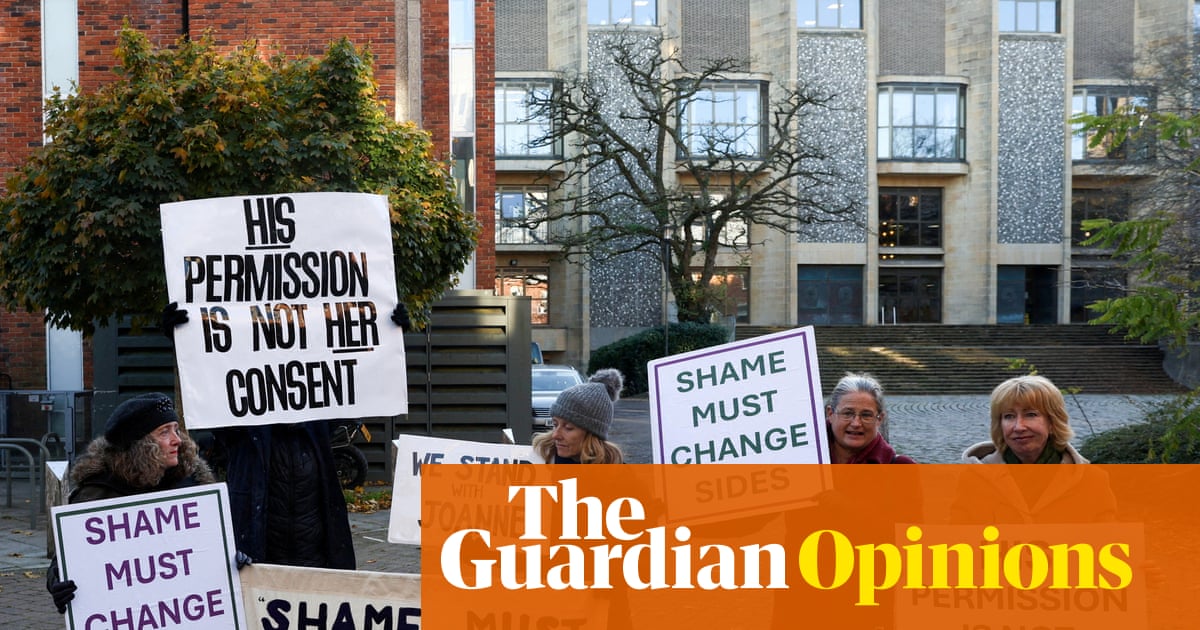
T he only thing they have in common is that they are men. Those convicted of the rape and sexual assault of Joanne Young – who was drugged by her husband, so that he could offer her unconscious body to strangers – do not come from one class or ethnic group or age cohort. Like the 50 men convicted alongside Dominique Pelicot for the serial rape of his wife, Gisèle, which this case resembles, they run the full range. Young’s oldest abuser is now 62, her youngest was 22. The four convicted on Thursday included two who were white, two who were not. Among them was a former music producer, a taxi driver and a one-time contractor for the Ministry of Defence. The only thing they have in common is that they are men.
That closes off a delusion that many reach for when confronted with heinous crimes committed against women: the claim that such appalling acts are peculiar to a specific category of man. Last week, the focus was on famous men, prompted by the rape conviction of Russell Brand and the allegations of underage grooming and predatory behaviour by David Walliams , accusations Walliams denies. There was earnest discussion of the enabling power of celebrity, how stardust blinds people from seeing what’s in front of them. Some suggested the problem was narrower still, with abuse cast as a function of the way British comedy operates, lacking a recognisable HR structure or protection for junior workers from big names with clout. In parallel, a debate began about staggering the age of consent , addressing the particular dynamics of older men who target younger women, including those who would be regarded as children by any definition except the letter of the law.
All of those are valid questions, by the way. But if, underlying them, is the consoling hope that we are facing a limited problem, one confined to, say, high-status men or those whose victims are very young, then Thursday’s verdicts should dispel it. The grimmer truth is that this problem is wider and deeper: the guilty were ordinary men, carpenters and cabbies, ready to violate a middle-aged woman who was audibly and visibly unconscious.
Even this especially shocking crime – in which a man recruits other men online to rape his sedated wife – may not be as rare as we imagine. A similar case is now being tried in Manchester and, according to Wiltshire police: “This may be a significantly under-reported crime type.”
Of course, there are specific elements and contexts that make rape and sexual abuse more possible. Just as the entertainment industry provided a hospitable environment for Brand, so Philip Young could advertise for fellow rapists thanks to online forums such as Craigslist and Reddit. The internet made it easier for him to secure sedative drugs. But these things facilitate rather than drive the impulse. They are not the heart of the matter. Which is, to state it plainly, male hatred of women.
Of course, such hatred is not universal; not every man is infected by it. But it is embedded in our world and sits deep in our culture. (After Pelicot and Young, you look again at Sleeping Beauty: what exactly did we think was going on in a story that, in its 17th-century telling , had the king discover the unmoving, unconscious body of a woman, rape and impregnate that woman, and then flee?)
In Afghanistan, the Taliban have imposed gender apartheid, prohibiting girls and women from learning, singing, taking a bus without a man or walking to the park. According to Human Rights Watch, one directive ordered the removal of windows, lest Afghan women, “imprisoned in their homes, might see the outside world”. Closer to hand, you look at the manosphere, whose leading lights delight in the degradation and humiliation of women, treating their girlfriends as, at best, unpaid domestic servants or, at worst, property and chattel. You contemplate the rates of femicide, which include three women killed every fortnight in England and Wales by a current or former partner. You look at the rape statistics, including the estimate from the Centre for Women’s Justice (CWJ) that only 15% of all rapes get reported and that, of those that do, only a tiny percentage ultimately ends in a conviction.
Women have been saying all this, loudly and clearly, for years. When cases such as Brand or Walliams or Philip Young erupt, it tends to be women who lead the debate and make the arguments, in print and on the airwaves. On one level, that’s obvious – in the same way that, say, Jewish voices are given the floor when there is a murderous attack on Jews. But it’s also incomplete. Because it misses out, and risks letting off the hook, those who have most work to do. In this case, men.
The logic of that was encapsulated well by a small sign – no more than an A4 piece of paper – held up by a woman protesting in New York earlier this year over the case of the Cornell seven : the fraternity brothers at Cornell University accused of gang-raping a female student they’d incapacitated through ketamine, and doing so over the course of seven hours. The protester’s sign carried three words that had been crossed out: Protect Your Daughters. In their place were three different words: Educate Your Sons.
This shifts responsibility to where it should lie. It honours the principle articulated so concisely by Gisèle Pelicot herself who, like Joanne Young, waived her right to anonymity, believing there was no need to hide herself since she had nothing to be ashamed of. Or, as she put it , “Shame has to change sides.”
That makes moral sense, but it might make practical sense too. Take the kind of young man susceptible to the example of Andrew Tate and his fellow denizens of the manosphere. If such a man hears a woman condemn misogyny, if they hear a woman speak of the necessity of consent, they will hear those as messages that stand in opposition to manliness. They will understand their own sexual desires as manly and restraints on those desires as their opposite, as unmanly or feminine. For a man such as this, it is perhaps only condemnation by other men, framed in terms of maleness, that will cut through.
A useful precedent could be what was, in a different era, called wife-beating. Not so long ago, the culture all but countenanced such behaviour. Think of the Beatles’ song, Run For Your Life, both its title and lyric: “Well, I’d rather see you dead, little girl / Than to be with another man”. But attitudes moved. “The norm did shift,” CWJ founder Harriet Wistrich told me on Friday. These days, if a man were hitting his partner in sight of another man, that second man would, she hopes, step in.
This, then, is how fathers might best heed that protester’s call to educate their sons. To tell them that the kind of behaviour that has been revealed in courtrooms and on front pages these last two weeks is wicked and inhuman, but also pathetic, inadequate and weak – and, yes, worthy of shame. That to prey on those who have less power, or no power at all, is the mark of someone who is not merely a failure as a person – but no man at all.
Jonathan Freedland is a Guardian columnist
Information and support for anyone affected by rape or sexual abuse issues is available from the following organisations. In the UK, Rape Crisis offers support on 0808 500 2222 in England and Wales, 0808 801 0302 in Scotland , or 0800 0246 991 in Northern Ireland . In the US, Rainn offers support on 800-656-4673 . In Australia, support is available at 1800Respect (1800 737 732). Other international helplines can be found at ibiblio.org/rcip/internl.html
Do you have an opinion on the issues raised in this article? If you would like to submit a response of up to 300 words by email to be considered for publication in our letters section, please click here .