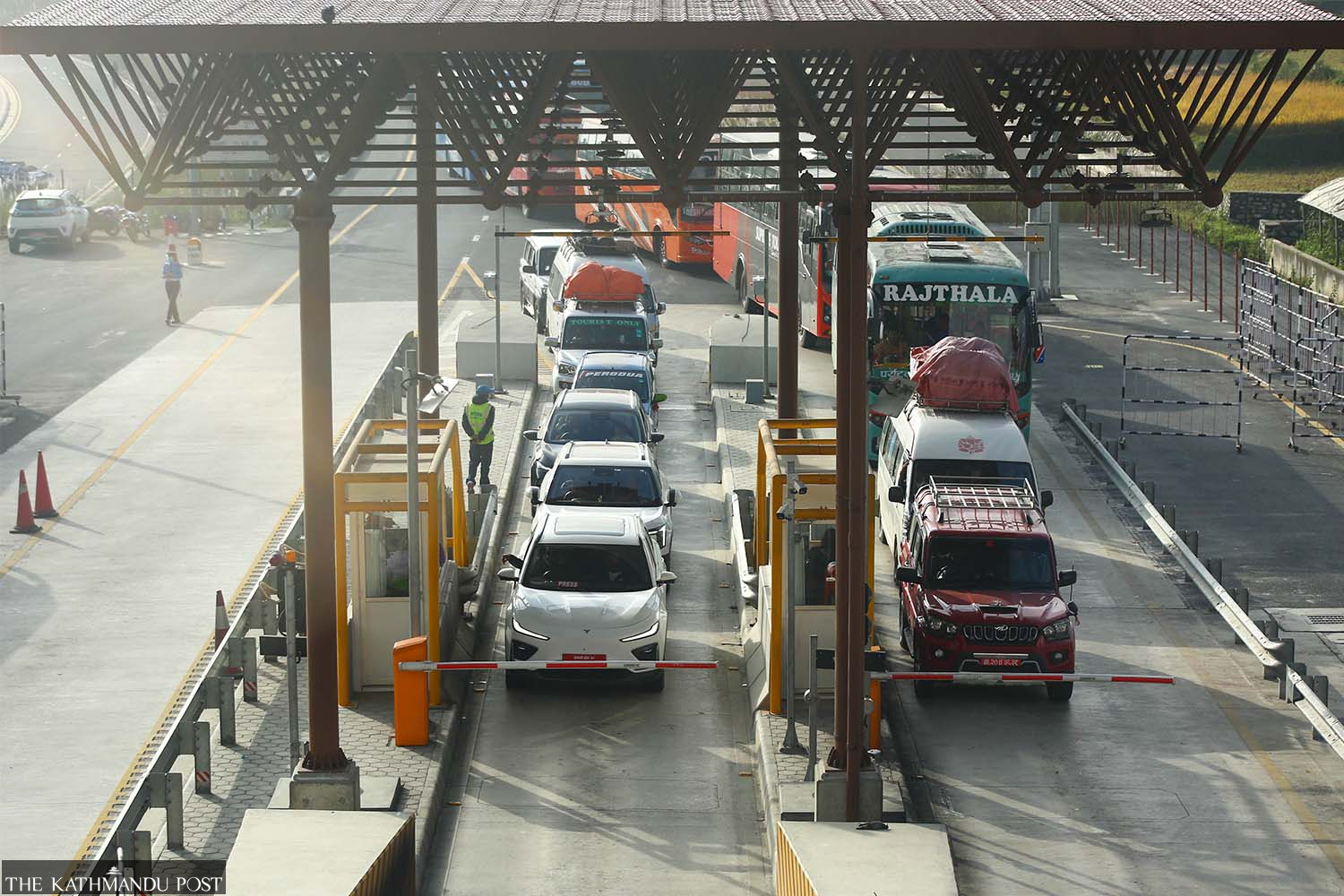
The Nagdhunga-Sisnekhola tunnelwat generated more than Rs16.4 million in toll revenue in its first 15 days of operation, after toll collection began on November 1.
A total of Rs16,447,000 was collected during which 119,029 vehicles used the tunnel, according to the Nagdhunga Tunnel Construction Project.
The toll rates vary by vehicle type and direction of travel. Cars and vans pay Rs65 when entering Kathmandu and Rs60 when leaving the Valley. Minibuses, mini trucks and tippers are charged Rs115 and Rs80, respectively. Buses and trucks pay Rs260 towards Kathmandu and Rs200 in the opposite direction. Larger trucks and heavy vehicles, including lorries, are charged Rs600 when entering the Valley and Rs250 when leaving.
Daily traffic ranged from a high of 10,354 vehicles to a low of 4,266. Toll revenue peaked at Rs1,465,915 on the busiest day and fell to Rs371,850 on the least busy day.
On average, 7,935 vehicles used the tunnel each day, generating daily revenue of Rs1,096,467.
Operating the tunnel is expected to cost Rs1.1 billion over five years, or around Rs220 million annually. The project estimates that the amount collected during the initial period may not reflect normal traffic and revenue levels, as the opening weeks coincided with the festive season, when vehicle movement typically increases.
“We will have a clearer picture after seeing how many vehicles use the tunnel and how much revenue it generates in mid-November to mid-December,” an official at the project said. “That will help us estimate the revenue that can be collected over a full year.”
The tunnelway is operated by the Yusin-ART joint venture, which is required to deposit the toll revenue into the Road Board Nepal's account every day. Except on public holidays, bank employees visit the tunnel at 3pm to collect cash and deposit it into the board's account. Payments made through QR codes are transferred directly to the board's account.
Motorists can pay tolls either in cash or through QR codes. The joint venture has been contracted to manage and operate the tunnel for five years.
The tunnel has significantly reduced travel time between Dhading and Kathmandu. When traffic is congested on the Nagdhunga uphill road, small vehicles previously took about 15 minutes to travel the stretch, while larger vehicles needed around 35 minutes. The tunnel now allows motorists to travel from Sisnekhola in Dhading to Kisipidi in Balambu in about seven minutes, according to the project.
Fifteen jet fans have been installed inside the tunnel for ventilation. The main tunnel is 2.688 kilometres long, while the emergency tunnel measures 2.557 kilometres. Seven cross-passages connect the two tunnels at intervals of 375 metres.
Pedestrians, motorcycles, three-wheelers and non-motorised vehicles are not permitted to use the tunnel. Vehicles carrying highly flammable materials, including diesel, petrol and gas, as well as explosives, are also prohibited.
The tunnel remains open around the clock. A total of 64 employees are deployed on a 24-hour basis for toll collection and tunnel operations. The project says 140 people are currently working at the tunnel facility.
Japanese contractor Hazama Ando Corporation constructed the tunnel and handed over the completed works to the Nagdhunga Tunnel Construction Project in May 2026. Under the contract, the company is responsible for repairing any problems that arise in the tunnel during the first year after handover.