Development works in Tinkar and Chhangru, two remote border villages in the northern part of Darchula district in northwestern Nepal, have come to a halt after Indian security forces barred the transport of construction materials through Indian territory.
Because Nepal lacks a direct motorable road or even a usable foot trail to these settlements from its own territory, builders and residents must rely on Indian roads to reach the border point at Sitapul. Following restrictions imposed by India’s Sashastra Seema Bal (SSB), a community-led drinking water project in Chhangru has stalled, while a federally funded water lifting scheme and a suspension bridge linking Tinkar remain unfinished.
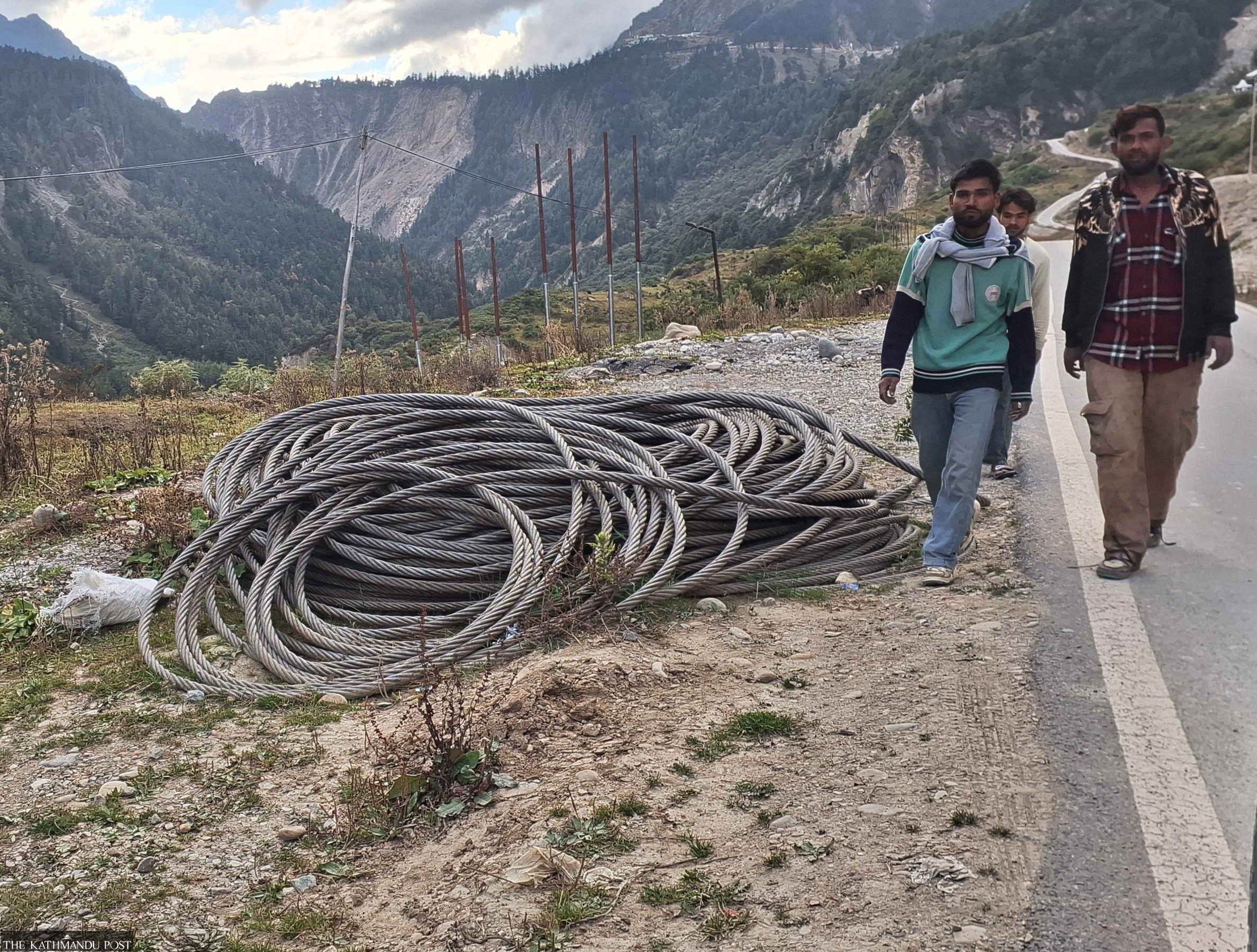
Although 75 percent of the suspension bridge has been completed, vital cables, and steel plates have been stranded across the border for two years.
Chhangru, located in ward 1 of Byas Rural Municipality, has faced an acute drinking water crisis for six years. The village’s 125 households rely on just two public taps, neither of which supplies enough water.
“This water system was built during the Panchayat era. Back then, water flowed round the clock and the population was smaller,” said Jagat Aitawal, a local. “Now the village has grown, and over the past five or six years, the water flow has dwindled.” He added that the water source, roughly four kilometres away, is gradually drying up.
With taps running dry, villagers fetch water from a well 20 minutes away on foot. “It takes 20 minutes to walk down, but climbing back up with a load takes 40 to 50 minutes,” said Radha Bohara, an octogenarian of Chhangru. “Those with horses or mules can transport water easily, while others suffer. For elderly people like us, it takes an hour.”
After repeated appeals to ward, municipal, and provincial authorities went unanswered, villagers pooled money through voluntary contributions, with additional donations from Chhangru natives living abroad. Led by local resident Hemendra Bohara, villagers salvaged old pipes, dug trenches, and hauled stones through voluntary labour to tap a spring at Galendharu, about 3.5 kilometres away.
In May, villagers bought additional pipes and fittings in the district headquarters, Khalanga, and transported them via India to Sitapul, where SSB personnel stopped the consignment.
“The SSB halted us, saying these were construction materials, not household goods,” said Hemedra. “Had they let the supplies through, water would have reached our village by June. Everything remains stuck.” He noted that while Indian guards previously cleared goods carrying VAT bills and recommendation letters from the Darchula District Administration Office, enforcement tightened this year. “We showed every document, yet they denied us permission, claiming orders from above—though nobody knows whose orders,” he added.
The blockade has also crippled work in the neighbouring Tinkar village. Construction of a suspension bridge across the Tinkar stream to connect Tinkar with Langchhupu—a federal project worth around Rs40 million—has stalled for two years after cables and steel plates were barred from crossing into Nepal.
Dhanlal Pun, site representative for contractor Junction Nirman Sewa, said the materials lie abandoned at Garbyang near Sitapul, which links ward 1 of Byas Rural Municipality with India. Before Dashain, the firm brought 67 workers from Rolpa to carry the bridge cables, only to send them back empty-handed. “We still had to cover their bus fares, food, and travel expenses,” said Pun. “The company lost Rs1-1.2 million without doing any work.” The materials have been stuck at Garbyang since November last year.
Company representative Tirtha Khadka said repeated appeals in Kathmandu and New Delhi failed to resolve the impasse. “The Indian Embassy in Kathmandu wrote a letter permitting the transit, and we even sent representatives to Delhi, but to no avail,” said Khadka. “Without a trail on the Nepali side, using the Indian route is our only option.”
Nepal’s Ministry of Foreign Affairs had sent a diplomatic note to the Indian Embassy seeking facilitation. The embassy instructed Indian customs offices to clear the cargo without delay. Still, contractors say SSB personnel ignored the letter.
A separate lifting water project funded by the federal government in Chhangru faces the same fate. Project chair Surendra Aitawal said galvanised pipes, cement, and fittings reached the border in June but could not cross into Nepal. “We stacked the supplies near the road. When the SSB blocked transit, they wouldn’t even let us move them to a shelter,” he said. “Monsoon rains ruined all the cement, and the remaining materials are still lying out in the open.”
Darchula Chief District Officer Bartaraj Paudel said fresh diplomatic efforts are underway. “After the embassy’s earlier letter was ignored, contractors submitted a new application, which we are pursuing through the Foreign Ministry,” said Paudel, declining to give a timeline for clearance.
Nepal operated a customs office at Sitapul until 2001, when it was withdrawn during the Maoist insurgency and never reinstated. Residents say the absence of a customs post worsens border restrictions. “They only allow small quantities of lentils, rice, salt, and oil for daily use, but bar all building and trade goods,” said Charan Tinkari, another local. He said repeated requests to the rural municipality and District Coordination Committee to restore customs have gone unheeded.
Darchula Customs Chief Madhu Khanal said the government owns land across from Sitapul but lacks infrastructure, with no immediate plans to reopen the post. “Even the main customs office in Darchula sees minimal trade,” said Khanal. “Discussions on a sub-customs office may follow once the Nepal-India motorable bridge in Khalanga—scheduled for inauguration during Prime Minister Balendra Shah’s visit to India—comes into operation.”
Basant Pratap Singh is the Bajhang correspondent for Kantipur Publications.






.png)