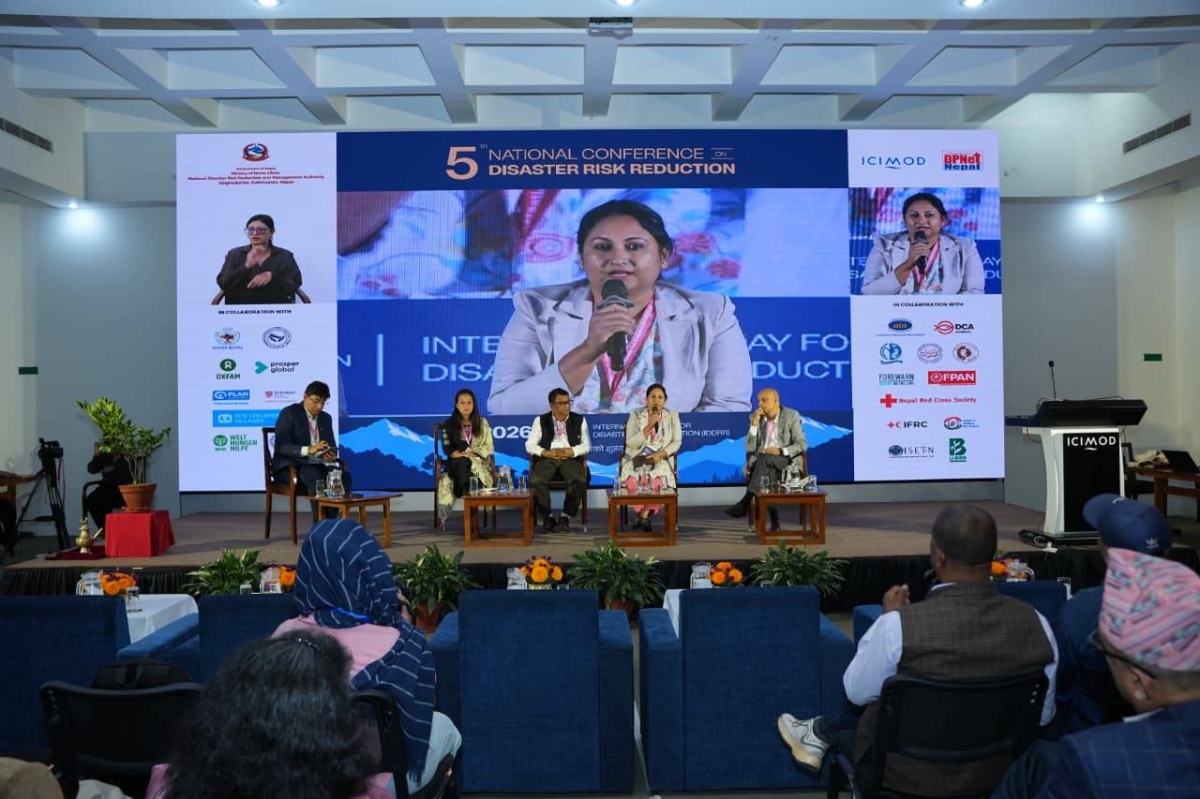
When we talk about disaster recovery, we usually talk about roads, bridges, houses and public infrastructure. We assess the damage, calculate losses and begin discussing reconstruction. But while moderating a panel at the 5th National Conference on Disaster Risk Reduction (NCDRR) 2026, following the Bhotekoshi–Trishuli floods, one question kept coming back to me: What happens to the business owner the morning after the relief phase ends?
The conference theme was "Resilience Starts at Home." Our panel brought together an affected entrepreneur, local government, the organized private sector and banking. What emerged was a gap in the way we often think about disaster recovery. A missing middle between humanitarian assistance and large-scale reconstruction.
A Rapid Damage and Needs Assessment can tell us what has been damaged, estimate losses and calculate recovery requirements. This is necessary. But the question an affected SME owner asks are much simpler: "What happens to my business now?" Humanitarian assistance understandably focuses on immediate household needs such as food, shelter, health and safety. At the other end, reconstruction budgets tend to focus on roads, bridges, electricity and major public infrastructure. Between the two sits the small business. Its shop may be gone, inventory washed away and cash flow stopped. Customers may no longer be able to reach it. Yet salaries, supplier dues and bank loans may remain. Too often, that entrepreneur is expected to find a way back largely on their own. That is the missing middle of disaster recovery.
Anila Shakya, an entrepreneur from Trishuli Bazaar, brought this reality into the room. "Before the flood, I had a running business. After the flood, the question became: how do I start again?" A business is more than its physical premises. It is stock, suppliers, customers, records, working capital, relationships and years of accumulated trust. As Anila reminded us, "It is not only about money. You need a place to operate, customers to return, supplies to restart and the confidence to begin again." That distinction matters. Relief helps people survive. Business recovery helps them earn again.
Deputy Mayor of Bidur Prabha Bogati widened the discussion beyond the individual enterprise. She spoke of Betrawati, Trishuli Bazaar, Devighat and Dhunge not simply as damaged locations, but as economic and trading centers. "The flood did not only destroy structures; it took away the means through which many people earned their living." Her remarks made me think differently about infrastructure. A bridge is not merely a physical structure. It connects farmers to markets, shops to suppliers, workers to jobs and businesses to customers. So, after a disaster, perhaps we should not only ask, Which infrastructure suffered the greatest damage? We should also ask, Which infrastructure, if restored first, will restart economic activity fastest?
This issue is particularly important to me because through The NET Consortium (NETCON), I have been involved in working with SMEs and women entrepreneurs and advocating for greater disaster preparedness among enterprises. Small and micro businesses dominate Nepal's enterprise landscape and contribute significantly to employment and economic activity, yet they remain surprisingly peripheral in disaster planning. We expect them to sustain local markets, create jobs and support families. But when disaster strikes, mechanisms designed specifically to help viable small businesses restart remain weak.
Raj Kumar Karki of FNCCI brought this out well when he said, "The first thing we have to rebuild is the confidence of entrepreneurs who have lost everything." But he also acknowledged the other side of the equation: "The private sector also has to prepare itself. We cannot begin thinking about disaster management only after disaster strikes." Businesses therefore cannot only ask what government will do. Insurance, continuity plans, protected records, emergency arrangements and risk awareness must increasingly become part of normal business practice. Business associations, too, have a larger role to play, not merely lobbying for assistance after a disaster, but organizing and preparing their members before one occurs.
The discussion with senior banker Upendra Prasad Poudyal brought the missing middle into even sharper focus. I presented a simple situation: yesterday my business was operating. Today my stock is gone, my collateral may be damaged and my cash flow has stopped. But my bank loan is still there. His response was important: "At a time like this, banks cannot treat the borrower exactly as they would under normal circumstances."
That is the financial paradox of disaster recovery. Businesses need capital most precisely when they suddenly become least bankable. Upendra argued that, for some period, conventional loan recovery needs to give way to helping viable businesses get back on their feet. This is not about indiscriminate loan waivers. It is about recognizing the difference between a failed business and a viable business temporarily devastated by an extraordinary event.
His other important point was about risk sharing. The entrepreneur cannot carry the entire burden. But neither can commercial banks. Loan restructuring, temporary repayment flexibility, refinancing, guarantees, insurance, blended finance and other risk-sharing mechanisms therefore deserve serious consideration. The real question is not simply whether banks should lend more. It is how government, banks, insurers and businesses share the extraordinary risk created by disasters.
By the end of the panel, one thing was clear to me. Nepal needs to connect damage assessment with economic recovery. Government must create systems that help viable enterprises restart. Municipalities must reconnect markets and rebuild more safely. Banks need flexibility. Insurers need to become meaningful recovery partners. Business associations need to organize and prepare their members. And businesses themselves must take preparedness seriously.
The success of disaster recovery cannot only be measured by how quickly we rebuild what was destroyed. We should also ask a simpler question: How quickly are people earning again?
Because when the next disaster comes, our small businesses should not once again be left standing between relief and reconstruction, wondering where they belong. That missing middle is where resilience now needs to be built.
Shakya is the Founder at Tangent Waves