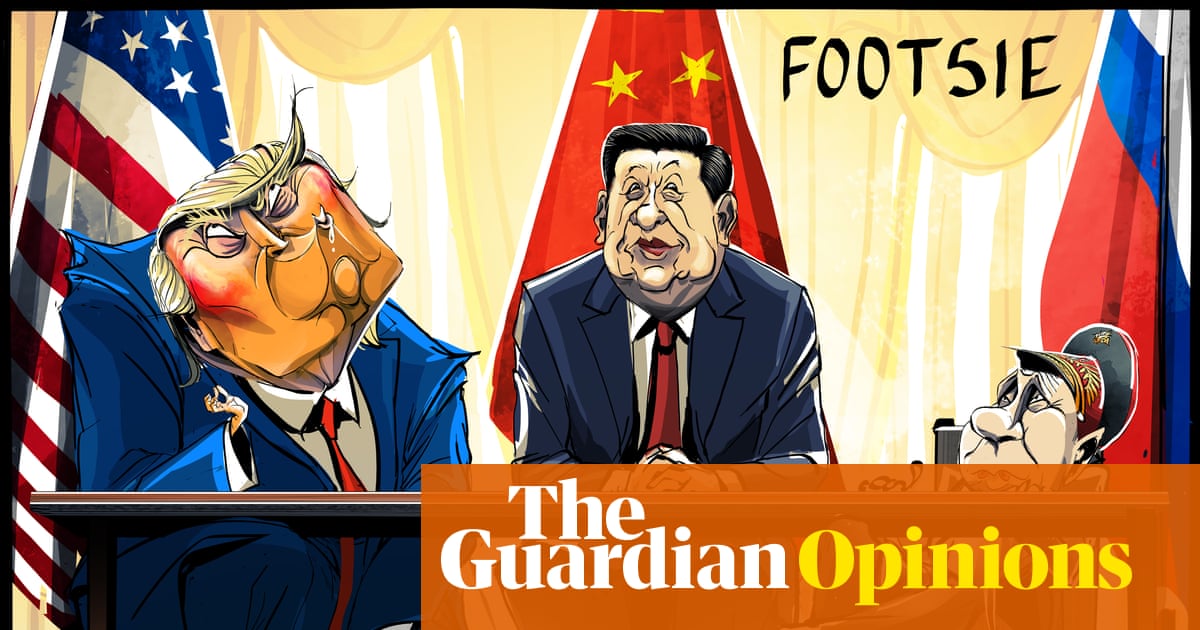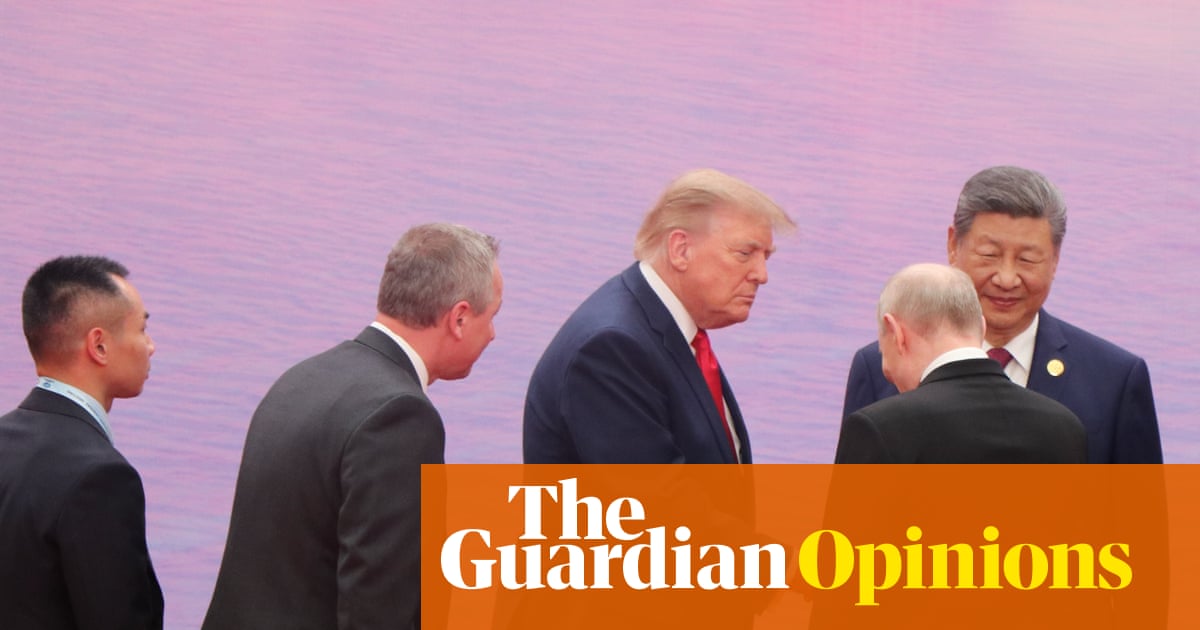

“H istoric” is a neutral descriptor, not a favourable one. Things can be unprecedented for good reason. Donald Trump’s meeting with Xi Jinping and Vladimir Putin in Shenzhen, China on Thursday will be the first time that the leaders of the US, China and Russia have gathered for talks as a trio. The trilateral on the sidelines of the Asia-Pacific Economic Cooperation summit is striking, but it is not an achievement.
The lack of a clear agenda is telling: the spectacle really is the substance. Mr Trump sees international affairs in terms of spheres of influence. This meeting reinforces the obvious conclusion for the rest of the world – that they don’t get to sit at the table, only to be on the plate. Mr Xi promotes the notion of a multipolar world. Others would be more sympathetic if all three governments were not determinedly undermining multilateralism.
Mr Xi looks like the power broker bringing Moscow and Washington together, and the gracious host, in a city which showcases China’s economic and technological progress and aspirations. The contrast between the glossy metropolis and a US currently beset by glaring tech failures hitting everything from flights to banking is especially flattering. For Mr Putin, who gloated about the “humiliation” of Europe in the run-up, this meeting is an even clearer win, making him look like a superpower peer rather than the leader of a pariah nation with a struggling economy.
Mr Trump has got a red carpet embrace, another “first” to promote – preferable to headlines dwelling on the Republicans’ midterms disaster – and the congenial company of strongmen. His nation has less to celebrate. Mr Trump seems to see meeting longstanding US allies as at best a chore. His bruising tariffs and nakedly transactional approach to security, as well as his love of autocrats, have pushed countries like the Philippines – which hosted the US president en route to China – into hedging their bets.
Mr Trump is not expected to raise Nvidia and suspected Chinese espionage – perhaps not least because his closeness to Jensen Huang, the company’s ousted CEO, makes the issue at least as discomfiting for him as it is for Beijing. The US president is unlikely to embarrass the two countries that are central to Iran’s ability to resist his disastrous and illegal war, or to press China over its facilitation of Russia’s war against Ukraine . Ukraine and Taiwan have reason to be anxious any time he speaks to Mr Putin and Mr Xi. But the US president is as likely to undermine them, whether deliberately or otherwise, in bilaterals or via a throwaway remark.
Comparisons to the 1945 Yalta summit of Joseph Stalin, Franklin D Roosevelt and Winston Churchill – which divided up Europe – grotesquely overstate the importance of a meeting scheduled to last less than an hour. Mr Xi does not do spontaneity, and is unlikely to be lured into sudden announcements. And despite the surface amity, the three still have strongly competing interests. China’s threat to rare earths brought a trade truce, but skirmishes continue. Mr Trump has said he wants to talk about denuclearisation . While China is arming itself at worrying speed, its arsenal is still dwarfed by those of the US and Russia.
Talking to rivals and adversaries is not inherently unwise. Under another US president, a closely focused and carefully prepared trilateral on, for instance, disarmament might even be fruitful. This is not that world. This will not be that meeting.
Do you have an opinion on the issues raised in this article? If you would like to submit a response of up to 300 words by email to be considered for publication in our letters section, please click here .