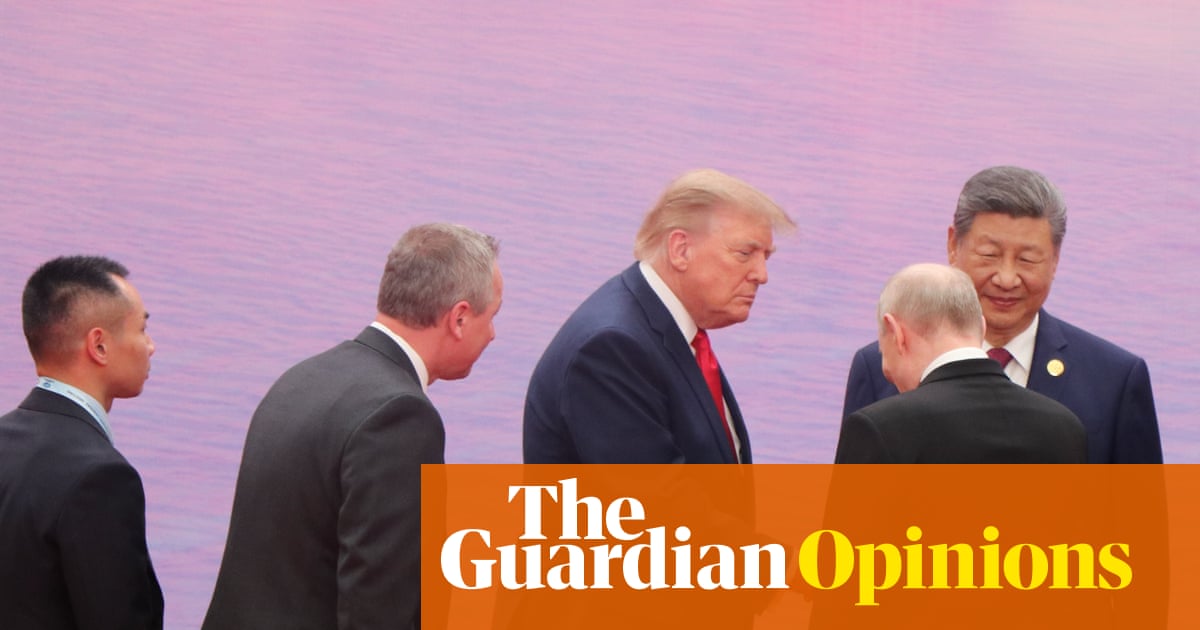
It’s fine for presidents to meet leaders of US adversaries. But Donald Trump’s summits with authoritarians are so odd because he treats them as friends.
This jarring dynamic may reemerge in his landmark summit with Chinese leader Xi Jinping and Russian President Vladimir Putin in southern China on Thursday. He hopes to complete a trifecta of tyrant check-ins by also meeting with North Korea’s Kim Jong Un.
The symbolism of the three-way talks in Shenzhen is stark. Three great powers, each of which stakes a hegemonic claim in its wider geographical orbit, will send a signal of dominance that deliberately excludes smaller, weaker nations.
The optics would be less striking if Trump acted as the leader of the free world facing down ruthless strongmen. But the president shows contempt for US allies and admires the iron rule of Xi and Putin. He frequently excuses their conduct or seeks to avoid upsetting them.
Before leaving for Asia, he argued that Putin — who is raining drones and missiles on Ukrainian civilians — was showing restraint and could be a “lot tougher.” Trump also explained he wasn’t confronting Beijing over an espionage drama involving advanced semiconductor chips because “I don’t think you want to insult China just before you get there.”
There is a fine line between talking with US enemies and appeasing them. The Shenzhen summit may test the boundaries between useful diplomacy to lower superpower tensions and dictator role-playing between two strongmen and an American president who’d like to be one.
Critics fault Trump’s relish for pomp over substance. He basks in flattery from shrewd interlocutors keen to manipulate him. His summits with Xi, Putin and Kim in his first term looked great but delivered little.
Breakthroughs are not expected in Shenzhen. Trump says the leaders might discuss nuclear weapons, Iran and Ukraine. But he’s got little patience for the painstaking prep and intense consultations with allies that predated President Ronald Reagan’s Cold War summits with the last Soviet leader, Mikhail Gorbachev.
“Is this meeting with Putin and Xi Jinping in the national interest of the United States?,” former US ambassador to China Nicholas Burns asked on CNN’s “AC360” Tuesday. “Think of the symbolism. President Trump is throwing a lifeline to Vladimir Putin, who has been spurned for nearly five years because of his aggression in Ukraine.”
Burns, a veteran US diplomat, added: “He lavishes praise on Xi Jinping, which I think is directly contrary to what he should be saying about Xi Jinping, who’s an adversary of the United States.”
In every metric apart from the size of its nuclear arsenal, a remnant of the Soviet Union, Russia is an inferior power to the United States and China. But Trump often seems to elevate Putin, for instance with the recent sanctions-busting deal to buy Russian diesel or his invitation to Putin for the G20 summit at his Miami golf resort in December.
But Trump, like Putin, is looking for personal validation in Shenzhen. After his stunning rebuke from voters in the midterm elections, he needs to show the world, and Americans back home, that he’s no mere lame duck.
As host, Xi can lay on a show for China’s state media, posing as the dominant partner convening leaders of two other great powers.
The dangers of the summit are obvious, as nations such as Ukraine and those in Europe and in the Middle East wonder whether Xi, Trump and Putin will forge understandings that favor their own interests.
But there may be a case for the world’s most prominent nuclear powers to have open channels and regular meetings.
The world is hardly stable. And each leader has a stake in dangerous regional disputes — in Ukraine, Iran and Taiwan — that could spark global conflagration. A productive summit might defuse such flashpoints or even a nuclear arms race in space.
Criticism leveled at Trump that an offer of meetings is a concession is at times overblown. Talking to your enemies can be a sign of strength. In an inaugural address delivered amid soaring US-Soviet tensions, President John F. Kennedy said, “Civility is not a sign of weakness, and sincerity is always subject to proof. Let us never negotiate out of fear. But let us never fear to negotiate.”
Trump is not the first modern president to open channels with US enemies. President Barack Obama acted on a pledge to do so that was criticized by his 2008 primary foe Hillary Clinton, making deals with Iran and Cuba. Trump reversed both openings with his hard-line policies.
Lyle Goldstein, director of the Asia Program at Defense Priorities, a think tank that advocates a more restrained US global posture, recognizes the critique that Trump’s summits create good visuals and little else. But he believes that they can be useful nevertheless.
“I’m in favor of summits and meetings and engagement,” said Goldstein, who also leads the China Initiative at Brown University. Relations between Trump and Xi seems genuinely cordial, he added. “Let’s face it. Personal chemistry does matter, and Trump and Xi seem to be building a kind of chemistry.”
Such a connection could be critical to avoiding wider conflict in the event of a sudden crisis — perhaps over a naval confrontation in the South China Sea.
Trump has said that he also hopes to meet Kim in China. There’s an argument that his friendship with the brutal tyrant eased tensions during his first term. But their meetings failed to reverse North Korea’s nuclear program, and the Stalinist state now has more weapons and missiles than ever.
Goldstein also argued that the three-way summit format might become a more useful concept if it is repeated in future years because it could establish a framework for more regular progress.
Trump and Xi meet at a moment of extraordinary intrigue in US-China relations. The president has shrugged off reports that the former CEO of Nvidia had an affair with an executive flagged by US intelligence as a possible Chinese asset. The drama underscores China’s attempts to infiltrate US tech as the rivals’ AI race, which has huge military implications, heats up.
Trump’s first term Vice President Mike Pence told CNN’s Kaitlan Collins on Tuesday that the president should take a firm stance. “I’ve seen firsthand the rapport that he has with President Xi. I think he has the ability to speak forthrightly with him, and tell him what’s not acceptable to the United States of America and the things for which there will be consequences,” he said.
There’s another angle in Shenzhen that Trump may prefer not to think about. Barring revolutions, illness or death, Xi and Putin can expect to rule for years. Trump has the inconvenience of living in a democracy — one that has just delivered the kind of censure from which his authoritarian pals are immune.
That imbalance could have policy consequences. China may opt to stick to its characteristic long game in anticipation of yet another US policy reset with a new president in 2029. Putin may reason that he might score a better deal on Ukraine with Trump in office than with any other US president.
As summit host, Xi will seek to exploit Trump’s political frailties.
“The Chinese do see that Donald Trump is significantly weakened, first by the results of the midterm elections and then by the mishaps over the technological issues that happened in the last few days,” Steve Tsang, director of the SOAS China Institute in London, told Becky Anderson on CNN International. “This will certainly embolden the Chinese if Donald Trump tries to put pressure on them.”
But Tsang added that Xi won’t be rude because he wants to maintain a good relationship, “whatever his personal feelings about Donald Trump.”