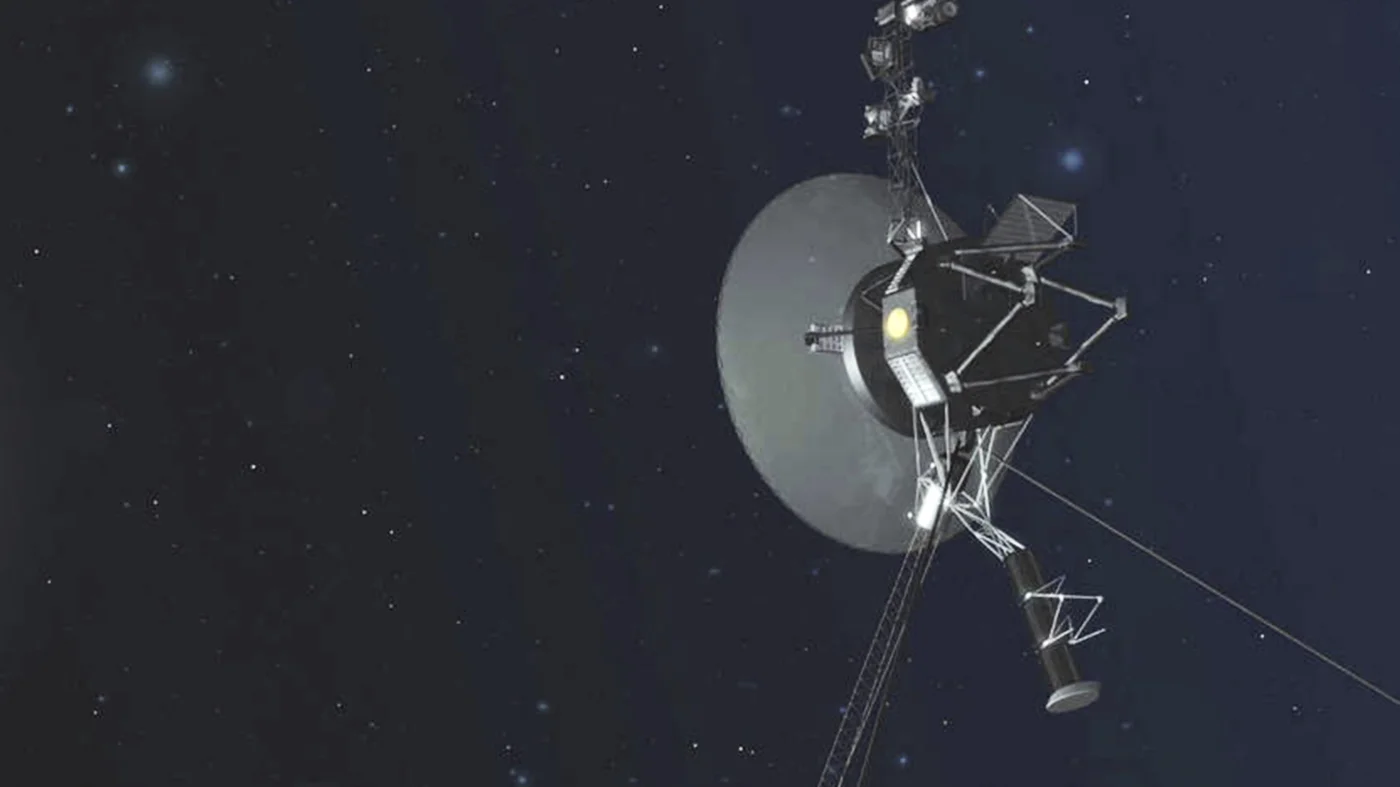
One of NASA’s longest-tenured spacecraft is quite literally stuck in the past.
Voyager 1 , launched in September 1977 toward the outer planets of our solar system, is poised to achieve a historic milestone on Wednesday: It will be the first human-made object to reach one light-day from Earth. The spacecraft will be so far away , that by the time its light reaches Earth, it will come from the spacecraft as it existed one day in the past. The achievement is one researchers hadn’t planned on , and yet, as Voyager 1 wades deeper into uncharted stretches of the galaxy, it continues sending back valuable scientific information.
“It's just a wonderful happenstance,” Kareem Badaruddin, Voyager mission manager at NASA’s Jet Propulsion Laboratory, says of the milestone. “Just as the stars were aligned for the tour of the planets, they're also aligned for this really magical, special thing that's happening for humankind.”
For Fran Bagenal, a planetary scientist at the University of Colorado, Boulder, who began working with Voyager 1 as a graduate student during its earliest years, the occasion is a momentous technological feat. “What's exciting is the fact that we have a spacecraft that was built in the mid ’70s that is still working,” she says. “Storing data on an eight-track tape that’s working on a spacecraft after 50 years—I mean, it’s amazing.”
Even as Voyager 1 approaches its 50-year anniversary next September, and its end of mission perhaps not long after that, the spacecraft is still checking items off its laundry list of scientific achievements. The spacecraft—alongside its twin, Voyager 2—was originally intended to take advantage of a rare planetary alignment to observe the outer planets .
But Voyager 1 kept traveling beyond the solar system and is now exploring the interstellar medium that fills the space between star systems. Voyager 1’s remoteness gives researchers a rare opportunity to study how the effects of the sun ripple even into the interstellar medium—and at what point those effects wane, says Jamie Rankin, deputy project scientist for the Voyager Mission at Princeton University.
Just as both Voyager spacecraft are moving through space, so is our own solar system—only about 35,000 miles per hour slower, Badaruddin says. That means that as the pair continue their journeys, they’re sending back information about the space that our own sun and planet will pass through in about three years’ time.
“We can learn from telescopes and Earth-orbiting observatories, but there's really nothing like having a spacecraft in that environment that's sending us data,” Badaruddin says.
Voyager 1’s unprecedented journey isn’t without challenges. The craft has stayed in communication with Earth far longer than planned and is trekking through regions of space that it was never built to encounter or study. Researchers are helping maintain crucial functions, but they’re now doing so with a full day of lag in communications both to and from the spacecraft, Badaruddin says.
“Light time is really affecting us,” he says. “You factor it in. It’s like having a long commute.” Building new commands for the spacecraft is now a week-long process, for instance, since it takes time to receive data from the spacecraft, analyze it, and create a new command, he adds.
Still, the Voyager team is used to navigating unforeseen circumstances. For decades, they’ve been managing to make do with a dwindling power supply coming from the craft’s nuclear generators. In September, mission operations switched off some of Voyager 1’s devices in lieu of lower-power alternatives, a maneuver the team dubbed the “Big Bang.” The swap, which saved the craft 10 watts of power, kept mission operations from having to switch off another instrument as early as next summer.
Even when contact with Voyager 1 is eventually lost, the spacecraft will leave a lasting legacy—especially for any future such far-traveling missions, should NASA or another space agency launch one. A successor to Voyager might, for instance, have new devices such as a dust instrument to better analyze the interstellar medium or cameras to give astronomers a better view of these distant stretches of the cosmos, Rankin says.
“I would hope that the Voyagers and their reaching interstellar space has taught us the lesson that we've got to just keep reaching for the stars,” she adds.
Every mission must meet its end, though. And Badaruddin’s best guess is that Voyager 1’s could come in the next three to five years, as the plutonium-238 powering it decays further. Once the craft transmits its final signal to Earth, it will still continue its silent tour of the galaxy.
But Badaruddin acknowledges he’s part of a lineage of mission managers who have said that the spacecraft only has a few years left, only to be proven wrong . “The Big Bang was a rabbit we pulled out of a hat. As long as we can keep finding rabbits, we can keep going,” he says. “Don’t bet against Voyager.”
In your inbox: Inside WIRED’s newsroom with Katie Drummond
Nvidia employees want Jensen Huang back
The Big Interview: Zohran Mamdani on data centers, AI in schools, and the Democrats
Stephen Miller wants a “servant class, not a working class”
Introducing the app: More ways to make the most of WIRED