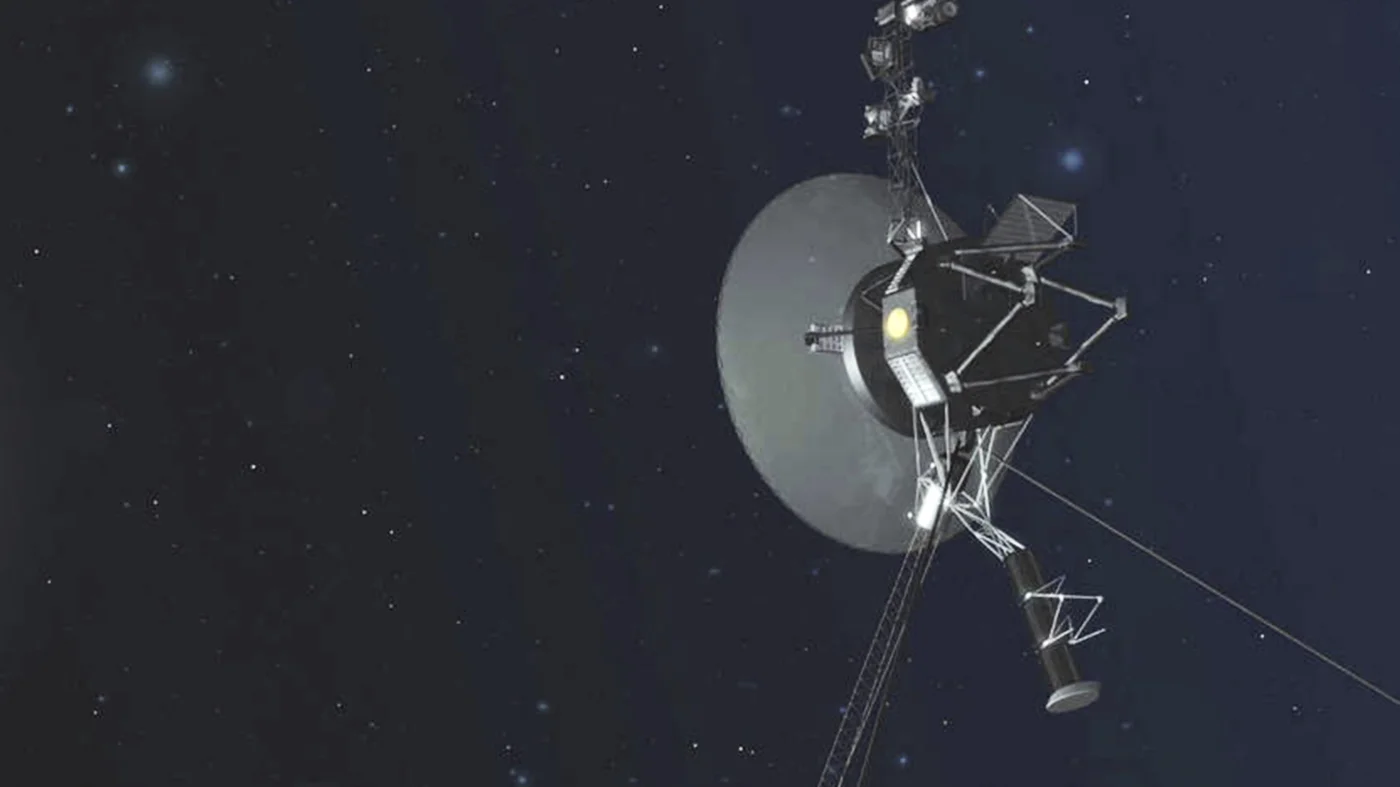
Voyager 1, NASA’s celebrated deep-space probe, has reached one light-day from Earth — a historic milestone that no other human-made object has achieved.
One light-day is the distance at which a radio signal, moving at the speed of light, takes 24 hours to reach the spacecraft. That’s equivalent to roughly 16 billion miles (26 billion kilometers), making Voyager 1 the farthest human-made object — a title it has held since 1998, when it surpassed another NASA probe called Pioneer 10.
“It’s never happened before, and it may never happen again — it’s that kind of extraordinary,” said Kareem Badaruddin, Voyager mission manager at NASA’s Jet Propulsion Laboratory in Pasadena, California.
Since it lifted off in September 1977, Voyager 1 has racked up an impressive list of achievements. The probe and its twin spacecraft, Voyager 2, which launched a month later, were originally built to last just five years and explore Jupiter and Saturn. Both have extended their missions nearly 10 times longer than expected.
“That they are still operating in a scientifically useful way after 49 years is a testament to the dedication and talent of those who designed and built them and those that continue to operate them,” said William Kurth, a research scientist at the University of Iowa who started working on Voyager as a graduate student in 1974. He now leads the Voyager Plasma Wave Science investigation.
The Voyager probes are currently studying interstellar space, having left the heliosphere — a vast protective bubble generated by the sun’s magnetic field — in 2012 and 2018, respectively.
“We’re having to figure out how to fly these machines to explore the interstellar medium, when they were really designed to explore the planets,” Badaruddin said. “We’re using very old machines to do something they weren’t really designed to do.”
Voyager 1, which reached one light-day just after 5:16 a.m. ET Wednesday, is now heading toward Gliese 445, a star more than 17 light-years away from Earth.
NASA is still able to send commands to and receive data from the spacecraft using the Deep Space Network, a collection of large ground-based radio antennas. But messaging isn’t exactly snappy.
“One way we can think about it is a phone call,” Badaruddin said. If you called someone on the other side of the Earth, the phone signal — traveling at light speed — would take less than one-tenth of a second to reach them, he explained. With such an insignificant delay, “you can have a conversation as though they were in the same room.”
Ringing up Voyager 1 is a much trickier long-distance call. “Our signals to the spacecraft move at the same speed, the speed of light, but it literally takes 24 hours for them to get to it,” Badaruddin said. “That’s how far the spacecraft is from us.”
Once a signal has reached Voyager 1, engineers must then wait another 24 hours for a response to travel all the way back to Earth. And that’s in ideal conditions, when telecommunications and the spacecraft’s instruments are working as expected.
“Operating a remote device with a round-trip communication time of two days requires a totally different mindset than any other operational scenario I can imagine,” Kurth said in an email.
Just a few weeks ago, NASA didn’t hear from the probe for two days, stoking fears that Voyager 1 might have been lost.
To keep the Voyager spacecraft running well beyond their expected lifespan, NASA engineers have had to come up with some creative solutions over the years. “I think of it like pirates trying to avoid the laws of the land,” Badaruddin said. “We try to avoid the laws of physics as we continue our journey.”
The main problem has been the probes’ constantly declining onboard power. They’re each equipped with three thermoelectric generators that use plutonium, a radioactive element, as fuel. The radioactive decay of the plutonium generates heat, which is then used to produce electrical power.
Unlike solar panels, commonly used on spacecraft, these generators don’t require sunlight, but the power output decreases as the plutonium naturally breaks down over time and the hardware ages.
At launch, the generators onboard Voyager 1 supplied 470 watts of electrical power — roughly the amount of a small household appliance such as a blender. But the probe loses about 4 watts per year, which means it’s currently producing roughly 210 watts.
Only two of the 10 scientific instruments onboard Voyager 1 are still running and returning data to Earth, as NASA has progressively switched off the others over the years. Those still operating are the magnetometer, which analyzes magnetic fields, and the plasma wave subsystem, which studies the density of charged particles. Both are suited to observe interstellar space, where the probe is currently traveling at 38,000 miles per hour (61,155 kilometers per hour).
NASA recently performed a daring reshuffle of the power distribution onboard — simultaneously turning off some non-scientific hardware components while turning others on — to try to save electricity while maintaining essential heat. The computers have to be warm enough to work, and the propellant used to direct the probe must be kept from freezing, because that would prevent important maneuvers such as pointing the antenna toward Earth to exchange data.
“This summer we made a change where we turned off three onboard devices that used a lot of power, and turned on three devices that, in total, used less power than the three we turned off,” Badaruddin said. “We chose the devices so that they were distributed around the spacecraft, so that all the propellant lines remained liquid and warm enough.”
It was a radical change, he said: “We called it the ‘Big Bang,’ because it was everything all at once.”
This “Big Bang” fix will allow Voyager’s remaining science instruments to work for longer than the previous configuration. Badaruddin said that, even after about a year of preparation to convince themselves that the test might work, Voyager team members were very nervous because “there were seven power commands that had never been used in flight.”
“It’s going to save us 10 watts, so it bought us about two and a half years of power,” he added. “To find 10 watts without having to turn off an instrument, that’s just wonderful, wonderful savings. I call it pulling a rabbit out of a hat. So now we’ve got our arm deep in the hat and we’re looking around for another rabbit.”
But in late October — just weeks after the daring instrument swap — Voyager 1 experienced a different issue: a temporary loss of communication . Even though it resolved itself after 48 hours, the incident was an alarming and poignant reminder that the probe is on borrowed time.
“It was quite a surprise, and we’re still trying to understand what happened,” Badaruddin said. “We know that we are living in very thin margins, and episodes like that are probably going to become more frequent.”
It’s hard to predict exactly how much longer Voyager 1 can operate. For decades, mission managers have continued to estimate the mission would last three to five more years, Badaruddin said — “unless we can find another rabbit in the hat,” he added.
Voyager 1 is one of five spacecraft currently on trajectories that go beyond the solar system. Voyager 2 is expected to reach the one light-day milestone in 2035, but it’s unclear whether the twin vehicles will still be operating and communicating by then. Two other probes, Pioneer 10 and 11, will also head out of the solar system, but stopped communicating long ago; a fifth, New Horizons, is currently traveling through the Kuiper Belt, a vast ring of icy objects beyond Neptune’s orbit.
It will be a tough moment for astronomers and researchers when the Voyagers finally give up, Badaruddin said.
“We fight with everything we have to keep these spacecraft flying. When ultimately that’s not enough, it will be difficult to come to terms with,” he said. “At the same time, the Voyager mission is one of the great things that humans have done, and it is meaningful to everyone on Earth. It’s deeply humbling to be a part of that.”
They will leave behind a legacy of major scientific discoveries, including new moons around Saturn and Jupiter, active volcanos on Jupiter’s moon Io, and details about the atmosphere of Saturn’s largest moon, Titan. Voyager 1 also took the famous “Pale Blue Dot” photograph, which put into perspective Earth’s place in the vastness of space.
Both probes are now gathering data about interstellar space in a way no telescope ever could.
“We use telescopes to study the interstellar medium from Earth, but just like visiting a planet, there’s a huge difference between having a device actually in the medium that you’re studying versus studying it from a distance,” Badaruddin explained.
Voyagers 1 and 2 also carry the Golden Record , a 12-inch gold-plated copper disk that contains images, natural sounds, music and spoken greetings in 55 languages, as well as messages from former US President Jimmy Carter and former UN Secretary-General Kurt Waldheim.
Even if they lose all power, the probes will continue traversing through space at the same velocity, carrying these cultural capsules with them. It will take about 40,000 years for Voyager 1 to make its closest approach to the star Gliese 445, passing within about 1.7 light-years of the distant object.
The farthest spacecraft from Earth are shutting off instruments in interstellar space
“The Voyager spacecraft have survived nearly 50 years of flight while retaining the ability to tell us about our galactic neighborhood,” Kurth said.
“Any possibility to follow the Voyagers into the interstellar medium will necessarily require decades in development and flight time,” he added. “We need to acquire as much as the Voyagers have to give before they go silently about their orbits around the galaxy.”