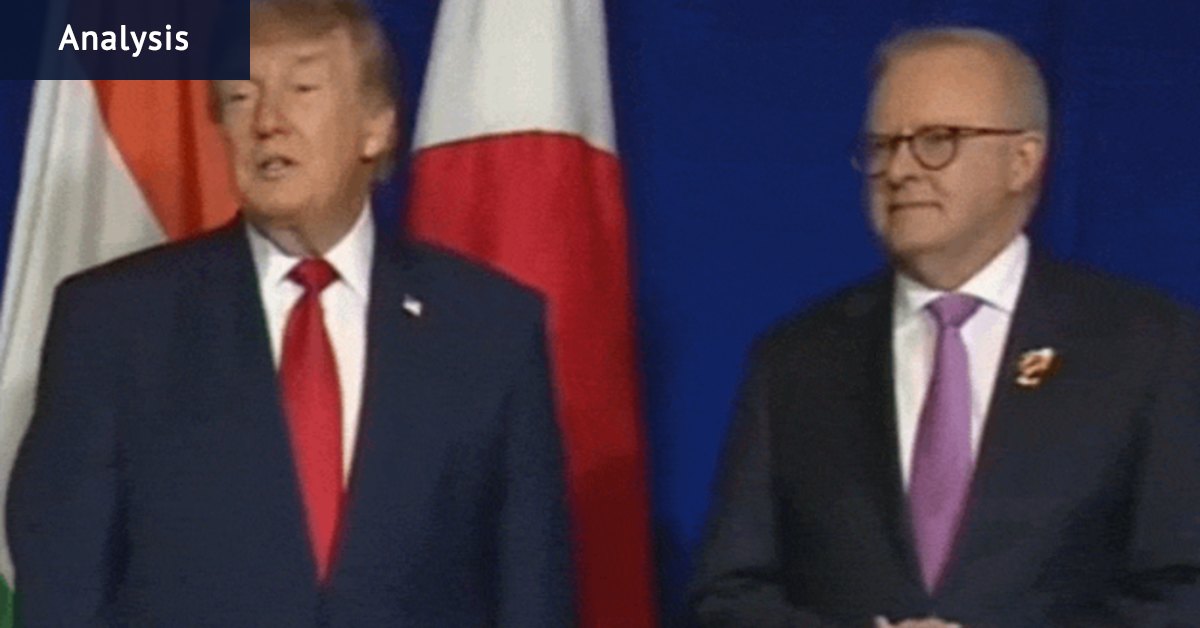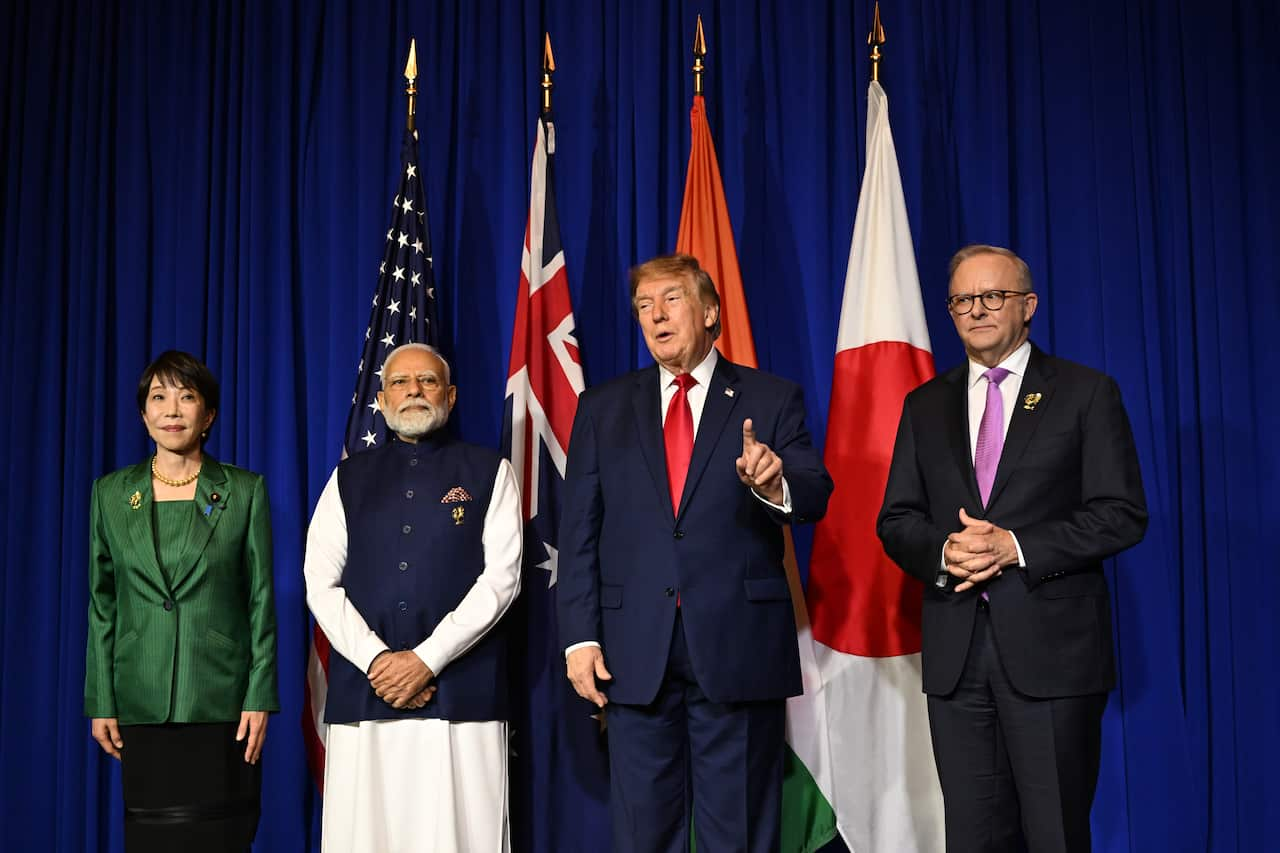
Technology capability and cybersecurity were prominent topics during Tuesday night's Quad meeting in the Philippines, with the leaders of Australia, the United States, Japan and India affirming support for US-led development on artificial intelligence.
In a joint press statement, the leaders said: "We are securing critical supply chains, protecting freedom of navigation and overflight, driving growth through technologies of the future including investments in and deployment of trusted Super Intelligence (SI)*".
That asterisk pointed to a clarification further down.
"*In Australia, India, and Japan, 'Super Intelligence' refers to 'artificial intelligence,'" it said.
The phrase has been a regular addition to joint statements since US President Donald Trump's executive order in September to replace the term "artificial intelligence" with "super intelligence" in all official US communications to better reflect "the full promise and opportunity of these technologies".
Your trusted source for staying up-to-date with the world around you. Get free daily news updates and analysis, straight to your inbox.
AI and the resources needed for its use and development continue to shape international diplomacy, as the US and China compete for technological advancement.
Olivia Shen, the director of the strategic technologies program at the United States Studies Centre, has been to multiple Quad meetings over the years.
"Technology cooperation has always been a really important stream of work under the Quad," she told SBS News.
"So it makes sense that now we're looking at these announcements that expand on that by looking at the things that people are really worried about right now."
Key concerns include the security of undersea cables, the protection of critical mineral supply chains, and cybersecurity, particularly with advances in AI.
It's one of several disconnects developing between the view of artificial intelligence promoted by US leaders and its reception in wider society, as AI infrastructure proves divisive in communities internationally and shapes election results .
This week, Australia, India and Japan were among 10 countries that signed a US-led declaration to strengthen controls on supply chains critical to AI development.
The San Francisco Declaration reinforces collective responsibility to protect sensitive technologies and critical infrastructure from undue influence. A spokesperson for Prime Minister Anthony Albanese said the joint statement was about ensuring the technologies and supply chains Australia relied on were secure.
The agreement was part of Trump's broader Pax Silica initiative, an alliance aimed at building a global supply chain for the technology and infrastructure needed for AI among the US and allied countries. It excludes China, which has a dominant lead in producing and refining critical minerals used in AI hardware and other infrastructure.
Launched in December last year, it now has 26 signatories — including Australia, Japan and India, as well as the United Kingdom, South Korea, Singapore, and Israel.
In the Philippines, another Pax Silica signatory, the initiative has sparked protests over a proposal to build a 1,600-hectare industrial hub to support semiconductor manufacturing, the processing of critical minerals, and other AI infrastructure.
Activists opposed to the project say it will displace members of the Indigenous Aeta community and local farmers and strain water and electricity supplies.
In the capital Manila, thousands of people took part in demonstrations this week criticising Trump's arrival and — among other issues — calling for the Philippines to reject involvement in Pax Silica.
After Tuesday night's meeting, Trump said the Quad countries were working together to "advance super intelligence", which he called "the greatest opportunity for economic growth since the industrial revolution".
"And it's working out amazingly well," he told reporters.
"Things are not going overly well," she said.
"The reality is that US frontier models are still more advanced than Chinese rivals at this point in time, but they're about five to six months ahead of the curve."
Chinese models are gaining popularity, offering more affordable options to consumers and often released as open-weight products, enabling tweaks that let users fine-tune the model.
"The US, in a way, they're quite right that the US AI technologies win on performance and probably on security as well, considering China's past history of building in back doors and surveillance technologies into their hardware and software," Shen said.
"But I think the trend lines show that the economics of what China's offering, is getting a lot of traction."
China has also been leading its own push for collaboration through the World Artificial Intelligence Cooperation Organization, which has 37 member countries, including Russia and Iran. Its signatories include 15 countries in Asia, 13 in Africa, four in Europe and five in the Americas.
"That's seen as a bit of a rival to the US-led Pax Silica initiative that is all about securing and safeguarding AI supply chains," Shen said.
"What the US is trying to offer is that countries around the world can become great by adopting the American technology stack because they have a lead over China.
"And particularly for countries that are very worried about cybersecurity and security of critical infrastructure, then they probably do want to go with the best models and they may be willing to pay a premium for it."
However, China remains excluded from access to the US' advanced chips.
Trump's government on Monday moved to close a loophole that allowed Chinese companies to train on technology from companies like Nvidia at data centres in other countries.
Some Chinese companies aren't reliant on renting US tech for training AI models so won't be affected by the crackdown but there will likely be an overall dampening on China's capabilities, Kyle Chan, a fellow in the John L Thornton China Center at The Brookings Institution, told the ABC.
He said the competition between China and the US is "very intense... but lopsided" as the US has technological advantages, while China is more focused on integrating powerful AI models into the rest of its economy.
"In terms of the bilateral relationship between Australia and the US, there is a strong sense that the US sees Australia as an important partner on critical minerals and rare earths," Shen said.
This has become more important as China has sought to restrict the access of other Quad nations over the past several years.
Rare earths are needed for electronics, semiconductors, magnets, alloys and advanced materials used in anything from data centres to jet engines.
"Rare earths are just a really important part of the supply chain where you want more diversity and we want more resilience rather than being beholden to a single source that could use that against us," Shen said.
— With additional reporting by the Australian Associated Press.