

P eggy Guggenheim, art enthusiast and socialite born into a wealthy New York family, was often photographed outside her palazzo in Venice with a handbag dog and outré sunglasses. The Peggy Guggenheim Collection as we now know it, however, was nearly not in her Venice palazzo but London, evidenced by a short-lived and largely overlooked period between January 1938 and June 1939 when she ran Guggenheim Jeune in Cork Street. This exhibition posits that this initial gallery’s activities were far more influential in the shaping of contemporary art than previously recognised. Guggenheim Jeune mounted a flurry of 20 exhibitions including such UK firsts as a group show dedicated to collage, and solo exhibitions by Wassily Kandinsky , Jean Cocteau and Yves Tanguy .
How to demonstrate the pioneering qualities of a gallery that is now a ghost? With reassembling and contextual padding, it appears. The catalogue states that at least 60% of the artworks in this exhibition were originally shown at Guggenheim Jeune, though only a handful of captions list definitive instances. Does this imply that where not stated, they are included for illustrative purposes? This may be due to relevant works being difficult to obtain; for the segment representing Jean Cocteau’s exhibition in January 1938 we have one of his ink drawings for his 1937 play Les Chevaliers de la Table Ronde, and another in reproduction only.
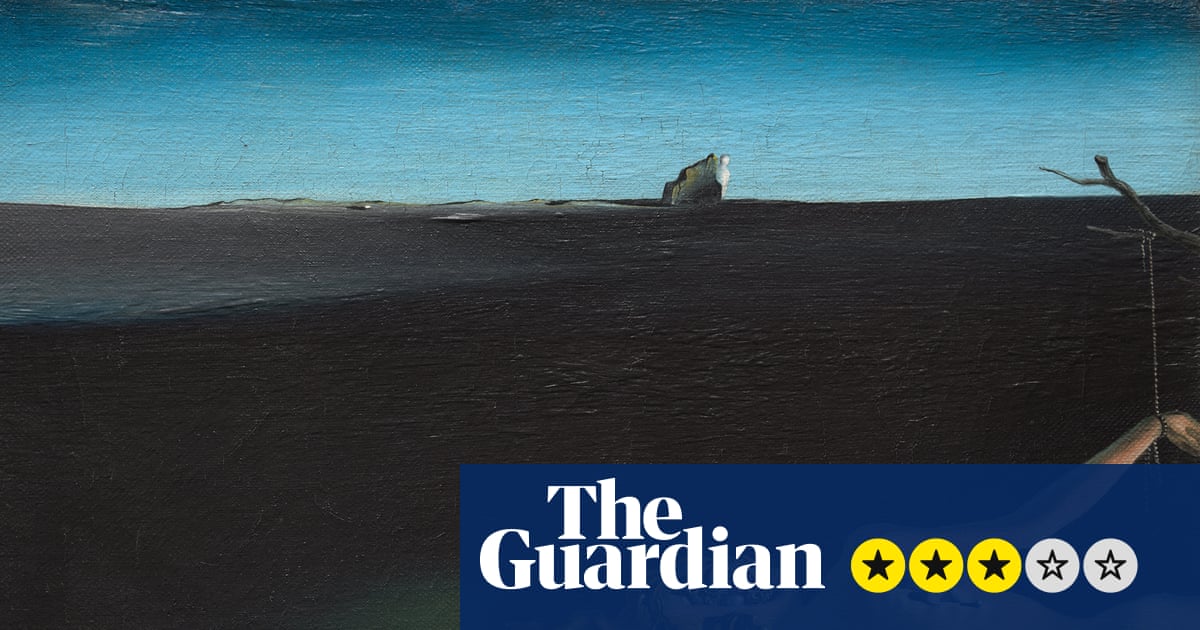
Kandinsky’s knockout Dominant Curve , we are told, was purchased by Guggenheim directly from its 1938 retrospective appearance, but what of the other, wonderful, Kandinskys also present? His ectoplasmic Green Figure of 1936 is loaned from the Pompidou: was it at Guggenheim Jeune or not? The same may be said of the magnificent – and massive – Mondrian Composition No 1 with Grey and Red 1938 and Composition with Red 1939, explicitly stated as included in the Exhibition of Abstract and Concrete Art in May 1939 and then acquired by Guggenheim for her collection. It’s shown next to César Domela’s Relief no 11 C , a light relief of painted wood and concentric ellipses and honeycomb textures, which by contrast has no contextual anchoring in its text. If an exhibition deliberately cites a prior one, accuracy is crucial. One is inclined to be forgiving however with the inclusion of such rare treats as a tiny 1931 Salvador Dalí, and the barely visible oil on board Old Man Running completed by Lucian Freud apparently aged 15.
In contrast with a previous show at Petersfield Art Gallery about Guggenheim’s time living in West Sussex, which more heavily focused on her social life and affairs, this show is more academically flavoured and less is expounded on her social networking and activities, though they are inextricably bound. The clue is in the show’s subtitle: “the making of a collector ” not curator . As such, we glean a sense of Guggenheim as facilitator and promoter of existing players moving within her orbit rather than a visionary selector. She famously set a goal to buy a picture a day, which sounds not unlike someone declaring themselves an intellectual for owning a large library. It was actually Winifred “Wyn” Henderson who managed the gallery, deciding on the name, finding the Cork Street location, shaping its promotional graphic design and using her professional network to bring artists into its circle; and Marcel Duchamp behind the scenes shaping its opening, educating Peggy on the difference between abstraction and surrealism.
We have then among big names that are well established in the art historical canon – Tanguy, represented here beautifully in dreamlike biomorphic landscapes, is said to have been Guggenheim Jeune’s only commercially successful show – lesser known surrealists such as Grace Pailthorpe and Reuben Mednikoff , who were suggested by Wyn and perpetuated what they called “psychorealism”: a mix of automatic drawing with psychoanalysis. Similarly, probably the only reason a sequence of monosyllabic portraits by Cedric Morris were exhibited, featuring the same flat modelling and blank expression, was because he was friends with Guggenheim and delivered a hundred of them to the gallery, of which mercifully only a handful make it here. A revelation however is Wolfgang Paalen ’s delightful, macabre umbrella made of sponges, experiments with candle smoke and a gun made out of “poultry and mammal bones, brass and velvet”, mounted so high you’d be forgiven for missing it.
The show was pitched by the Peggy Guggenheim Collection Venice curator Gražina Subelytė and independent curator Simon Grant, so it is useful to bear in mind an underlying purpose serving the Guggenheim estate; it would be instructive to be able to compare Guggenheim Jeune’s purported influence on London contemporary art with other players – such as the Redfern Gallery or Mayor Gallery – beyond such amusing anecdotes cited here that customs were so flummoxed by avant garde art that it was demanded it be imported according to its base materials. Making tangible and cohesive a short but brilliant burst of activity, a precursor to what is now a cultural behemoth in Venice, was clearly a feat enough.
Peggy Guggenheim in London: The Making of a Collector is at the Royal Academy, London, 21 November to 14 March