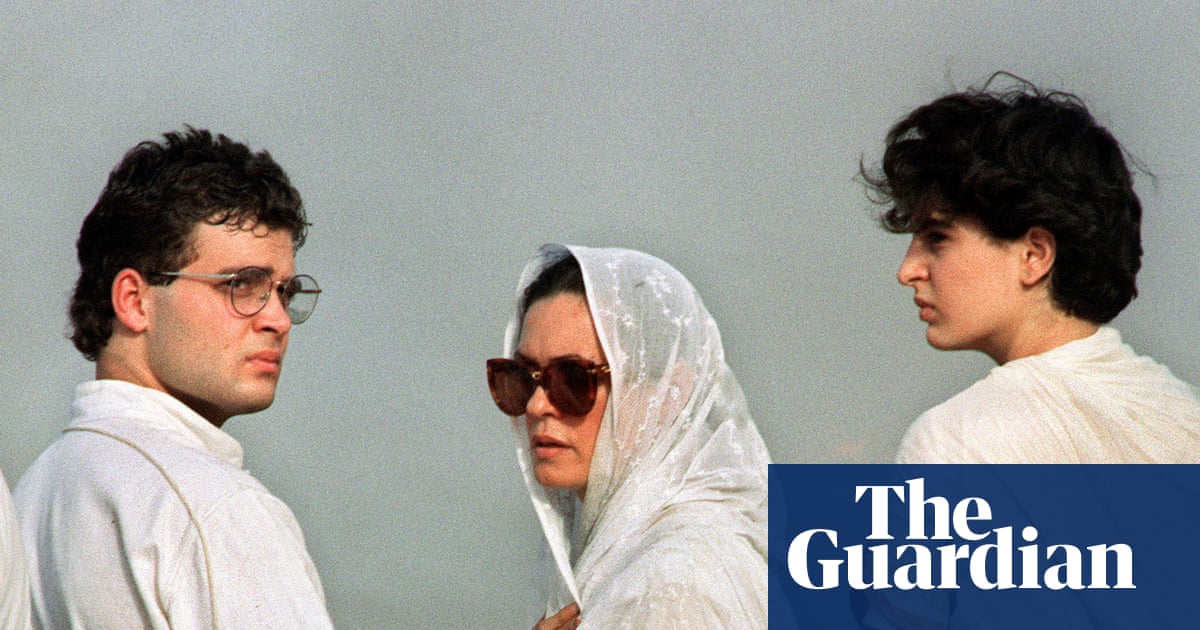

B y any measure, it is one of the most extraordinary political stories of our age: a shy Italian girl locks eyes with the scion of an Indian political family, falls instantly and steadfastly in love, “transplanting herself” as a result, suffers soul-shattering tragedies, then takes the reins of power in the world’s largest democracy. It is a life that spans the extremes of privilege and distress, and half a century of seismic national history.
No wonder publishers have been keen to secure the memoirs of the famously guarded Sonia Gandhi , soon to turn 80. Yet when the chance came, the deal with the country’s biggest publisher, Penguin Random House India, fell through at the last minute over what it termed “an impasse over a particular issue” in the text, with HarperCollins stepping into the breach. For those unfamiliar with the sensitive political context, the Nehru-Gandhi family has been in charge of India for about half the eight decades since independence – and the principal opposition to Narendra Modi’s prickly BJP regime for the past 12 years.
As it turns out, Belonging does not read as incendiary. It errs, rather, towards discretion and legacy-building. It is also, at its best, a heartbreaking story of love and loss.
Gandhi’s voice is measured and generally frill-free. Flourishes do accompany the meet-cute at a Greek restaurant in Cambridge in the mid-1960s that sets off the story. “That January Sunday, which was to change my life,” she writes, “the sky [was] a beautiful azure dotted with puffy white clouds as in a Tiepolo fresco.” The introduction to fellow student Rajiv Gandhi was “a bolt of lightning”.
And, as in a film, there is parental resistance. Sonia’s father, a businessman who worked in construction in a small Italian town, is a second world war veteran, nicknamed Maino the Lion. A 1998 New Yorker profile by Patrick French, briefly a collaborator on Belonging, had him down as “an unrepentant fascist” until his death. Well, was he? We don’t get to find out. Wherever expedient, Gandhi maintains her strategic silence.
Stefano Maino, at any rate, is “ padre padrone ” – literally, “father master”. When he hears about his middle daughter’s love interest, he brings “his fist down on his writing table” with a shout of “ Basta! ” And yet, he buys her a ticket to India the moment she turns 21.
On the boy’s side is the person who would come to be described as the world’s most powerful woman, Indira Gandhi, the daughter of India’s first prime minister, Jawaharlal Nehru. Barely has Sonia landed in Delhi than Indira decides the pair must wed (the news reaches the Mainos via radio; Signor Maino stays away). Indira then manages Sonia’s first pregnancy, directs the name-giving ceremony – you get the picture. Gandhi refers to her, factually, as “my mother-in-law”, but, subverting the stereotype, she becomes a devoted daughter. Walking us through her induction into elite Indian family life, she draws an affectionate portrait of this formidable 20th-century figure.
But family and party allegiance are a distorting lens through which to view history. Charged events, such as Indira’s crushing of a huge railway strike, acquire a benign gloss. The 21 tumultuous months of the 1975 Emergency – which saw members of the opposition arrested, civil liberties curtailed, the press censored, while a despotic nepo-baby (Sanjay, Indira’s younger son) ran amok – are rendered with a brisk calm. Tenderness is reserved for the repercussions on the family in its subsequent period out of power.
Sanjay’s death at 33, just after Indira’s return to power in 1980, leaves the matriarch broken. “In her eyes [Rajiv] was the only one who could come to her rescue.” Gandhi does not interrogate the hereditary approach to democratic politics, but she does recount, affectingly, the fight to protect herself and Rajiv – a commercial pilot with no greater ambitions – and their two children from the inferno.
In the book’s strongest scene, she waits disoriented in a crowded hospital in 1984, “shivering under my dressing gown”, having ferried her mother-in-law’s bullet-ridden body there. Indira was slain by her Sikh bodyguards in revenge for ordering the army into the Golden Temple, Sikhism’s holiest site. As Rajiv embraces her with the words “they want me to be sworn in as prime minister”, Gandhi feels “a rage welling up deep inside me”. “They will kill you too!” she says. “They will kill me anyway,” he replies. The “they” is unspecified, and gives these pages an air of foretold tragedy.
Rajiv’s eventful term plays out under this death cloud. It starts with a pogrom against Sikhs, spearheaded by Congress leaders. Gandhi goes some length to eulogise her husband’s tenure: in reality, it was a troubled and contradictory record. Rajiv was 40, severely underqualified, and grieving. Miscalculations abounded, among them clumsy religious manoeuvring that played into the Hindu-nationalist BJP’s hands, and a military entanglement in Sri Lanka designed to end the civil war with Tamil separatists.
And that death cloud never blows way. The children are withdrawn from school; Gandhi, perpetually anxious, finds her hands trembling in public; Rajiv is once shot at. When he loses the election his successor vindictively withdraws his special security cover. Their son Rahul (the current leader of the opposition) predicts the worst. At a rally in Tamil Nadu in 1991, a Tamil Tiger operative makes to place a garland around Rajiv, then 46, with explosives strapped around her body.
The graphic photograph of the aftermath of that scene is seared into Indian memory. Thanks to the vigilance of her children, Gandhi has never seen it. “I had become the child to be protected, they the parents,” she writes, in a wrenching section. Years later, when she collapses in Japan, a nurse is startled to find her grown children lying on either side of her on the small hospital bed.
Gandhi’s first reaction on hearing the news about Rajiv? “I wanted to die.” Gradually though, she picks up the smithereens of her life. As the remaining Gandhi elder, she picks up the pieces of the splintering Congress party, too.There are few parallels to a life as singular as this. A century ago, Congress had its first foreign-born female president, the British theosophist Annie Besant; farther afield, Janet Jagan, the American-born Jewish wife of Cheddi Jagan herself became president of Guyana – but both women were political activists to begin with. Gandhi, in her words, “had no right – except for the fact that I carried the family name”.
The exhortations to Gandhi to take over the party reveal plenty about Congress culture, and they are eventually successful: the spectator becomes the player. We watch her bone up on her Hindi, lead campaigns, stitch up alliances (including with a party sympathetic to the Tamil Tigers), and combat the BJP, which brands her, among other things, a “Monica Lewinsky” who would establish a “Rome Raj”. In 2004, she leads an alliance of parties to victory.
To her children’s horror, Gandhi is badgered into nearly accepting the post of prime minister. Instead she handpicks a candidate, Manmohan Singh, while keeping charge of the party (eventually leading it for a staggering 22 years) and chairing the ruling coalition as well as an advisory council that keeps a hand on policy levers.
“It had been my choice to become Indian,” she reflects after the long night of the soul that leads her to decline the premiership – a source of fascinated speculation over the years. “I made it out of love for a man, but that love came to encompass his family and his country. And it was this love for India that had demanded the most from me.”
Belonging comes into its own when unpacking those demands, and showing the transition from grief to its successor emotion, resilience.