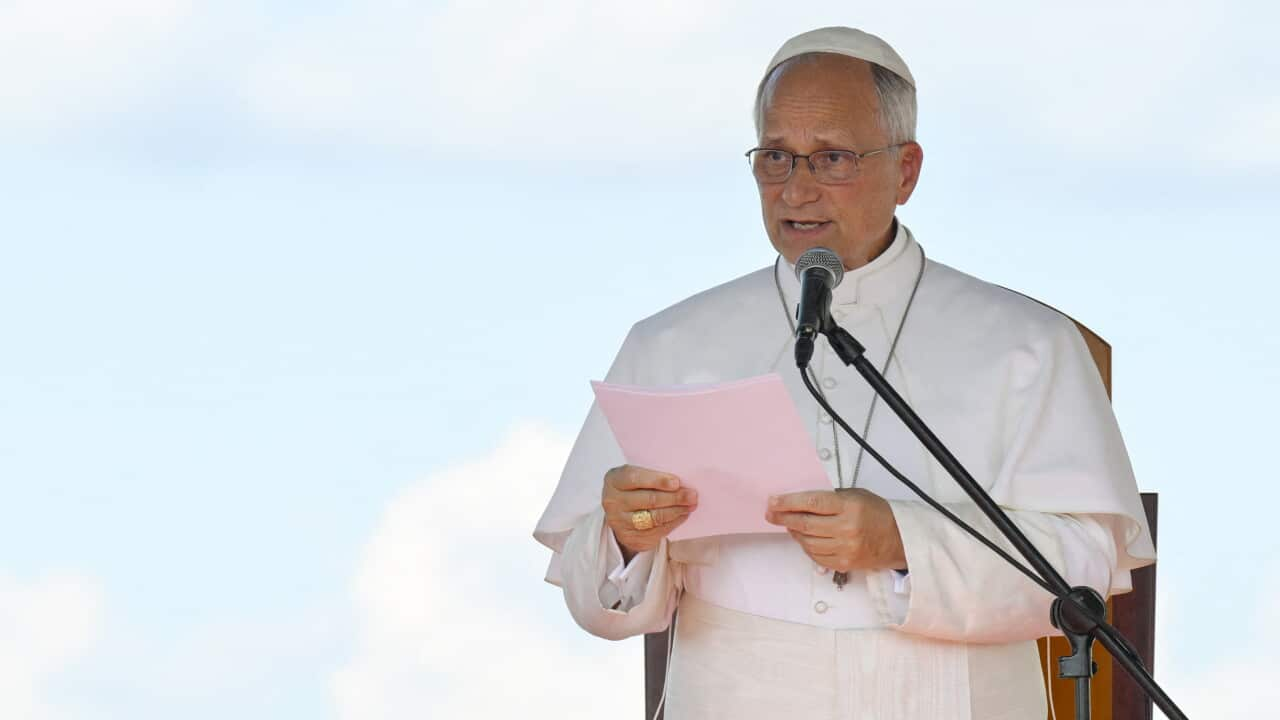
Pope Leo said his faith in democracy is what makes him an American, as he gave wide-ranging remarks that touched on his cancer diagnosis, church doctrine and the question of married priests on board the papal plane back to Rome from his visit to South America .
The pope, who also holds Peruvian citizenship, explained that “in many ways” he’s a “gringo, an American,” and this is apparent through his belief in democracy and how he addressed his recent surgery and health difficulties.
“When I talk about things, I’m generally straightforward, I tell it like it is,” he told reporters during an in-flight news conference on the plane departing from Lima. “When it comes to my health – even talking about it, like saying ‘well I’m going through this’ – that wouldn’t be typical in many countries and in many cultures, but in the United States it’s a bit more common.”
He added, “My deep faith in democracy and democratic participation is also part of being American.”
On his flight out to South America, the first US-born pope told CNN that he was “proud to be an American” and had cast a mail-in ballot during the US midterm election, likely the first time a pope has voted in secular, democratic elections.
On board the plane home after his trip, the pope addressed his health saying he is still “not 100%” but feels “quite well” and that “endurance is one of the gifts the Lord has given me.”
The pope explained that the discovery of a growth on his lung came as a “surprise” during a routine annual check-up, and that he had not experienced any symptoms before the tests. His surgery on October 13 removed the lower lobe of his right lung , and since then the pope has made a good recovery.
Leo stressed, however, that he didn’t see the need to sign a letter of resignation should he become incapacitated or fall into a coma, as some of his predecessors had done, explaining that church law makes provisions for such a scenario but that he would consider it in the future.
‘God is not neutral’: A look at Pope Leo’s political message in Latin America
During the 45-minute news conference, he covered a range of topics including the question of married priests in the Catholic Church, pertinent given he had visited the Amazon region of Peru where there is a drastic shortage of clergy. A major church gathering convened by Pope Francis in 2019 had petitioned to allow for the ordination of married men in the Amazon.
The pope said he would not make any changes in the short term to maintain church unity, but it was a topic that remained under discussion.
“It’s not the only solution, but it’s a solution, which in certain areas of the church can cause division because there is not universal… acceptance of that concept,” he said, adding that his priority had been to promote unity.
“The Pope doesn’t change church doctrine,” he added. “We all have to listen. The bishops have to listen. It may be in the future that some things will change.”
But he stressed that an “important part of my ministry to the church is to heal, bring people together,” and to “consider what we believe the priorities need to be, and then we’ll see how we walk forward from there.”
Pope Leo presides at biggest Mass of his papacy in Buenos Aires, drawing 2.5 million crowd
The Roman Catholic Church made celibacy a mandatory requirement for ordination to the priesthood in the 12th century, although there are exceptions.
Leo XIV said his meeting with victims of abuse within the church in Peru (he also met survivors in Argentina), was aimed at helping victims find a path that can gradually “lead them toward genuine healing” while representing a commitment that such abuses “never happen again.” He added that the Vatican was studying the topic of “spiritual abuse” within the church and trying to give it a legal definition, even though it remains a “vague concept.”
Although President Javier Milei’s austerity measures and funding cuts have affected the Catholic Church’s charitable work in Argentina, Pope Leo said his encounter with the Argentinian president had been “a positive encounter” and that they had been able to find a shared understanding on “the value of life – the value of the human being at every stage.” Milei, who was seen in tears saying goodbye to Leo as he left Argentina, “showed an openness to hear this message,” the pope said.
Pope Leo’s return to Latin America reveals the missionary message of his papacy
Leo also saw the funny side of being hit on the face with a religious item during the final mass in Lima. He said it was simply someone “of great faith” who wanted to offer him a rosary and showed the enthusiasm and deep faith in Peru.
“These are things that one carries in the heart, perhaps in your eyes,” he added.
Finally, the said he was not planning to ease restrictions on the traditional Latin Mass, which was codified in the 16th century and then reformed following a gathering of bishops at the Second Vatican Council, 1962-65. While Leo pointed out that the older liturgy can be celebrated with a dispensation, some have been pushing him to ease restrictions put in place by his predecessor, who said he had become concerned about some Catholics using the older liturgy to undermine church unity.
The traditional Latin Mass has several high-profile supporters including Shia LaBeouf, the actor, and Harrison Butker, the Kansas City Chiefs kicker.