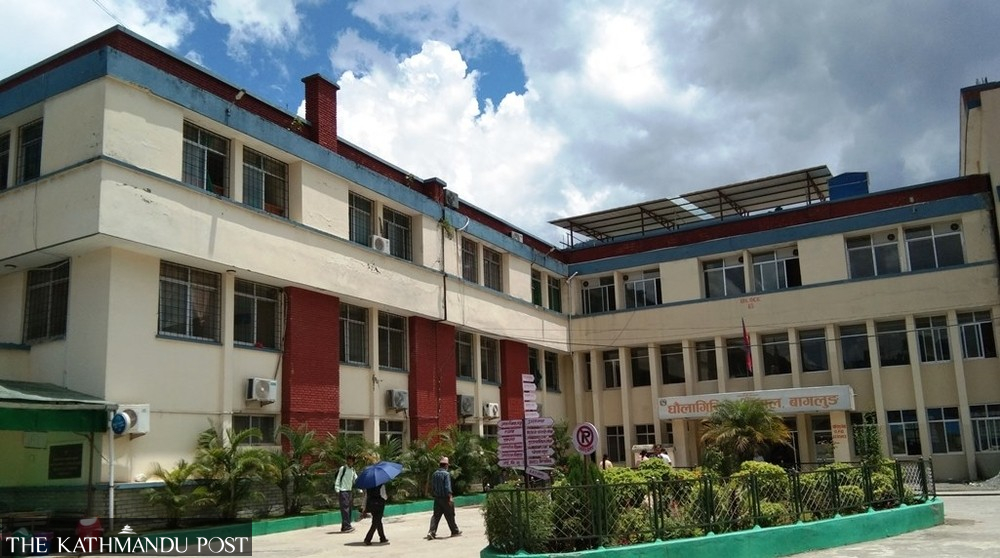
Constituent Assembly member Hari Bahadur Khadka was seriously injured in a road accident near Baglung Bazaar. He was taken to Kathmandu for treatment but died on December 7, 2014. As Dhaulagiri Hospital in Baglung lacked facilities to treat head injuries, he could not receive timely treatment. His death prompted discussions about establishing a trauma centre at the hospital.
In 2015, the government incorporated a plan to establish the Hari Khadka Trauma Centre into its policy and programmes. However, a decade later, the centre has yet to become fully operational. The hospital has been providing trauma care through a trauma unit for the past 10–11 years, but the plan to operate a separate centre has not materialised. The hospital still lists the Hari Khadka Trauma Centre in its long-term development plan.
Saying that its three existing buildings are insufficient to accommodate all its services, the hospital management committee has prepared a detailed project report (DPR) through the Building Division Office for the construction of two additional blocks—D and E—and requested budget allocations from the concerned department.
The hospital has already arranged equipment and specialist doctors for the proposed centre, said its chairperson, Shriprasad Sharma. The need for a dedicated trauma centre has become more pressing with the operation of the Kaligandaki Corridor and the Mid-Hill Highway, which have brought an increase in road accident cases.
The hospital's medical superintendent, Dr Kiran Tiwari, said a trauma centre was essential as patients with head injuries and other trauma-related conditions arrived almost daily.
According to hospital records, more than 150 patients with head injuries and similar trauma cases visit the hospital every month. The number of patients with other types of injuries is more than double that figure. A CT scan machine has already been installed, and the hospital has acquired other equipment as well.
Tiwari said the hospital was already performing surgical procedures that were generally available only at major hospitals in urban areas, adding that this would make it easier to operate a trauma centre.
"If we can establish a department with at least one MDGP doctor, we can run the centre," Tiwari said. "The shortage of space in the existing buildings is also making things difficult."
The Gandaki provincial government had allocated Rs1 billion for the hospital, from which a CT scan machine was purchased. The hospital has also procured other equipment and supplies required for trauma care and arranged specialist doctors. However, it still lacks an MDGP (general practice and emergency medicine) doctor. According to Tiwari, having an MDGP doctor would allow the hospital to continue surgical services more smoothly even when other specialists were unavailable.
Since the fiscal year 2019-20, the Gandaki provincial government has been allocating Rs5 million annually for the trauma centre. Although the amount is insufficient, Tiwari said the hospital could manage operations with its existing staff if it had the necessary sanctioned positions and rooms.
He said the hospital had also arranged for two radiologists, leaving no major technical obstacle to starting the centre.
"Our challenge now is to ensure the centre operates sustainably and that qualified personnel are available on a regular basis," Tiwari said. "If the required posts can be approved, we can establish a system for regular operations."
The hospital management committee believes that establishing an intensive care unit (ICU) with at least 10 beds would help fulfil the objective of the trauma centre, while also accommodating patients undergoing other surgical procedures. The hospital currently has four ICU beds, although it can use up to six.
Under the existing legal provisions, the Health Ministry must conduct an organisation and management (O&M) survey and submit a report on staffing positions, equipment and technology requirements before the trauma centre can become fully operational.
Prakash Baral is the Baglung correspondent for Kantipur Publications.