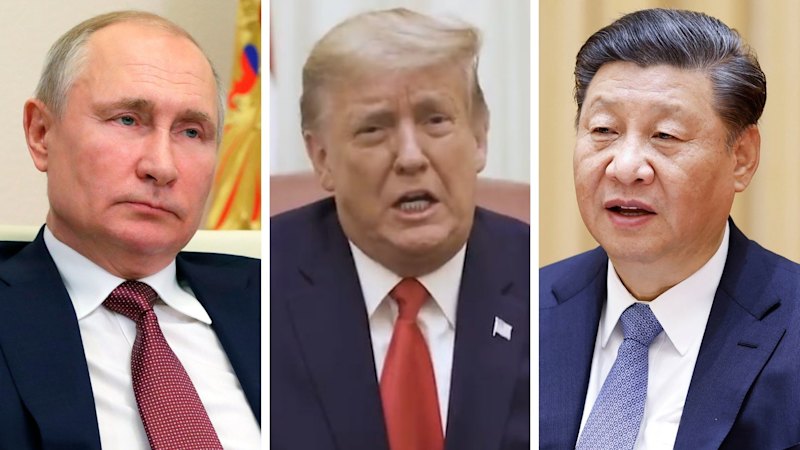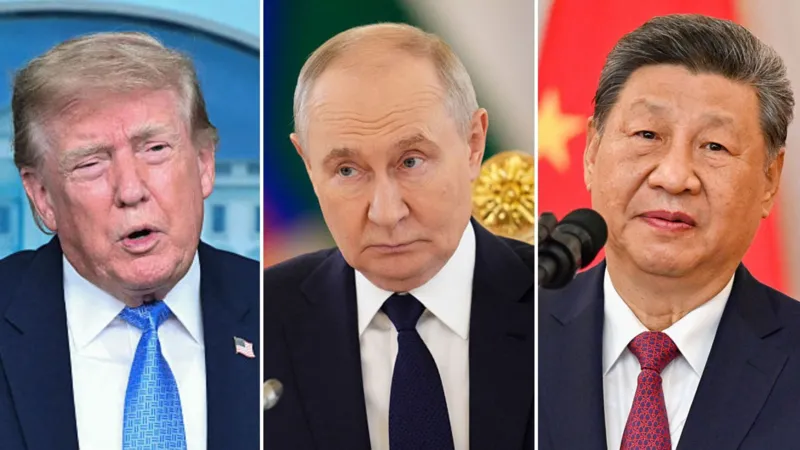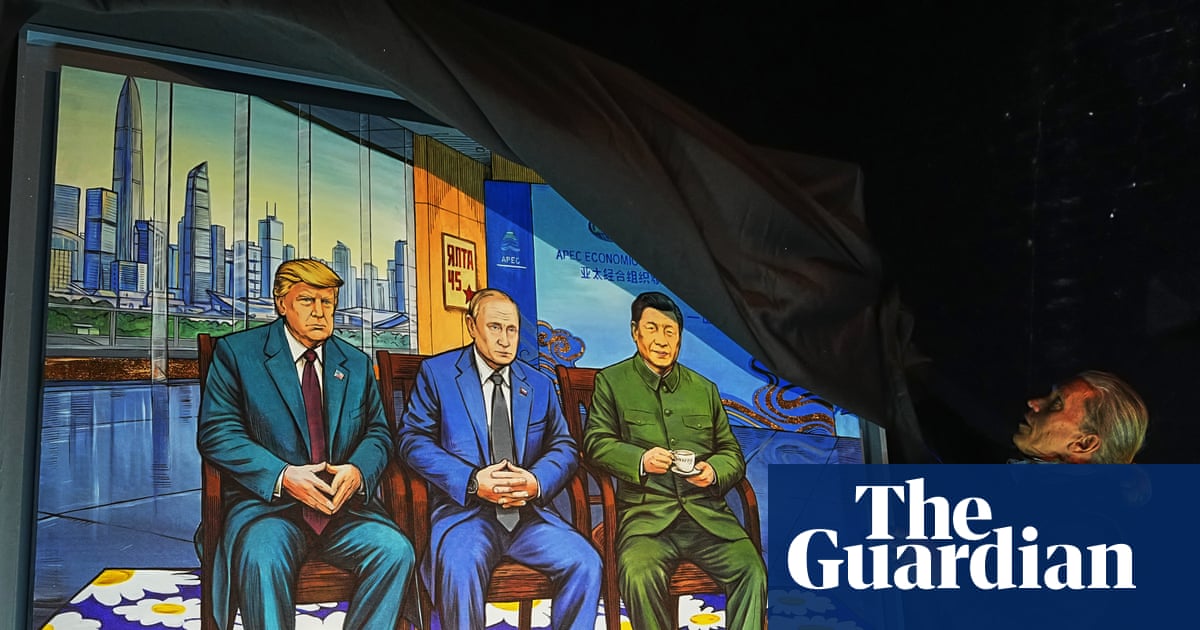


T he Ukrainian president, Volodymyr Zelenskyy, is among those who have expressed concern that the world will witness a Yalta 2.0 moment if Donald Trump, Xi Jinping and Vladimir Putin meet trilaterally, as expected, on the sidelines of the Apec summit in China next week.
It is a truism in diplomacy that if you are not around the table, the risk is that you, or your values, are on the menu and about to be carved up. Many excluded from the summit in Shenzhen, principally Ukraine but also eastern Europe and Baltic countries, Taiwan and even Iran, have reason to be nervous that their sponsors might abandon them in a complex geopolitical trade-off that Putin envisions, and Trump seems to endorse.
Putin has long proposed this re-enactment of the greatest wartime summit, held in February 1945 at Joseph Stalin’s insistence in a rundown Tsarist resort on the south coast of Crimea alongside Franklin D Roosevelt and Winston Churchill.
Trump has cast himself in the role of the enthusiastic guest while Xi acts the bashful host, ever reluctant to embrace the status of a traditional global superpower.
No one quite knows what will happen if the three men meet or even if China will allow more than a stiff protocol-driven exchange of statements. China is already trying to push nuclear disarmament off the agenda.
It may prove to be little more than abbreviated geopolitical theatre that Putin can retail domestically to show that Russia – even with an economy seven times smaller than that of the EU – still plays with the big boys.
But if Putin has his way he will try to ensure that this becomes the first of a series of meetings in this format in which the big powers organise a new world order on a set of security oriented principles in which liberal values play little part.
As Russia’s chief negotiator, Vladimir Medinsky, told Russian TV: “The task is to create a comprehensive system of comprehensive security in Europe that will become a new modern Yalta or Potsdam. If we manage to create such a security system then we will ensure peace in Europe for decades, perhaps even centuries. That is our main task.”
Russia’s foreign ministry spokesperson, Maria Zakharova, said the summit could mark “the start of a return from this slide into absolute chaos to stabilisation”. For Zelenskyy, the concern is that almost any time Putin and Trump converse, it is Kyiv that suffers.
The original Yalta is widely remembered, outside Russia, as a moment of cynical trade-offs, even ignominy, to rival the appeasement of the 1938 Munich agreement. It was eight days that shaped the postwar world in which absent countries were discarded or divided by the imminent wartime victors.
FDR, months from death, was intent on enlisting Russian support for a new League of Nations organisation and for Russian participation in the war against Japan. In return, he accepted the fait accompli of Russia’s presence in Poland, and covered his treacherous tracks by persuading Stalin to sign a declaration that affirmed the principles of “sovereign rights and self-government” should prevail in countries freed from Nazi rule.
Few thought the dictator had any intent to honour the agreement. Indeed, honour was somewhat absent throughout the eight days. When Churchill told Stalin it was a “matter of honour” that the independence of Poland, Britain’s original casus belli , was preserved, Stalin replied the issue for him was “a matter of life and death”. Churchill had no means to confront Stalin since by then he was the victor of Stalingrad and Kursk, and the commander of an army that had crushed Germany.
The subsequent sense of shame about the betrayal of Yalta accumulated mostly in America, so much so that in May 2005, before a trip to Moscow for the 60th anniversary of Victory in Europe Day, George Bush told an audience in Latvia that Yalta had “consigned millions to communist captivity. When powerful nations negotiated, the freedom of small nations was somehow expendable. Yet this attempt to sacrifice freedom for the sake of stability left a continent divided and unstable.” It was a view shared across Europe.
The Republican tradition expressed by Bush has been expunged by Trump. In his 2025 national security document, Trump lauded the sphere of influence geopolitics championed at Yalta. He named the western hemisphere as America’s domain. It remained deferential to Russia and China’s spheres.
Unfortunately, Trump took little notice of the strategy prepared for him. He retained his respect for Putin and Xi, but indulged himself, and Israel, in a disastrous imperial overreach elsewhere, notably in Iran .
As a result, the US and Russia are approaching the summit seeking China’s help to extricate them from wars of choice that have wounded them. Xi is cast in the role of Stalin, hosting two countries in need of his beneficence.
It leaves China somewhat wary, reluctant to use its leverage if it helps the US, or is seen to run counter to the Chinese narrative of being a force for stability and coexistence. Speaking at the Emirates Policy Center conference in Abu Dhabi, Prof Minghao Zhao from Fudan University gave a classic exposition of Chinese non-interference. “The Russia-Ukraine war is the strategic mistake made by the Russian president. The Iran war is the strategic mistake made by President Trump. China is managing the consequences of those conflicts.”
By contrast, Dr Wang Huiyao, the president of the Center for China and Globalization and an early advocate of a trilateral summit, argued China was needed. He referenced the Kindleberger trap – a period of chaos caused by too little global leadership. He said China was trying to be helpful by propping up multilateralism and might provide guarantees in Iran, something the Iranian leadership favours, but even he saw China’s stabilisation role largely through the prism of developing the global economy.
In short, China might help extricate Trump in the Middle East. After all, open waterways are necessary to meet its insatiable demand for oil.
But China sees Ukraine as a strictly European security issue in which it is not willing to betray Putin, or endorse a settlement reached without Europe’s agreement. China is in the midst of repairing relations with Europe after China’s industrial overcapacity in 2025 flooded the European market, risking its deindustrialisation. China’s embrace of Putin’s vision of a new European security architecture would infuriate Germany and the European Commission.
For some, such as John Ikenberry, the theorist of liberal internationalism, the sight of the US president carving up the world with autocrats is anathema. He thinks there is a viable alliance of democracies.
But Charles Kupchan, a senior fellow at the Council on Foreign Relations, says more Yaltas are the future. “We have to learn to work across the geopolitical and ideological dividing lines,” he said. “We are now in a world in which the US and its democratic allies are no longer the preponderant coalition.
“Who is coming up? China, India, Indonesia, large countries of the global south – all of then playing the field and most of them have closer economic ties with China than with the US.
“We are going to have to learn to work with autocracies and to live with them more comfortably. Is there a downside risk? Sure. Might Trump throw Taiwan and Ukraine under the bus? Possibly, but I doubt it. But we need to break the ice. These conversations have to start now and I give credit to President Trump for starting it.”