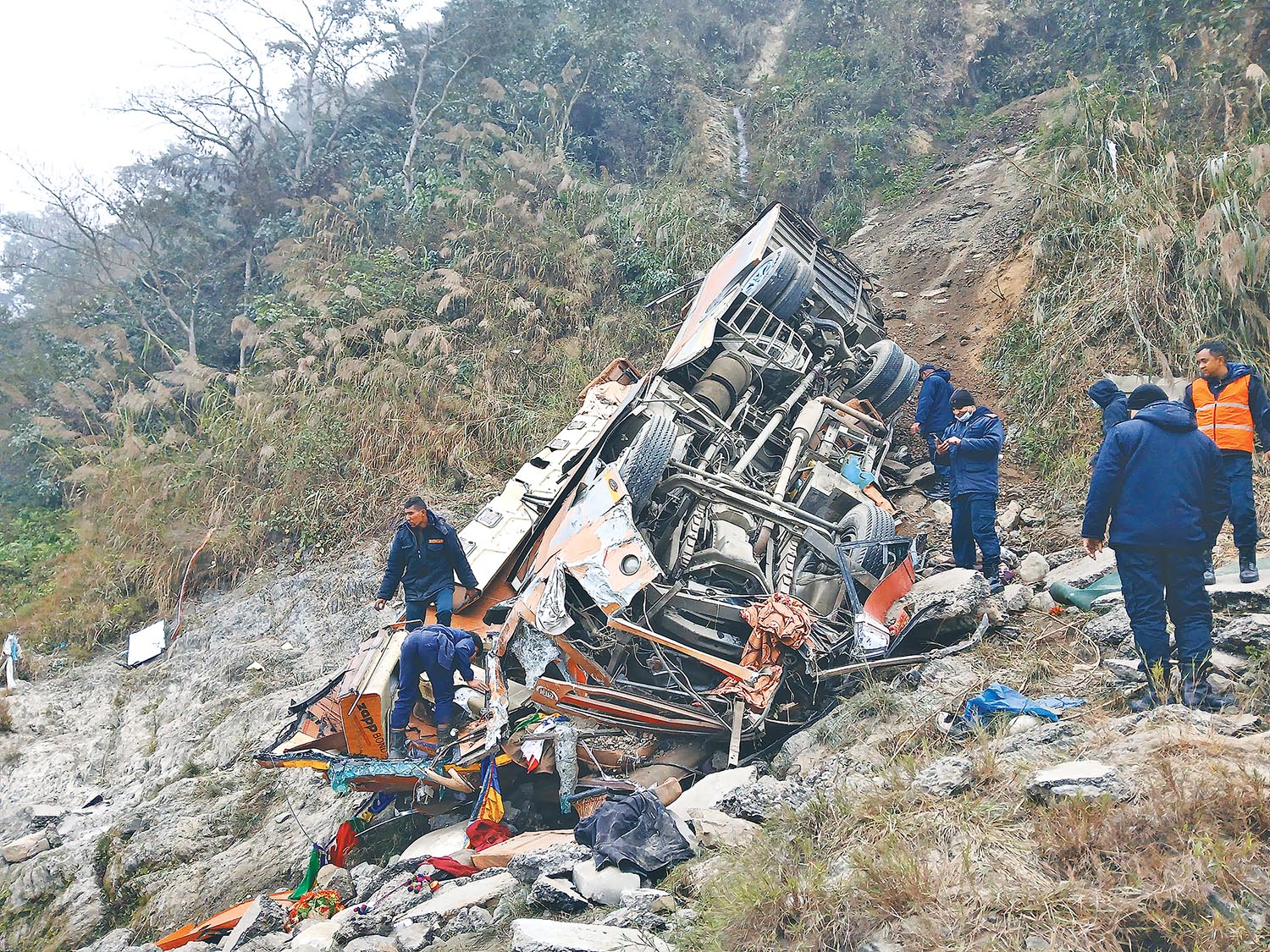
When a passenger bus travelling from Pokhara to Kathmandu plunged 200 metres off the road in Benighat Rorang, Dhading, on February 24, 19 people were killed. The home ministry formed a task force to investigate the crash.
The task force concluded that driver fatigue had caused the accident, as the driver had been unable to maintain control of the vehicle. It recommended introducing a system to manage driver fatigue, setting maximum working hours for drivers on night services and making rest breaks compulsory. It also called for digital monitoring of public vehicles, improvements to road safety infrastructure, closer monitoring of night-time travel, and the installation of cameras and tracking systems in public transport.
None of these recommendations has been implemented.
Nearly two months later, on April 30, a vehicle travelling from Rukum East towards Jaljala in Rolpa crashed, killing 20 people.
The home ministry again formed an inquiry committee. Although the committee submitted its report, its findings were not made public. Police said the jeep crash was caused by several factors, including continuous rainfall, overloading and inadequate monitoring of vehicles.
On Thursday, 14 people, including the driver, were killed when a microbus crashed in Bhimphedi, Makawanpur. The vehicle, with a seating capacity for 11, was carrying 20 people. According to Makawanpur police, 13 passengers and the driver died.
Police suspect that overloading and the driver's long hours behind the wheel may have contributed to the crash.
A committee led by Shesh Kanta Poudel, assistant chief district officer of Makawanpur, has been formed to investigate the accident. It has been given seven days to examine the cause of the crash, the condition of the road and potential risks, and submit a report.
Such committees and task forces are routinely formed after major accidents. Their investigations repeatedly identify familiar problems: poor road conditions, driver negligence, long hours behind the wheel without adequate rest, unhealthy competition among drivers and vehicles carrying more passengers than their permitted capacity.
Yet, despite identifying the problems and recommending solutions, the reports are often shelved.
Stakeholders say road accidents are increasing rather than declining because the recommendations are not effectively implemented.
The government must take road safety seriously and make protecting human life its top priority to prevent such accidents from recurring, said Punya Prasad Sitaula (Saroj), president of the Federation of Nepalese National Transport Entrepreneurs.
Writing on Facebook after a microbus crash in Bhimphedi, he said the accident had raised serious questions about the safety, technical condition and operating standards of electric vehicles.
“On such matters, the government must act responsibly and sensitively,” he wrote. Road accident prevention, he added, was not simply a matter of fate but a responsibility of the state, requiring technical safety guarantees and collective accountability from all stakeholders.
According to Nepal Police, the country recorded 187,949 road accidents over nine years, from the fiscal year 2018-19 to mid-October of the fiscal year 2026-27. The crashes left 51,049 passengers seriously injured and killed 21,031 people.
One of the country's worst recent road disasters occurred on July 12, 2024, when a landslide carrying mud and debris swept two passenger buses off the Narayanghat-Muglin road at Simaltal in Bharatpur-29 and into the Trishuli river. Nineteen bodies were recovered. The two buses were carrying 62 passengers. Three people were found alive, while 40 remained missing in the river.
Three days later, on July 15, a six-member task force led by Home Ministry Joint Secretary Chhabi Rijal was formed through a ministerial decision to investigate the disaster.
The task force recommended a range of measures to reduce road accidents, to be implemented through the Ministry of Physical Infrastructure and Transport, now the Ministry of Infrastructure Development. These included drafting a new Road Safety Act, establishing a National Road Safety Council, formulating a national road safety policy, and preparing standards, codes and procedures related to road safety.
None of these measures has been introduced and implemented in line with the recommendations.
The report also called for standards based on road classification, mandatory crash barriers on hazardous roads, public disclosure of risk assessments for major highways, and the installation of streetlights and CCTV cameras at dangerous and strategically important locations along highways. These recommendations, too, remain unimplemented.
Asked why investigation reports prepared after accidents are not put into practice, Anand Kafle, joint secretary and spokesperson for the home ministry, said the recommendations often involved several government agencies.
“Once a report is received, the issues it raises often concern multiple agencies. The ministry forwards the recommendations to those agencies for implementation, while also carrying out measures within its own jurisdiction,” he said.
Kafle claimed that some investigation reports had been made public and their recommendations implemented. But he said the availability of resources at the agencies concerned could limit implementation, with some measures having to be accommodated within their regular budgets.
“Some recommendations concern policy reforms. The vehicle-related law is being revised through the Ministry of Infrastructure Development, and suggestions made in these reports are being considered while drafting laws and regulations,” he said.
Traffic police say speeding and driving under the influence of alcohol are also major causes of road accidents. Accidents increase when both drivers and passengers are in a hurry.
Former Additional Inspector General of Police Bhim Prasad Dhakal, however, says driver negligence is responsible for most accidents. He also points to poor road conditions and the failure to carry out technical inspections of vehicles.
“Accidents also occur because traffic rules are not followed,” said Dhakal, who spent much of his career working at the Kathmandu Valley Traffic Police Office.
With large numbers of people travelling home during festivals, the risk of accidents rises, he said. Traffic police, transport offices and the Department of Roads should therefore pay closer attention during these periods.
“Additional checks must be arranged, and those who violate the rules should be penalised on the spot,” he said. “Transport laws need to be revised. Because traffic fines are relatively low, some drivers seem to be careless.”
He also called for road improvements, regular vehicle inspections and greater caution when driving in adverse weather conditions. Although rules require two drivers on vehicles operating night services, he said the provision has not been fully enforced.
Section 104 of the Motor Vehicles and Transport Management Act, 1993, needs passenger vehicles operating long-distance services to have at least two drivers. It also says the transport operator or vehicle owner must ensure that the drivers take turns at the wheel every six hours.
The provision, however, is not being respected, and the agencies responsible for monitoring compliance appear to have shown little interest in doing so.
The failure to act on investigation reports after major accidents is a longstanding problem, said former Home Secretary Umesh Mainali.
“Task forces are formed to investigate major accidents and prepare reports, but there is no follow-up on the recommendations they make,” he said. Overloading, he added, continues to cause accidents.
The relevant authorities must ensure that vehicles carry only the number of passengers they are designed for and that only suitable vehicles operate on particular types of roads, he said.
“Passengers who have been waiting for a long time tend to board the first vehicle that comes along, eager to reach their destination. They often do not consider how crowded it already is,” Mainali said. “Drivers, meanwhile, keep taking on passengers without regard for the vehicle’s capacity. This is how overloading leads to accidents.”
He believes the failure to effectively implement investigation recommendations is giving rise to accidents.
“Vehicles must carry passengers only up to their seating capacity. Traffic police must enforce this strictly,” he said.