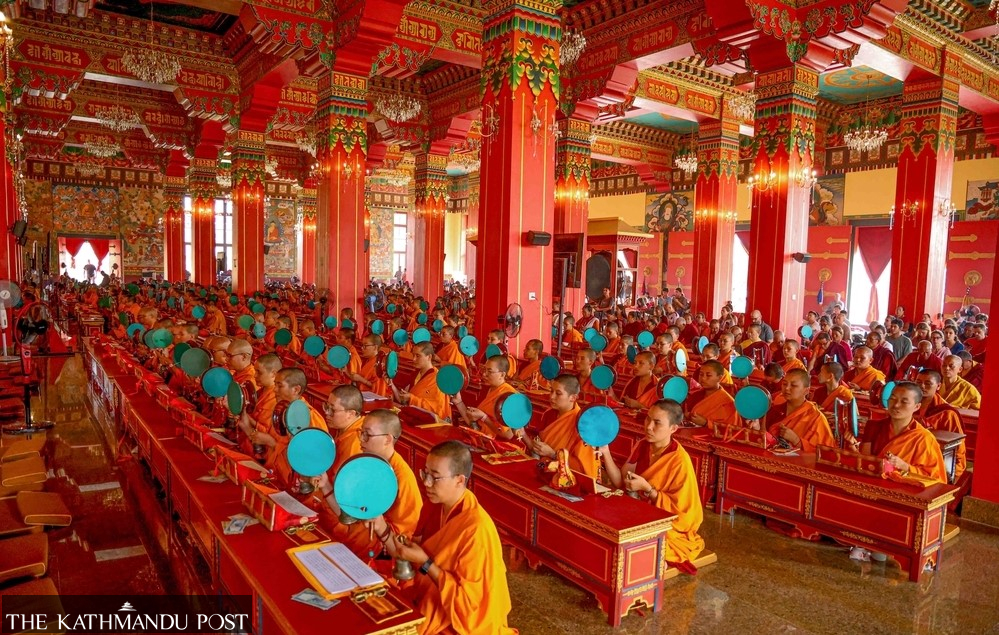
The steady chanting of sacred prayers fills the air. More than a thousand Buddha statues stand nearby as people dressed in yellow and saffron robes pray together. Theravada and Mahayana Buddhists take turns reciting religious texts, which are translated into seven languages for participants.
For the past two weeks, Lumbini, a sanctuary of world peace, has been alive with spiritual activity.
Large groups of monks, nuns, novice nuns and Buddhist teachers can be seen along its roads, accompanied by equally large numbers of lay devotees. After four to five years of relative quiet, the birthplace of Buddha is once again bustling with visitors.
A series of major spiritual gatherings has filled Lumbini with prayers and chants for world peace. The large-scale assemblies have also helped reaffirm Nepal’s place as a source of peace for the world, said Bhikkhu Siri Bajir, an assistant professor at Lumbini Buddhist University.
Three major international Buddhist prayer and teaching events are taking place in Lumbini around the same time.
Nepal’s novice nuns held the eighth World Peace Monlam Prayer from October 30 to November 1, with 100 participants. The event was organised by the Nepal Buddhist Lotus Sramaneri Association.
While the novice nuns’ gathering was under way, Buddhists from India’s Himachal Pradesh organised the first Taklung Kagyu National Great Prayer Festival, a five-day event in Lumbini.
The festival featured prayers for the protection, welfare, happiness, peace and longevity of all living beings. At the concluding ceremony on November 6, three prominent Nepali Buddhist teachers, Phado Rinpoche, Mafto Rinpoche and Chhemto Rinpoche, conducted an empowerment ceremony of the Thousand Buddhas and delivered religious teachings.
Around 250 monks and nuns attended the festival. More than 100 lay devotees from the United States, Canada, Malaysia, Vietnam, China, Hong Kong and Thailand also took part, said Khenpo Lophel, the event coordinator.
Alongside these two gatherings, the Thousand Buddha Temple-Pal Thubten Shedrub Ling- in Lumbini hosted the second International Pranidhana Ceremony from November 1 to 7.
Buddhist monks, nuns and practitioners from different countries came together to recite the Buddha’s teachings. Followers of various Buddhist traditions participated, with the scriptures recited in several languages, including Pali, Sanskrit, Chinese, Tibetan, Vietnamese and English.
The prayers and teachings were led by renowned Buddhist teacher Chhokyi Nyima Rinpoche. Foreign interpreters translated the proceedings into seven languages: Nepali, English, French, Spanish, Russian, German and Mongolian.
Following the first seven-day programme, a second phase of Buddhist teachings was held for three days from November 8.
Chhokyi Nyima Rinpoche, the revered head teacher of the Mahayana Kagyu lineage, conducted an empowerment ceremony of the Thousand Buddhas and delivered religious teachings. Around 250 foreign participants from 18 countries attended, alongside more than 500 lay devotees from different parts of Nepal.
The programme was organised to coincide with Lhabab Duchen, an important festival in the Tibetan Buddhist tradition. The festival commemorates Buddha’s descent to Earth after delivering religious teachings to his mother and other celestial beings in the realm of the gods.
Observed on the 22nd day of the ninth month of the Tibetan calendar, Lhabab Duchen is regarded as one of the four major sacred days in Buddhism, said Khenpo Pema.
The spiritual gatherings have also brought a welcome revival to Lumbini’s struggling tourism industry, said Lila Mani Sharma, president of the Lumbini Hotel Association.
The increase in religious activities has attracted more domestic and international visitors, creating a livelier tourism atmosphere. Tourist arrivals have gradually picked up, injecting fresh energy into a sector that had remained sluggish and raising hopes among local businesses and tourism entrepreneurs.
“Businesses here are encouraged by the increase in tourist arrivals,” said tourism entrepreneur Purushottam Aryal. “It would be even better if we could find ways to extend visitors’ stays. That will require proper planning.”
Jasper Moller, a tourist from Germany, said being able to experience Lumbini’s spiritual atmosphere and sanctity had given him a sense of peace and harmony.
He was equally impressed by the landscape: its green, open plains, clear weather, beautiful temples and views of the Himalayan range to the south.
Visitors to Lumbini were often captivated by the setting, he said.
“Walking through the gardens under an open sky and in clean weather gives you a genuine sense of peace,” he said. “Spending a night there on the occasion of Buddha Purnima was an experience unlike any other.”
The growing activity in Lumbini is significant not merely because of the number of visitors but also because of the presence of people whose faith is rooted in a commitment to peace, said Dr Haridhwaj Rai, senior information officer at the Lumbini Development Trust.
The gatherings are making a substantial contribution to the development of spiritual tourism in Lumbini, he said.
The trust expects tourist arrivals in Lumbini to increase by around 12 percent in 2026 compared with 2025. Lumbini is the most visited tourist destination in Nepal.
Manoj Paudel is the Kapilvastu correspondent for Kantipur Publications.