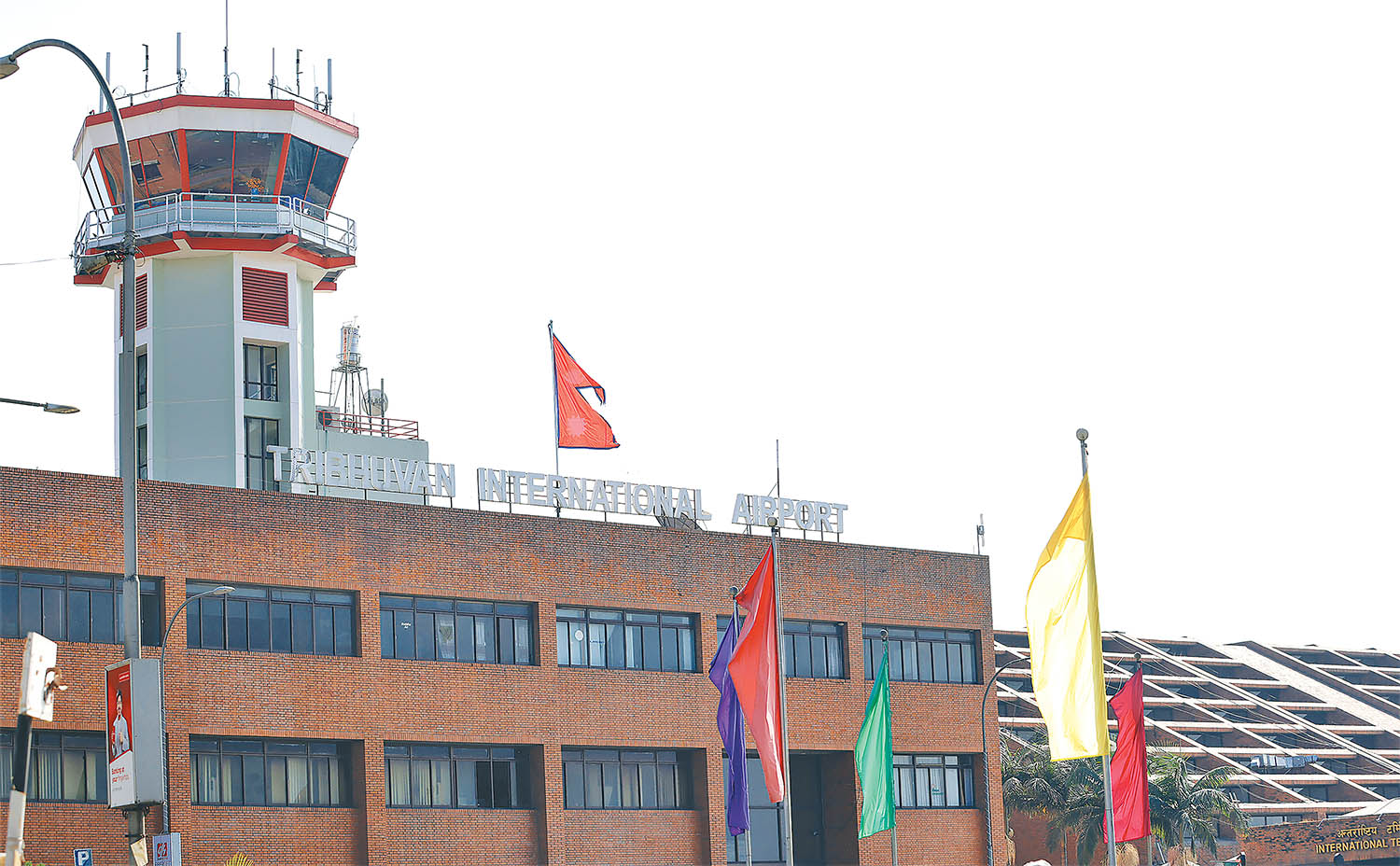
Forty-two entities, including government agencies, domestic and international airlines, hotels, construction companies, and other service providers owe Tribhuvan International Airport more than Rs1.55 billion, according to the latest statement on outstanding dues prepared by the Civil Aviation Authority of Nepal.
The largest amount is owed by the Tribhuvan International Airport Customs Office, according to the aviation authority’s statement. The office has outstanding dues totalling Rs572 million in rent, electricity and water charges, the authority said. It is followed by Himalaya Airlines, which owes Rs357.7 million, and Oriental Hotels Limited, which operates Hotel Radisson, with outstanding dues of Rs206.6 million.
The combined outstanding amount owed by these three entities alone exceeds Rs1.14 billion, accounting for nearly 73 percent of the total dues.
According to the authority's records, Universal Supply Agency owes Rs87.2 million, IMS Airport Services Rs62.6 million, Necon Air Rs46.3 million and Guna Airlines Rs43.9 million. Food City Nepal owes Rs29 million, Cosmic Air Rs26.9 million, Jet Airways Rs20.2 million and Gulf Air Rs18.6 million. All the aforementioned domestic and foreign airlines, except for Himalaya, are no longer in operation.
Tek Nath Sitaula, general manager of Tribhuvan International Airport, said the Rs572 million owed by the customs office comprises electricity charges and building rent.
The customs office has not paid these amounts since the Civil Aviation Authority of Nepal began operations in 1999. “The customs office owes us both electricity charges and rent. It has not paid from the beginning,” he said.
Although the authority has periodically sent bills and issued reminders demanding payment, it has yet to recover the outstanding amount from the customs office. Since CAAN began operations in 1999, the dues have accumulated over nearly 27 years.
The customs office's outstanding dues have long been a contentious issue. The Office of the Auditor General also flagged the unpaid building rent in its performance audit report published in 2022.
The auditor general's report noted that CAAN had been writing to the customs office since 2013, seeking to recover the outstanding amount. Tribhuvan International Airport collects rent from revenue- and fee-collecting agencies operating at the airport, except security agencies such as Nepal Police.
The outstanding dues owed by airlines include landing, parking and navigation service charges, as well as rent for rooms they use at the airport, Sitaula said.
“Landing, parking, and navigation charges are the main dues of airlines, along with room rentals,” he said.
Among foreign airlines that have stopped operating flights to Nepal, Gulf Air owes Rs18.6 million, Kingfisher Airlines Rs11.5 million, Air Sahara Rs3.4 million, Pakistan International Airlines Rs2.6 million, and Bahrain Air Rs2.4 million.
Necon Air, Cosmic Air, Air Sahara, Kingfisher Airlines and Jet Airways have not been in operation for a long time. Although these airlines are no longer operating, their financial liabilities arising from their use of the airport remain on the authority's records.
Reports by the Office of the Auditor General have repeatedly pointed out weaknesses in CAAN's efforts to recover outstanding dues from domestic and international airlines that have ceased operations.
The authority's latest list also shows that the United Nations Mission in Nepal (UNMIN), which ceased operations in 2011, owes Rs1.42 million. The auditor general's 2022 report stated that UNMIN had outstanding dues of Rs3.11 million across 20 airports in Nepal, of which Rs1.42 million was attributable to Tribhuvan International Airport.
CAAN has clear legal authority to recover outstanding payments. Section 10 of the Civil Aviation Authority of Nepal Act, 1996, empowers the authority to collect fees and rent for various services provided at airports, including electricity, the use of buildings and rooms, land rentals, and other amenities.
Section 27 of the Act provides that fees, rent, and compensation payable to the authority can be recovered in the same manner as government dues. The Airport Service Charge Rules, 2021, also provide for additional action against individuals, institutions, and airlines that fail to clear their outstanding payments.
Under Rule 29, fees must be paid within the period specified in the regulations. If no payment deadline is prescribed, the amount must be paid within the timeframe set by the authority. The rules also require advance payment of rent for buildings and rooms, land and hangars, advertising charges, and amounts payable under contractual agreements.
Under Rule 31, airlines must pay the relevant charges within 30 days of the issuance of an invoice. If payments are not made on time, a late fee of 0.05 percent per day is imposed for the first 60 days. Thereafter, an annual interest rate of 15 percent is charged on the outstanding principal along with the accumulated late fees.
The rules also allow the authority to suspend airport permits, agreements with CAAN or business approvals issued to individuals or organisations that fail to pay the prescribed charges.
The authority can also seize the organisations’ assets located within the airport premises and prohibit them from operating. If an organisation fails to pay its dues within 60 days of an invoice being issued, it can be barred from conducting business at the airport. In the case of airlines, their flights can be suspended immediately.
Institutions and companies that fail to pay amounts owed to the authority or violate contractual agreements can be blacklisted for up to three years, preventing them from engaging in businesses or activities related to civil aviation, airports, and the authority.
Airlines are also required to deposit, either in cash or through a bank guarantee, an amount equivalent to their estimated monthly landing, parking, navigation, aviation assistance, and security charges before commencing flight operations. If an airline has outstanding dues, the authority can deduct the amount from this security deposit.
Suraj Kunwar is a senior correspondent with over two decades experience covering Aviation, Tourism and Mountaineering. He received the IFJ Tolerance Award in 2005.