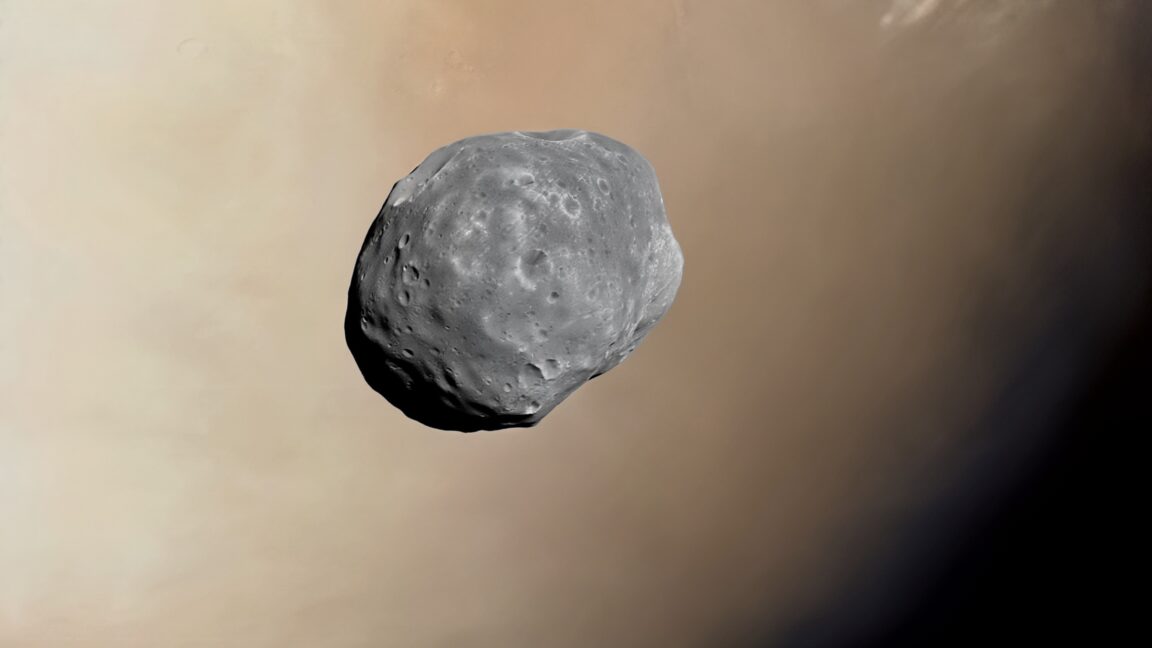
Japan launched a $578 million mission Monday on a five-year expedition to land on the largest moon of Mars and retrieve samples for return to Earth, a daring international project that could yield new insights into the formation of the Solar System.
The robotic Martian Moons eXploration mission, known as MMX, lifted off at 3:41 pm EDT Monday (4:41 am Japan Standard Time Tuesday) from Tanegashima Space Center in southern Japan.
The MMX spacecraft rode into orbit atop a 207-foot-tall (63-meter) H3 rocket, Japan’s flagship launch vehicle. The rocket assigned to MMX debuted a new souped-up configuration with four strap-on solid rocket boosters, full-throttle main engines, and an extended payload shroud to accommodate the demands of Japan’s heaviest and most ambitious interplanetary mission to date.
The rocket’s upper stage accelerated the MMX spacecraft to a top speed of more than 24,000 mph, fast enough to break free of Earth’s gravitational pull for the 10-month voyage to Mars. The nearly 9,900-pound (4.5-metric ton) spacecraft — two-thirds of its mass comprised of propellant — separated from the H3 rocket about 71 minutes after liftoff.
Hiroshi Yamakawa, president of the Japan Aerospace Exploration Agency (JAXA), declared the launch a success. “A long journey of five years has just started,” Yamakawa said.
MMX established contact with ground controllers, unfurled its solar panels, and was in a “very stable condition” soon after separating from the H3 rocket, according to Yasuhiro Kawakatsu, the mission’s project manager at JAXA. “So far, so good.”
“The MMX [mission] we launched today is a challenging mission aiming for the world’s first sample return from the Martian moons,” said Yoshihiro Seki, Japan’s science minister. “We hope that the results obtained through this mission will contribute to the development of our nation’s space science and exploration technology.”
The mission to the Martian moons builds on Japan’s success in leading the Hayabusa and Hayabusa 2 missions , the world’s first two spacecraft to bring back pristine specimens from asteroids. Scientists believe Phobos could itself be an asteroid that was captured into orbit around Mars billions of years ago. One of MMX’s science goals is finding out if that theory is correct.