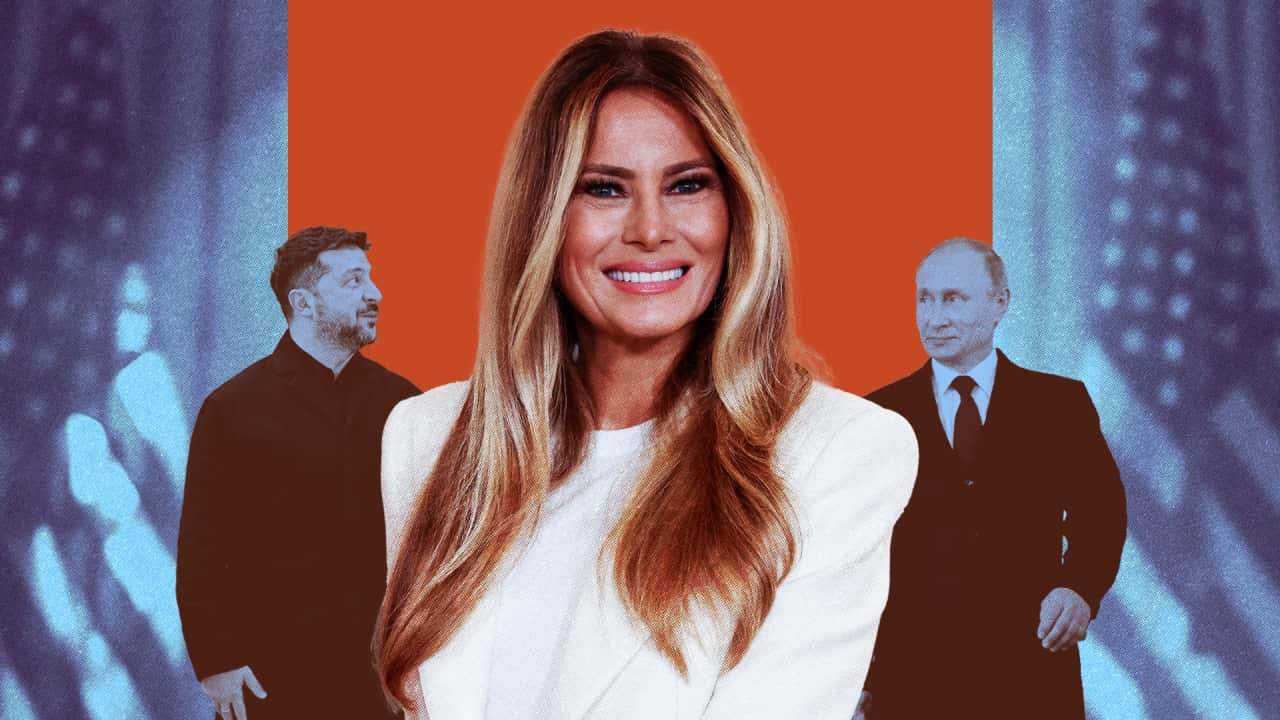
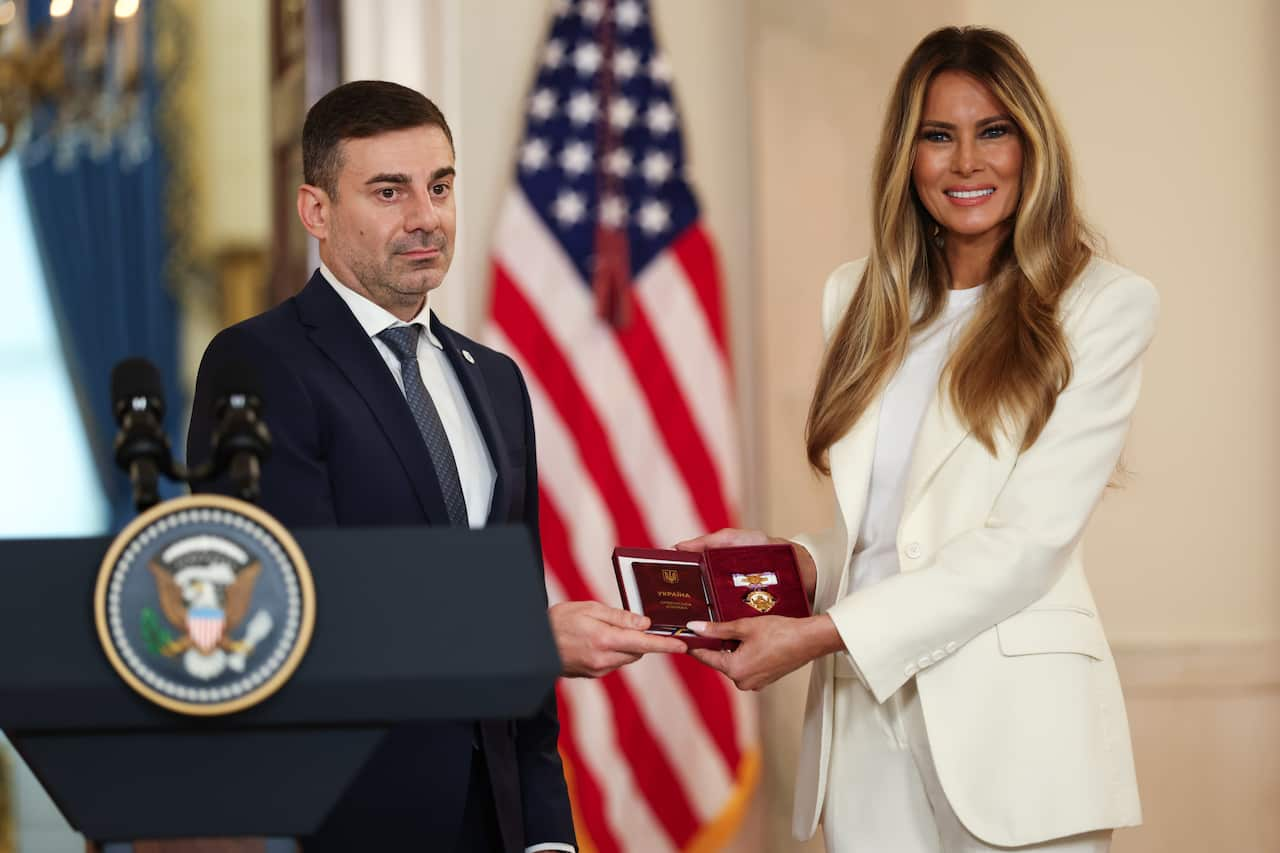
United States First Lady Melania Trump brought Russian and Ukrainian officials together at the White House on Friday.
She was marking a rare six-day ceasefire in Russian-occupied Ukraine, which allowed desperately needed aid to reach civilians and hundreds of people to escape a devastated city.
Melania Trump has been credited with helping broker the agreement, but questions remain over the extent of her involvement and whether it could lead to broader peace negotiations.
Experts tell SBS News the first lady's involvement raises questions about her diplomatic influence and whether the humanitarian breakthrough could lead to lasting peace.
Your trusted source for staying up-to-date with the world around you. Get free daily news updates and analysis, straight to your inbox.
The ceasefire, which ran from 27 October to 1 November, covered Oleshky and surrounding areas of southern Ukraine's Kherson region.
Residents of the Russian-held city had faced severe shortages of food, medicine and clean water, as well as years of bombardment and dangerous, mined roads.
Nearly 800 people were evacuated, Melania Trump told Russian and Ukrainian representatives at the White House on Friday.
Kyiv and Moscow have not independently published evacuation totals, but both sides acknowledged the operation's humanitarian outcome.
At Friday's gathering, she urged the delegations to build on that cooperation.
"We have chosen humanity over war," she said, calling for "something more enduring than a temporary ceasefire".
Her involvement began with efforts to reunite children separated from their families by the war.
In August 2025, she wrote to Russian President Vladimir Putin about the plight of children; US President Donald Trump delivered the letter during their Alaska summit.
The White House says those channels helped reunite 34 children with their families before Melania Trump directed her adviser Marc Beckman to work with Russian and Ukrainian officials over Oleshky.
She says both countries formally designated her an "exclusive intermediary" and that she personally reviewed evacuation routes, aerial images and medical arrangements.
For Olga Oleinikova, a Ukrainian-born associate professor of migration at the University of Technology Sydney, the result matters regardless of the politics.
"I think this humanitarian support is amazing," she told SBS News.
She described such initiatives as "low cost and high visibility for both sides", but said they also demonstrated that Russia and Ukraine could still reach agreements with people at their centre.
Robert Horvath, a Russian politics expert at La Trobe University, disputes the extent of Melania Trump's influence.
"I don't think there's any serious evidence that she has been a major actor in this process," he told SBS News.
French newspaper Le Monde reported that Russian and Ukrainian military intelligence services spent four months negotiating the evacuation, which was then organised by human rights officials from both countries.
The newspaper said the extent of the White House's involvement remained unclear. Melania Trump has said she initiated discussions with both countries and helped negotiate the terms of the ceasefire.
Horvath said Melania Trump's influence amounted to "being a symbol of the Trump administration", arguing that both Kyiv and Moscow had incentives to praise her to maintain favour in Washington.
He described the publicity as "basically a PR operation".
He also pointed to the administration's decision in October to temporarily ease US sanctions on Russian diesel, questioning whether the upbeat diplomacy obscured broader policy choices that benefit Russia.
While Horvath questions Melania Trump's diplomatic influence and suggests her involvement is benefiting Moscow, Oleinikova sees the humanitarian efforts as a positive step towards further negotiations.
She describes the first lady's involvement as "family diplomacy", arguing that her relationship with the US president and engagement with Ukraine's first lady Olena Zelenska could provide an alternative channel for diplomatic cooperation.
Oleinikova told SBS News that she believes there is a "soft power game" at play, with the potential to encourage further humanitarian cooperation.
Ukraine has formally recognised Melania Trump's humanitarian efforts, with President Volodymyr Zelenskyy awarding her the Order of Princess Olga, First Class, a state honour recognising women for exceptional contributions to public service and charitable work.
The award was presented by Ukraine's human rights ombudsman, Dmytro Lubinets, during Friday's White House meeting.
One question is whether a localised truce can change a war that continues elsewhere.
Ukraine's military has accused Russian forces of using the pause to rotate troops, reinforce positions and increase ammunition deliveries.
While the Kremlin said it had no specific information about Russian movements, it suggested Ukrainian forces might also have regrouped.
Russian attacks elsewhere in Ukraine continued during the Oleshky ceasefire, and Moscow has said no similar local ceasefire is currently planned.
Oleinikova remains hopeful that practical cooperation might create momentum, but acknowledges the limits.
"The humanitarian area and battlefield are two different things, unfortunately," she said.
She said she communicates daily with relatives in Kyiv, where residents continue to endure attacks and water shortages.
"There's no humanitarianism on the battlefield," she said.
Horvath, however, questions whether Melania Trump has any meaningful diplomatic influence, arguing that Putin stands to benefit from the publicity surrounding her peace efforts, without changing Russia's military objectives.
Donald Trump held private talks with Russian envoy Kirill Dmitriev following Friday's White House meeting, but did not meet with Ukrainian representatives.
The US is also scheduled to mediate talks between Russia and Ukraine in Abu Dhabi on 10 and 11 November.
Oleinikova said the remaining test is not whether a White House meeting looks like progress, but whether humanitarian cooperation ultimately changes the reality of the war.
"I want to be optimistic," she said, emphasising that previous humanitarian successes had not brought a broader peace.