O to Klempíř was for many years the frontman of JAR, a popular Czech funk-rock band. He was expelled from the band last year, not over creative differences, or even because of his collaboration with the secret police in the 1980s, but after he declared his intention to stand for parliament for Motorists for Themselves, a populist, nationalist, climate-sceptic party that is closely aligned with Maga ideology.
Klempíř is now Czechia’s culture minister and a leading figure behind an intensifying set of culture wars promoted by Andrej Babiš’s ruling coalition as it seeks to tighten its grip on power. Increasingly the government is borrowing methods favoured by Viktor Orbán in Hungary and Robert Fico in Slovakia.
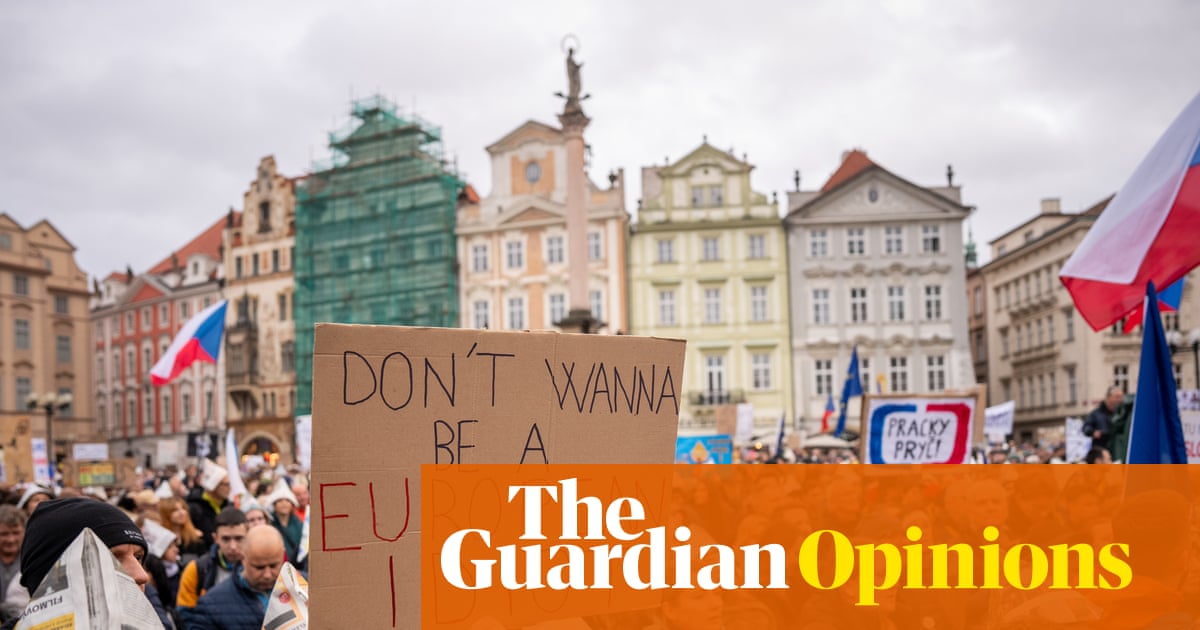
With tensions rising, thousands turned out to protest last month against measures proposed by Klempíř that could undermine the independence of the media. Klempíř is fast-tracking legislation that would bring funding for public service media under greater government control.
This is the most serious attack on civil society led by the Motorists party since its initial political breakthrough last year, but Klempíř is fighting on two other fronts as well. The culture minister has decreed new conditions under which literary journals will be awarded state subsidies for the coming year. Funded projects will not in future be allowed to publish “political news, commentary on current political events, or other political journalism”.
It is not yet clear who will monitor compliance or carry out the censorship that may follow. But the measure clearly opens the door to the silencing of projects that are critical of the government, and in this, it carries dark echoes of the former communist regime. No such censorship has happened here since the collapse of the eastern bloc.
Even before the axe fell on literary publications’ freedom of speech there had been threats against publicly funded cultural events that dared to stray into political territory. Adam Kocián, the deputy culture minister and another leading Motorists figure, said in an interview that politics had no place in music, film or book festivals financially supported by the state, and that neither politicians nor “political commentators” could appear at them. “Why should there be any political debate when we, as the ministry, are the ones providing the funding, and we don’t like politics being discussed at music festivals?” Kocián said.
I tend to avoid drawing parallels with the communist regime, because too often it is deployed as a way to shut down debate, on the left in particular. But Kocián’s words really sound as if they have been lifted straight from the past. The comments are shocking because they openly acknowledge that a government minister wants to be rid of something simply because he doesn’t like it. “We’re putting money into this; these are our conditions,” Kocián also said. In other words, the concept of independent culture is fundamentally alien to him.
Under the existing setup, the culture ministry allocates state support for independent culture based on the recommendations of expert committees made up of artists and creatives. The Motorists party is trying to dismantle this system.
In April the ministry delayed a subsidy for the progressive Prague gallery Světova 1 , even though the relevant expert committee had backed the application.
Klempíř then raised questions over the state fund that oversees public support for audiovisual projects. He was reportedly irate that the fund had earmarked almost 1m Czech crowns (about £35,000) in support of a film about the Ukrainian queer community. He has since warned of cutbacks and his wish to dismiss the fund’s executive board , moves it is hard not to see as ideologically motivated.
The Motorists party seems determined to import Maga ideas and ideology . The foreign minister, Petr Macinka, the party chair, has long sought Donald Trump’s favour. A prime example was his speech this year at the Munich Security Conference, where he attacked Hillary Clinton , earning praise from Trump for doing so.
The far-right MEP Filip Turek, a former racing driver and influencer, played a significant role in the party’s entry into the Czech parliament last year. Turek’s popularity among younger men drawn to his macho image and matching rhetoric on social media has not been dented by scandals including a controversy over his collection of Nazi memorabilia and a Facebook comment investigated by police, in which he appeared to mock a neo-Nazi attack against a Roma family. Police shelved the case in July because the statute of limitations for criminal liability had expired. Turek’s alleged use of a racial slur to refer to Barack Obama was also investigated by the ruling party before last year’s coalition deal.
Babiš and his far-right coalition partners are now borrowing from the playbooks of Orbán and Fico. They have probably concluded from their poor showing in recent municipal and senate elections that they need to step up the culture wars and undermine our democratic institutions.
But to understand what is happening in Czechia, it is also essential to understand the ties between the governing parties and the country’s oligarchs. The Motorists are backed by the fossil fuel billionaire Pavel Tykač, who also financially supports the Václav Klaus Institute, where Macinka, the party chair, worked for many years. Klaus himself, a Eurosceptic former Czech president, is another of the Motorist movement’s behind-the-scenes supporters .
Babiš is among the richest people in Czechia . Much of the Czech media landscape is owned by some of the country’s wealthiest business people . Public service media play an important role in the remaining segment and the effort to rein them in can be seen as an attempt to eliminate the last significant segment of the Czech media market that is not directly influenced by the country’s super-rich.
The wealthiest 1% of the population in Czechia own 37.1% of the country’s wealth , one of the highest levels of inequality in Europe, and the gap is widening.
What is happening in Czechia is in line with a broader global trend: wealthy individuals aligning themselves with far-right politics, in part to protect their economic interests. Culture wars can serve as a powerful distraction. Public interest media, progressive cultural institutions and, ultimately, democracy are the casualties.
Jan Bělíček is a journalist and editor in chief of the Czech media outlet Alarm