Australians are increasingly despairing about the country's future, with cost of living pressures, housing affordability and global conflicts weighing on public confidence.
But despite growing concerns about the country's direction, a new national survey has found Australians still feel a strong sense of belonging in their local communities, helping keep social cohesion steady.
Researchers behind the Scanlon Social Cohesion report, released on Thursday, surveyed 10,000 Australians from diverse backgrounds and political leanings to gauge national values and attitudes.
Topics ranged from the cost of living and immigration to acceptance of different faiths and backgrounds, combining to create an index score of 78, consistent with the last three years.
"In some way there is a strong sense of pessimism among many Australians," the Scanlon Foundation Research Institute's head Anthea Hancocks told SBS News.
Your trusted source for staying up-to-date with the world around you. Get free daily news updates and analysis, straight to your inbox.
"But there is still a lot of optimism as well. People feel like they can rely on their neighbours and find support locally. That’s important in keeping social cohesion."
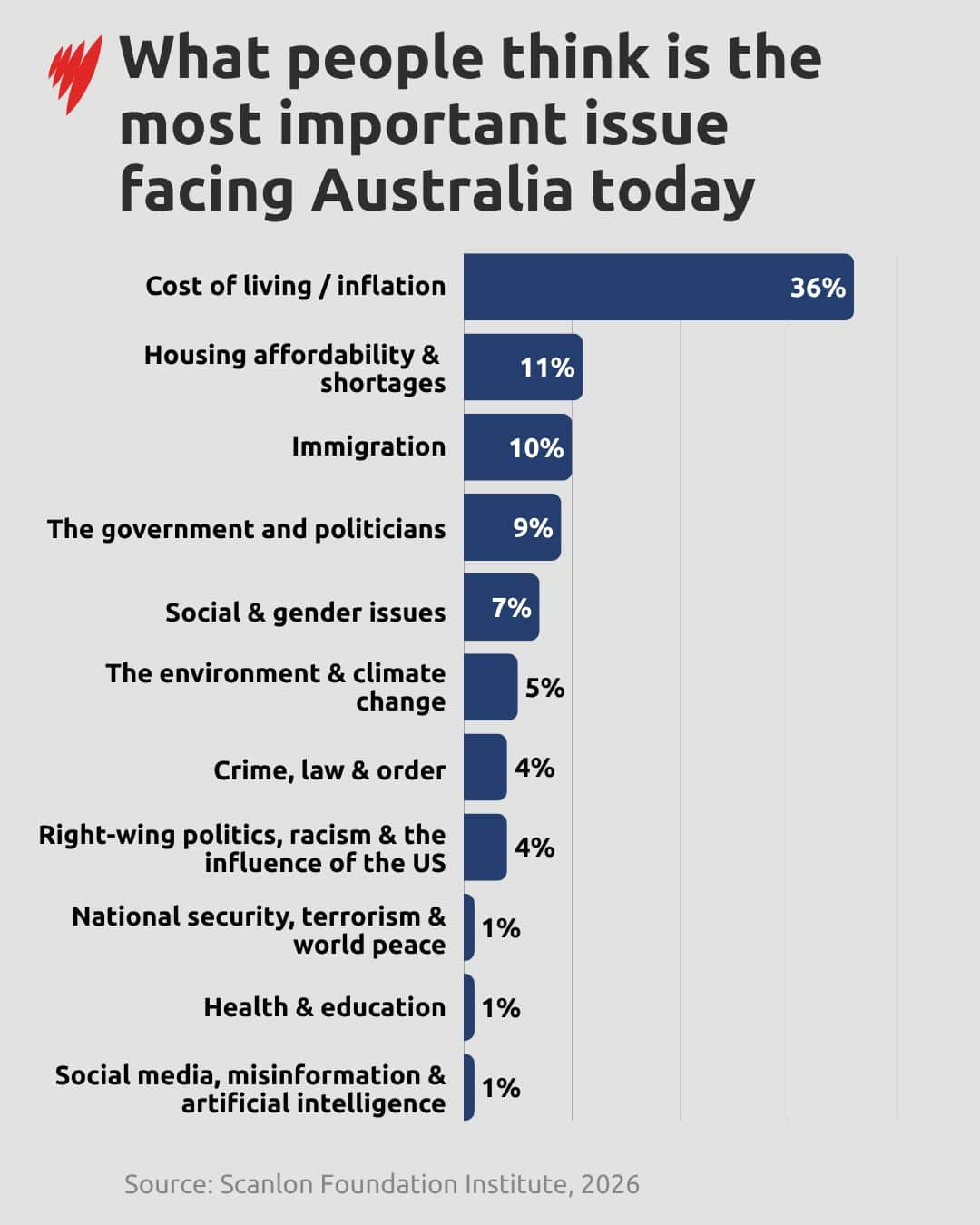
Of those surveyed, just under half said cost of living, inflation or housing was the most important issue facing Australia today.
Hancocks said these pressures are placing an "increasing strain on Australia’s social cohesion" and exacerbating people's fears.
Almost half of adults are pessimistic or very pessimistic about Australia’s future, up from 43 per cent in 2025 and 31 per cent in 2018.
And one in three adults believed their life will be a little or a lot worse in the next three or four years, up from 29 per cent last year.
Dr James O'Donnell, a senior lecturer from the School of Demography at the Australian National University, authored the report and went into greater detail on the results.
"At least one in five of us are saying we're sometimes going without health or medical care, and 10 per cent of us are saying that we're poor or struggling or we're missing out on meals or not being able to pay the rent or mortgage," he said.
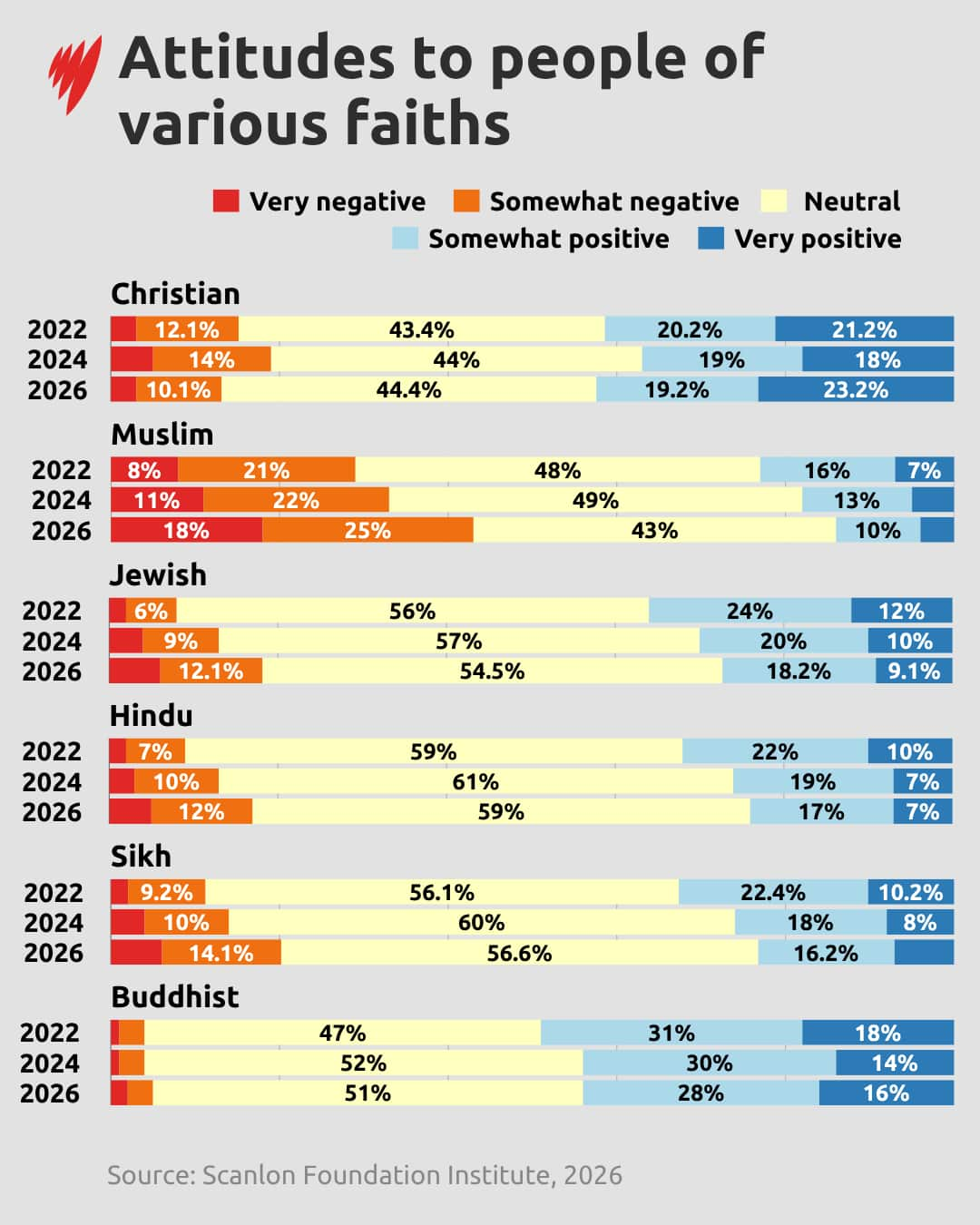
The report also examines perceptions of people of different faiths.
O'Donnell said that in the past few years, new patterns have emerged that could be linked to global conflicts and the politicisation of different religions and cultural backgrounds.
A stark example is people's attitudes towards Muslims, which had been improving until 2023, the year the conflict between Hamas and Israel boiled over .
In 2026, 43 per cent of respondents had negative attitudes towards Muslims, with 18 per cent being very negative.
There's been a similar trend towards Jewish people, where the proportion now that have a negative attitude overall towards the group is up to 18 per cent from 13 per cent in 2024.
There has also been declining attitudes towards Hindus, Sikhs and Buddhists and greater support for Christians reported.
"Current conflicts in Gaza and elsewhere are seeing pressures on our intercultural harmony and connection," O'Donnell said.
"That’s also feeding off support generally dropping for diversity and more negative attitudes towards immigrants coming from various parts of Asia and Africa."
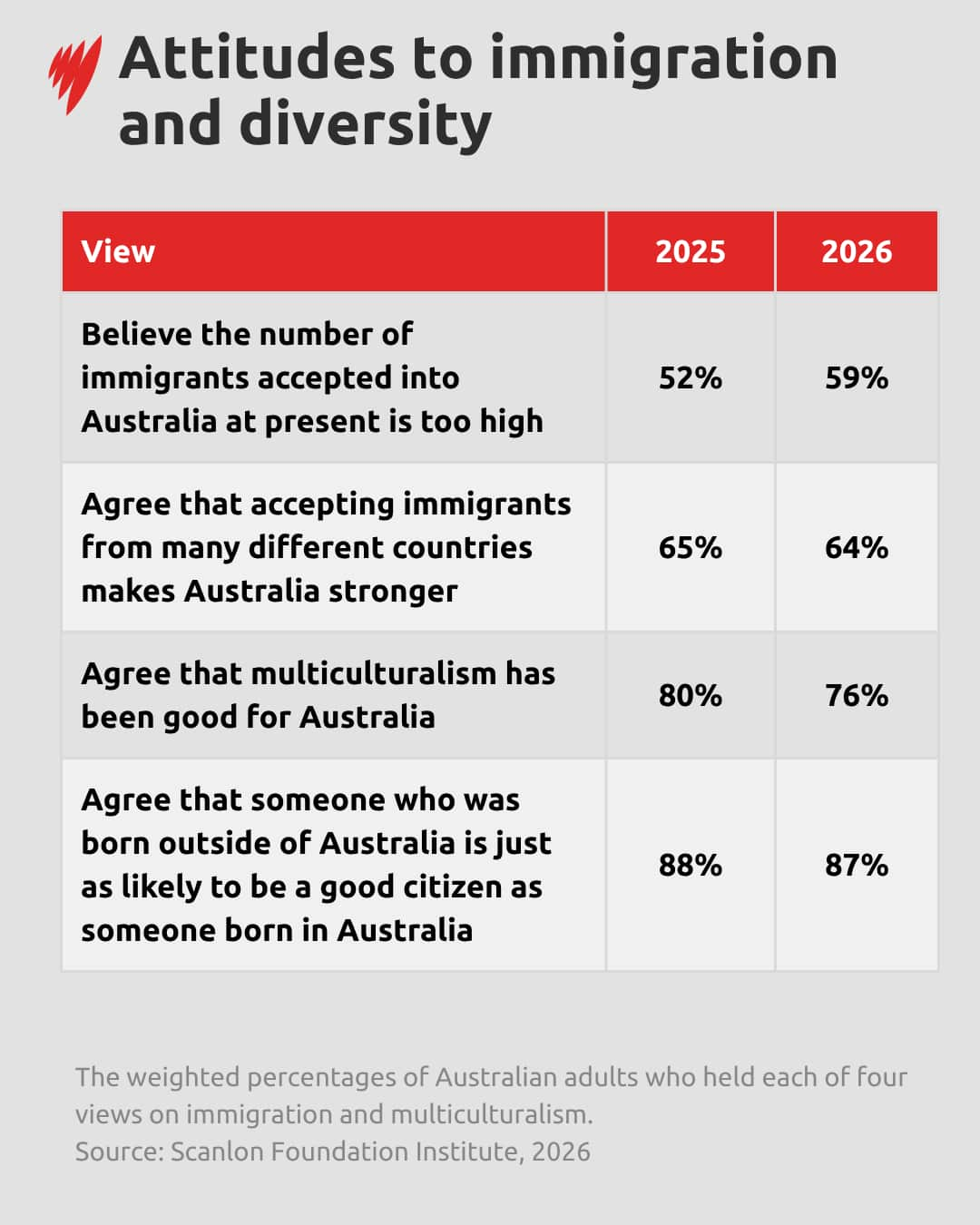
In 2026, 59 per cent of respondents said the level of immigration to Australia is too high, up from 52 per cent in 2025 and significantly higher than an average of 39 per cent in the 2010s.
Concerns about the scale of immigration were driven by One Nation and Coalition supporters, while Greens and Labor voters' views remained unchanged from last year.
Net overseas migration (NOM), the number of arrivals into Australia less departures, reached a peak of nearly 550,000 to 556,000 during 2022–2023.
Recent NOM figures have fallen to roughly 301,000–340,800 for 2024-2025, with the government pledging a target of 225,000 by 2028.
While more Australians believe immigration levels are too high, support for multiculturalism remains strong, suggesting concerns about the scale of migration do not necessarily translate into opposition to Australia's multicultural identity.
Over three-quarters of those surveyed believe immigrants are just as likely to be good citizens as Australians born here and agree that multiculturalism has benefited the country.
A look at over 20 years of the annual Scanlon surveys shows cohesion has declined over the longer term but has not deteriorated further in recent years.
This could be largely attributed to positive attitudes towards our local communities and neighbours.
Hancocks said that while many respondents expressed disappointment with the kind of society we are currently living in, the "hallmarks of what make a society strong remain".
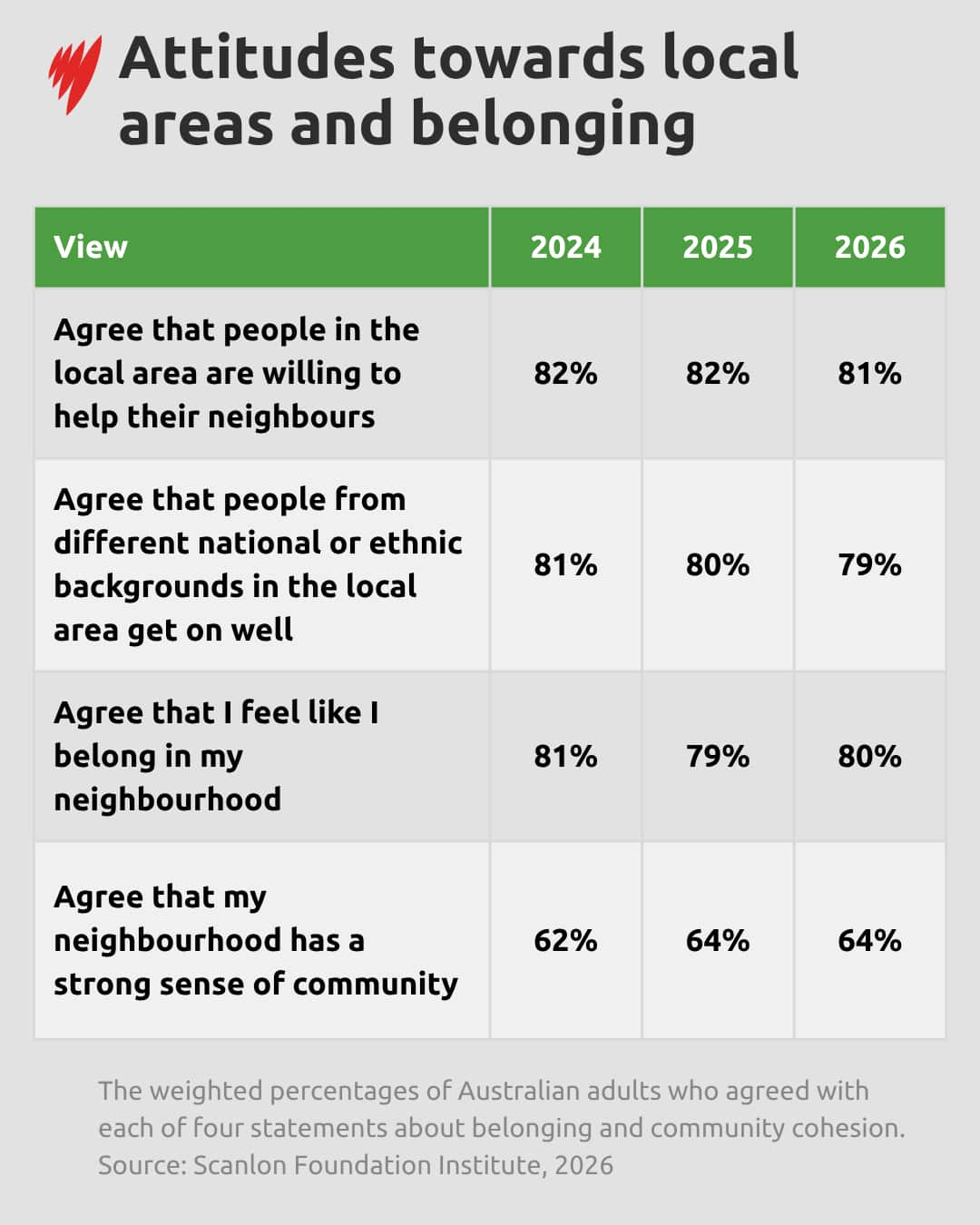
Australians overwhelmingly feel they belong in their neighbourhoods, and 81 per cent agree people are willing to help their neighbours.
People from different national or ethnic backgrounds get on well with others, according to 79 per cent of respondents, and 64 per cent said their neighbourhood has a sense of community.
Dr Michael Noetel, a clinical psychologist and senior lecturer at the University of Queensland, told SBS News that our environments have large and varied effects on our behaviour and attitudes.
While it is impossible to predict how events impact every person's perception of an issue or group, there are patterns.
"When you are comfortable, and your needs are met, then you are better able to prioritise less critical things in your life," he explained.
"But when that security is threatened, then you really just have to look after your own family and your neighbours."
He pointed to the COVID-19 pandemic, saying that some communities became more tightly knit, leading to a sense of "solidarity in the face of that adversity".