The franchise has evolved since 1998, but the first 3D Zelda stands up incredibly well in its Switch 2 remake.
Breath of the Wild changed everything. Two decades after The Legend of Zelda made the transformational shift to 3D, Breath of the Wild reinvigorated the franchise with an open-ended adventure that was built around player freedom and expression. Instead of following a set path, players could go wherever they wanted and tackle challenges in a variety of ways. That philosophy filtered down to subsequent games, letting players author their own creative solutions to puzzles in titles like Tears of the Kingdom and Echoes of Wisdom . As a result, Zelda has never been bigger , and the traditional, more linear Zelda games had become a thing of the past. Or so it seemed.
For one of the biggest Switch 2 exclusives so far, Nintendo has gone back to Ocarina of Time , which originally launched on the N64 in 1998. It’s one of the most influential and revered games in the long-running franchise, a game that showed that the classic Zelda formula — one that used a large world to connect a handful of intricate, puzzle-filled dungeons, creating a grand adventure — could work in three dimensions. Now Ocarina has been remade for the Switch 2 in a way that accomplishes exactly what a good remake is designed to do: preserve the core of the original experience while making it more accessible for modern audiences. And it shows there’s still some life left in the traditional Zelda formula.
The story remains unchanged from the original. It’s a third-person action-adventure game where you play as a little forest dweller named Link who gets pulled into an adventure to save the fantasy realm of Hyrule from a villain named Ganondorf. That’s true of basically every Zelda title, and here the twist comes from a musical instrument (the titular flute-like ocarina) imbued with magical powers. Over the course of the game you learn songs that can change the weather, warp you across the landscape, mess with the flow of time, and more.
The original Ocarina was renowned both for its large 3D world and for the intricacy of its dungeons, which required using the ocarina, along with various other items, to solve puzzles in clever ways. At a certain point you’re even jumping back and forth in time, navigating spaces as both tiny Link and his adult version. The challenge steadily grows in complexity right up until you face Ganondorf in his castle, forcing you to use a huge range of items at your disposal.
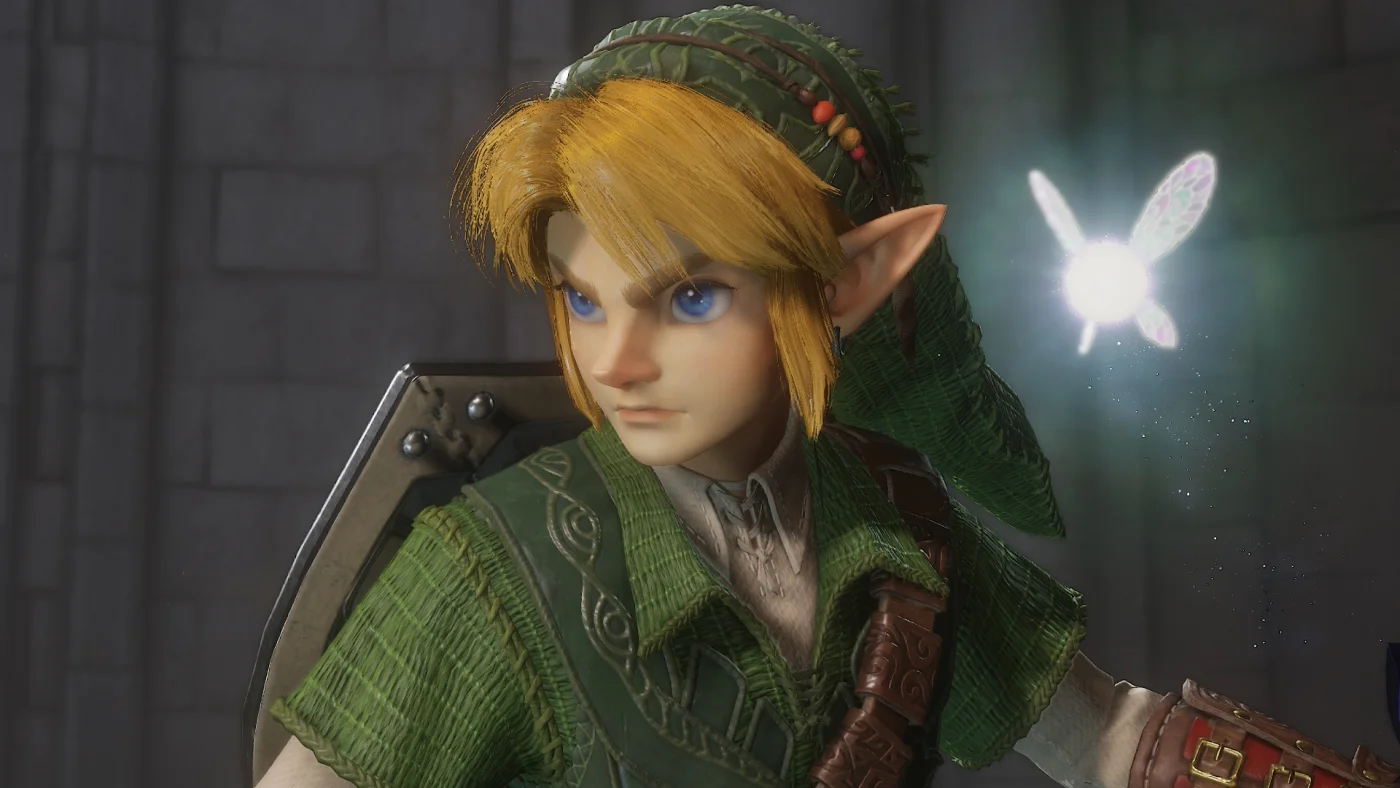
The most notable difference in the remake is how it looks. Gone are the blocky, fuzzy N64-era graphics, which have been replaced with something that blurs the line between fantasy art and realism. While it’s not a fully open world like Breath of the Wild , this version of Hyrule, which has a large open field that connects a series of dungeons and villages, is still incredibly lifelike; everything from rushing water in a lake to the swaying grass outside of a ranch looks and moves in realistic ways. The flip side is that, while the characters are more detailed than before, they’ve been rendered with a style inspired by puppets and stage shows . It’s a tricky balancing act that the game mostly nails. The characters look like exaggerated caricatures, but at the same time they’re imbued with such a level of detail that they don’t feel out of place against the more realistic backdrops. Link is the best example; while his face almost looks like a porcelain figure, his outfit is like something a real adventurer would wear, made by weaving together grasses found in Kokiri Forest, where he lives.
It looks great in practice — although Ocarina does suffer from some frustratingly dark areas, like in most modern games — and it also sets the remake apart from the rest of modern Zelda adventures. The Breath of the Wild line has a fantastical, Studio Ghibli-inspired look, while the top-down spinoffs have cutesy, toylike graphics . Ocarina splits the difference and comes out looking like something distinct, yet unmistakably Zelda . The Switch 2 graphics also do a great job of heightening the emotion. There’s an incredible sense of grandeur when you first walk into the stark Temple of Time, with a single ray of light illuminating the dark interior. Iconic moments like wandering blindly through the desert take on a new sense of tension and terror because of how the game looks as sand whips around you, obscuring your view of the harsh landscape. Fighting Dark Link on a foggy, desolate beach was enough to get my heart racing.
Perhaps more important than the visual update is a number of smart gameplay changes. Early 3D games can be awkward to play now because designers were still working out how best to navigate 3D spaces. The Ocarina remake fixes this in a few ways. For one thing, you now have free camera control, making it possible to look anywhere by moving the right stick, just like in any modern game. This makes it easier to keep your eye on enemies around you or spot important details for solving a puzzle. The game now also lets you jump whenever you want — in the original Link could only jump at designated points — which makes moving around in spaces feel less restrictive. Other modern touches include being able to equip items quickly with the D-pad instead of having to go to the pause menu, and the “threads of time,” which is a fancy name for a tool that tracks your quests so you can more easily figure out what to do next.
As an example of how much these tweaks can impact the experience, let’s revisit the infamous Water Temple. Over the years since Ocarina of Time first launched, this dungeon has become known primarily for being extremely difficult. It involves constantly playing a song to make the water rise and fall so you can access different levels, while also frequently equipping iron boots that cause Link to sink to the bottom when necessary. With the original controls this was tedious and frustrating. But I didn’t find it difficult at all in the remake; I could quickly equip the boots whenever I needed to, and the camera allowed me to clearly see what I needed to do. The Water Temple was always a well-designed dungeon hindered by the technology of the time. In the remake, I could fully appreciate what the developers were going for.
There are a handful of other changes — expanded dialogue, the ability to hum songs into the Switch 2’s microphone, the fairy Navi thankfully toning down her annoying hints — and they all build toward the same goal: enhancing the original without changing its essence. Unlike a lot of classic games, the original Ocarina of Time is still relatively easy to play; it’s available through a Switch Online subscription, and the 3DS version from 2011 remains a great port. But the remake does enough to make it the ideal way to play, particularly for that big new audience of Zelda fans that started with Breath of the Wild . More importantly, it’s proof that Zelda can be many things simultaneously. And that’s an exciting prospect for Hyrule’s future.
The Legend of Zelda: Ocarina of Time launches on the Switch 2 on November 5th.
This is the title for the native ad
This is the title for the native ad