While the Democrats have enjoyed a historic sweep of the midterm elections , US President Donald Trump says he'll use a key tool to block their legislation.
The 'blue wave' predicted by polling has been realised, with Democrats projected to take a majority in the House of Representatives and the Senate away from the Republicans.
The results were a "rebuke from the American public on the agenda of the Trump White House and the lack of delivery on core promises," Dr Scott Rollo from the Centre for International Security Studies at the University of Sydney told SBS News.
The landslide Democratic victory reflected deep anger over living costs, tariffs and Trump's war against Iran, which has sent fuel prices soaring and compounded dissatisfaction with the president, experts have suggested.
However, despite wresting power back in Congress, the president has now signalled Democrats will face a significant obstacle in any attempts to pass legislation.
Your trusted source for staying up-to-date with the world around you. Get free daily news updates and analysis, straight to your inbox.
"I guess I'll become Mr Veto," he said in a recent Fox interview.
In an interview with the New York Times on Tuesday evening (local time), Trump appeared to offer a conciliatory note to the Democrats, saying he's "willing to accept those results".
"We'll work with the Democrats and we'll look forward to working with them. We'll probably work something out," he said.
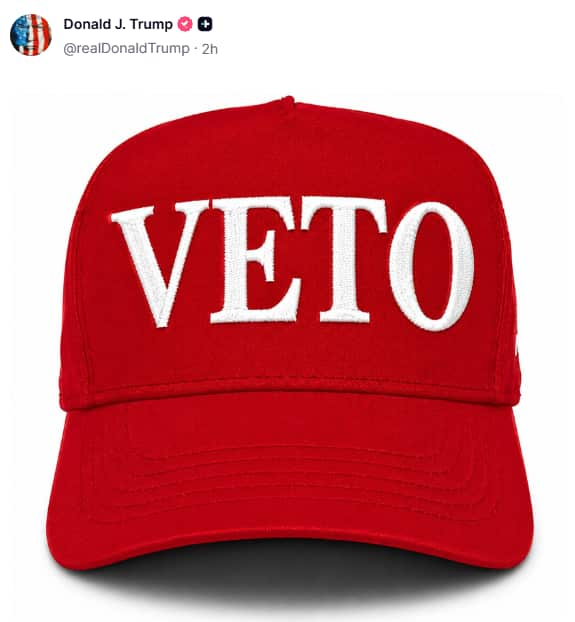
However, minutes later on social media, the 80-year-old signalled a clue as to how he intends to deal with Democratic attempts to pass laws, posting a picture of a red baseball cap emblazoned: "VETO".
In an interview with CBS News earlier in the day, Trump said he held an "ultimate power" in Congress.
"It's called 'veto'", Trump said, repeating an assertion he had made earlier in the week to the New York Post: "If we didn't win, I veto everything".
The Constitution grants the president the authority to veto legislation passed by congress. It is one of the most significant tools the president can employ to prevent the passage of legislation.
There are two types of vetoes: the regular veto and the pocket veto.
The first involves the president returning unsigned legislation to a house of Congress within 10 days, usually with a veto message. However, Congress can override this decision if it collects a two-thirds supermajority in each house.
The pocket veto is an absolute veto that happens if Congress has adjourned before the 10 days are up and the president does not return the legislation, indirectly killing the bill by keeping it in the pocket.
The number of vetoes used by previous US Presidents has varied significantly, with former president Franklin D Roosevelt vetoing 635 pieces of legislation.
In his first term, Trump vetoed 10 pieces of legislation with a 90 per cent success rate, according to the American Presidency Project at UC Santa Barbara.
Speaking with Fox News, Trump said that while Democrats were in control "they are not really in control".
"Because they can send over 50 different great bills that they are all excited about, and I send them back with a nice stamp," he said.
Now holding the power to challenge his policies, investigate his administration and block his nominees via Congress majorities, Democrats are preparing a legislative offensive against the president.
The party is promising swift action on living costs and the war in Iran, while signalling that investigations of alleged abuses and corruption will be a majority priority.
On Tuesday, House Democratic leader Hakeem Jeffries (likely to become the first Black speaker when Congress takes office in January), vowed to go after what he described as "unprecedented corruption" in the government.
"Because if you have people in high office who are so focused on enriching themselves, their family members, their friends, or their donors, then they're not focused on making life better for the American people," he said.
While control of both chambers gives the Democrats wide authority to launch investigations and hearings, the White House has remained defiant and said it was ready to fight back against any investigations or impeachment proceedings Democrats throw at it.
— With reporting by the Agence France-Presse.